

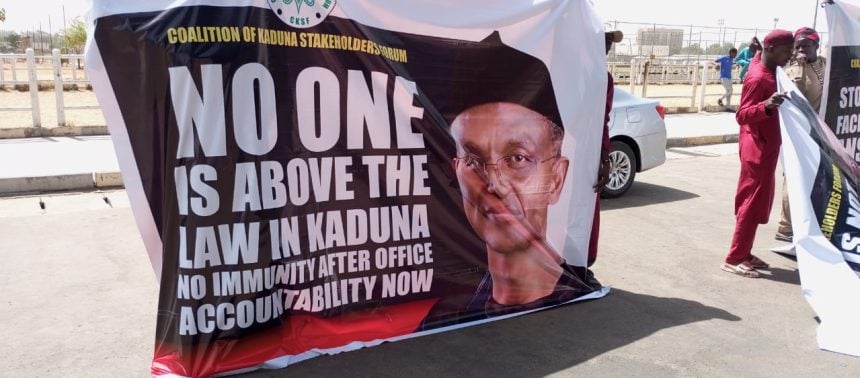
Hundreds of protesters, organised under civil society groups including the Northern Stakeholders Consultative Initiative and the Coalition of Kaduna Stakeholders Forum, on Monday, February 16, 2026, stormed the Kaduna State House of Assembly demanding an update on the ongoing legislative investigation into the administration of former Governor Nasir El-Rufai.

Led by Yerima Shettima and Aliyu Muhammad, the demonstrators submitted a formal letter to the Speaker of the Assembly, calling for full transparency and accountability regarding allegations of corruption and human rights violations during El-Rufai’s tenure.
The protest was described as a peaceful follow-up to an earlier public statement urging the former governor to “stop distracting the people of Kaduna State” and face lawful scrutiny.

Responding to the group, Speaker Yusuf Dahiru Liman defended the Assembly’s probe into the alleged misappropriation of ₦432 billion under the previous administration.
He confirmed that a committee was established in June 2024 to investigate the claims and has since submitted its findings to the relevant authorities.

“We share your pains and stand by our documented findings,” Liman said.
The Speaker stressed that the Assembly is performing its constitutional duty and warned against attempts to derail the process.
“Anybody found wanting will face the full wrath of the law,” he stated. “No one is above the law.”

Liman expressed support for peaceful civic engagement, adding: “If not that I’m elected, I would have joined you in the protest.” He urged citizens to remain law-abiding while the investigation continues.
The coalition highlighted specific allegations raised during the Assembly’s probe, including:

– Misappropriation of ₦423 billion in loans and state funds
– Diversion of ₦1.37 billion earmarked for a light rail project into private accounts without execution
– Laundering of ₦64.8 million by senior aides
– Misappropriation of over ₦155 million through disputed cash payments and contracts

The protesters also referenced broader criticisms of the handling of communal and ethno-religious conflicts, including the 2015 Zaria crisis involving the Islamic Movement of Nigeria, as well as demolitions of homes and businesses and the introduction of laws described by critics as punitive.
They called for the establishment of a public platform where affected citizens—traders, civil servants, displaced families, and others—can present grievances in an orderly and lawful manner.

The group vowed to continue pursuing all legitimate avenues to ensure accountability if the process is not conducted transparently.
The ongoing probe and public agitation reflect deep divisions over the legacy of El-Rufai’s administration in Kaduna State.




