


Nigeria’s legal and national security space has been stirred by reports surrounding former Kaduna State Governor, Nasir El-Rufai, following a televised statement in which he referenced possessing surveillance capability, including alleged monitoring of communications linked to the Office of the National Security Adviser (NSA).
While the matter remains subject to investigation and legal determination, security analysts note that — if substantiated — such conduct would fall within the scope of serious cyber and national security violations under Nigerian law.

Legal Framework: Statutory Provisions
Nigeria’s principal legislation governing electronic surveillance and cyber offences is the Cybercrimes (Prohibition, Prevention, etc.) Act, 2015 (as amended).
Relevant sections include:
Section 6 & 7 — Criminalise unlawful interception of electronic communications.
Section 24 — Addresses misuse of computer networks and systems.
Section 37 — Reinforces constitutional privacy protections.
Section 40 — Provides enhanced penalties where national security or critical infrastructure is implicated.

Legal experts note that unlawful phone tapping without judicial authorization constitutes a prosecutable offence, particularly where the subject involves classified state communications.
Additional statutes that may apply where national security exposure is established include:
Official Secrets Act
National Security Agencies Act
Criminal Code provisions on treasonable or subversive conduct (subject to prosecutorial thresholds)
Sentencing Structure: What the Law Prescribes
Under the Cybercrimes Act:
Basic unlawful interception attracts up to 2–3 years imprisonment or fines.

Where national security systems or critical infrastructure are implicated, penalties may extend to 5–10 years imprisonment.
If escalated to espionage, sabotage, or treasonable felony under other laws, sentences may rise significantly beyond cybercrime provisions to 25years or more.
This sentencing hierarchy has triggered policy debate over whether Nigeria’s baseline cyber-interception penalties remain proportionate to modern security threats.

Evidentiary Implications of Public Admission.
A televised statement referencing surveillance capability may constitute what legal scholars describe as an extra-judicial admission.
However, conviction cannot rest on media statements alone.
Prosecutors must establish:
Technical capability.
Evidence of execution.
Absence of lawful authorization.
Intent and national security impact.
Such public declarations nonetheless provide lawful basis for investigative agencies to initiate forensic inquiries, obtain warrants, and examine digital infrastructure where necessary.
National Security Risk Analysis.
Security professionals warn that — if such surveillance occurred — monitoring communications linked to the NSA’s office could expose:
Counter-terrorism operations
Military deployment intelligence
Strategic command communications
Confidential foreign security partnerships.

Classified intelligence sources.
This category of breach is internationally classified as compromise of strategic security communications, carrying grave implications for operational integrity and personnel safety.
Comparative Global Penalties.
United States:
Unauthorized interception under the Federal Wiretap Act attracts up to 5 years imprisonment per count, rising to 10 years or more where national security or espionage elements apply.
United Kingdom:
Illegal interception under the Investigatory Powers Act carries up to 2 years imprisonment, with heavier sanctions under the Official Secrets Act for classified breaches.
India:
Unauthorized surveillance under cyber and telegraph laws attracts 3–7 years imprisonment, with enhanced penalties for national security violations.
Comparatively, analysts argue Nigeria’s lower baseline sentencing may weaken deterrence — particularly in politically exposed or high-capability cases.
Rising Cybercrime and Foreign Syndicate Activity.
Nigeria has in recent years prosecuted multiple domestic and foreign cybercrime networks, with law enforcement agencies warning of increasing transnational digital espionage and financial intrusion attempts.

Security observers caution that lenient penalties risk positioning the country as a soft jurisdiction for cyber operations targeting state and financial systems.
Policy and Legislative Reform Debate.
In response, governance and security policy groups are advocating reforms including:
Minimum 8–10 year custodial sentences for unlawful interception involving senior security officials.
Removal of fine options in national security cyber offences.
Asset forfeiture for illegal surveillance infrastructure.
Expanded classification of “critical security communications.”
Such reforms, proponents argue, would align Nigeria’s deterrence posture with emerging global cyber-security standards.
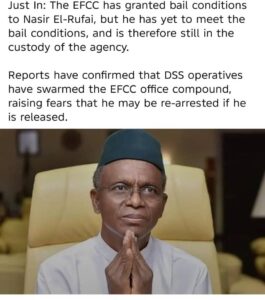
Elrufa’i still in EFCC office while DSS operatives have swamped the EFCC office ready to re-arrest him for
1.admitting tapping the NSA’s phone,
2linking the dissapearance of Abubakar Idris alias Dadiyata to former Kano State Governor, Abdullahi Umar Ganduje and
3.allegedly stating importing Thallium Sulphate by the office of NSA.

Conclusion.
While the allegations and reported admission remain subject to due process, the gravity of unlawful surveillance involving top national security architecture demands rigorous scrutiny.
Cyber-enabled interception is no longer a minor digital violation — it represents a potential breach of sovereign security command systems.
Strengthening investigative accountability, tightening statutory penalties, and modernising cyber deterrence frameworks will be critical to safeguarding Nigeria’s intelligence integrity in an era of rapidly evolving technological threats.
The National Patriots Movement views the reported admission of unlawful interception of the National Security Adviser’s communications as a grave national security concern warranting thorough investigation. Existing penalties, such as two-year jail terms, appear too mild and should be reviewed to a minimum eight-year custodial sentence without option of fine. As cybercrime escalates — including foreign syndicates operating locally — Nigeria must adopt stiffer sanctions to deter digital espionage and protect critical state security infrastructure.
Dr. G. Fraser MFR.
The National Patriots.
Headlinenews.news Special Investigative Report.




