

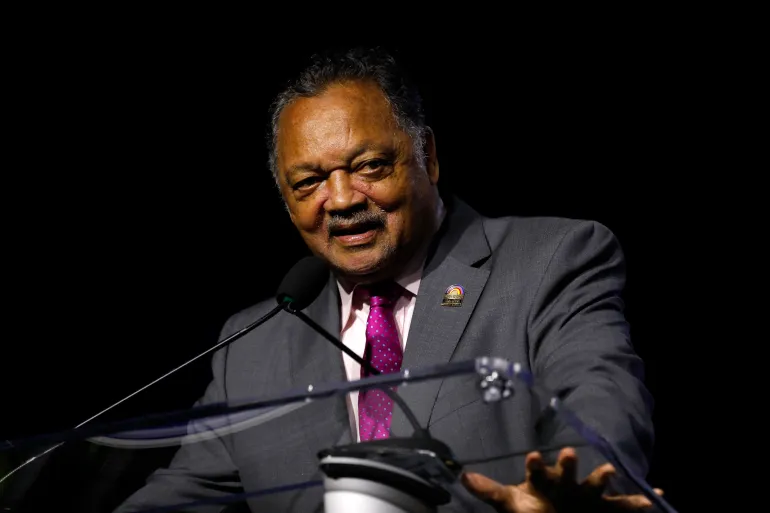
Renowned American civil rights leader Reverend Jesse Jackson has died peacefully at the age of 84, his family has announced.
In a statement, the family described him as a tireless advocate for justice, equality, and human rights, whose life’s work helped inspire a global movement for freedom and dignity. They said he was not only a devoted family man but also a servant leader to the oppressed, the voiceless, and marginalized communities across the world.

A close associate and mentee of civil rights icon Martin Luther King Jr., Jackson rose to prominence during the civil rights movement of the 1960s. He was present when King was assassinated in Memphis in 1968, an event that profoundly shaped his lifelong commitment to social justice.

Born on October 8, 1941, in Greenville, South Carolina, Jackson grew up in the segregated American South. He studied sociology before becoming actively involved in major civil rights campaigns, including the historic Selma-to-Montgomery marches.

Following King’s death, Jackson carried forward his legacy through activism and political engagement. He founded Operation PUSH to advance economic and social opportunities for Black Americans and later formed the National Rainbow Coalition, broadening the struggle to include other marginalized groups. He twice sought the Democratic Party’s presidential nomination and delivered one of the most memorable speeches in convention history, urging Americans to persevere despite adversity.

In later years, Jackson became an international mediator, serving as a special envoy for Africa and advocating for peace, human rights, and the release of political prisoners across different regions of the world. He also played a visible role in historic moments such as the election of Barack Obama as president.
Diagnosed with Parkinson’s disease in 2017, Jackson faced declining health but remained vocal on issues including racial justice, public health equity, and global peace efforts. Until the end of his life, he continued to call for hope, nonviolence, and collective responsibility in the pursuit of justice.




