

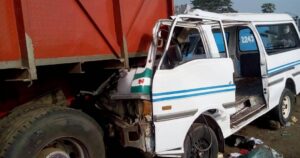
The death of a Lagos State Traffic Management Authority (LASTMA) officer at Badagry Roundabout on Monday was not just another traffic incident.
It was a public servant crushed while on duty.
Two other citizens died in the same chain of events.
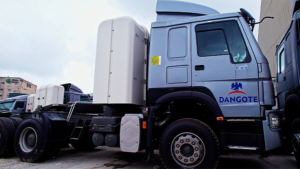
The truck involved was reportedly a fully loaded SHACMAN vehicle linked to a Dangote logistics operation.
Witnesses said brake failure caused the driver to lose control.
For many residents, the explanation no longer satisfies.
“This is not the first time we are hearing brake failure,” said Mrs. Abiola Kareem, a trader who operates near the Badagry corridor. “If brakes keep failing, then something is wrong with maintenance. How many excuses will bury our people?”
According to initial accounts, the truck struck the officer regulating traffic, rammed two pedestrians, and only came to a stop about 200 metres away.
The driver reportedly fled before being apprehended.
But beyond the immediate tragedy lies a bigger national concern: recurring fatal crashes involving articulated trucks across Lagos and other urban centres.
Mr. Seun Olaniyi, a university lecturer interviewed by Headlinenews.news, argues that the problem is structural. “Nigeria does not enforce fleet accountability. In advanced jurisdictions, if a company’s truck is repeatedly linked to fatalities, regulators audit the entire fleet, suspend operations if necessary, and demand documented maintenance compliance. Here, we wait for the next funeral.”
A retired police officer, ASP (rtd.) Musa Adetola, adds a sobering perspective.
“In countries like the UK or United States, investigators will examine not just the driver but the maintenance logs, training records, rest schedules, and company compliance culture.
Corporate manslaughter laws exist.
The company’s directors could face serious consequences if systemic negligence is proven.”
Nigeria lacks consistent enforcement of such standards.
In the UK, operator licences can be revoked for serious safety failures. In the United States, federal regulators can issue out-of-service orders against unsafe carriers. In parts of Europe, repeated safety violations trigger suspension of operating authority.
In Rwanda and South Africa, structured roadworthiness checks and corridor restrictions are enforced with increasing strictness.

Here, enforcement remains reactive.
The Dangote Group, as one of Africa’s largest industrial conglomerates, carries enormous brand equity.
With that scale comes heightened responsibility.
Whether or not investigations ultimately confirm mechanical negligence, the company must recognise that recurring incidents damage public trust.
Compensation is another sensitive issue.
“Families often receive small settlements that do not reflect the lifetime loss,” said Mrs. Kareem. “A father dies, and the family is left with nothing. Is that justice?”


If corporate liability is established, compensation should follow international civil liability standards — calculated to sustain dependents over decades, not months.
Structured judicial awards, not informal settlements, ensure fairness and transparency.
Where past cases resulted in inadequate compensation, authorities should review them.
At the same time, it is important to be factual.
Headlinenews.news cannot independently verify broad claims circulating online regarding total casualty figures nationwide.
What is verifiable is that fatal heavy-truck incidents occur repeatedly, and systemic reform is overdue.

The way forward is practical:
Mandatory digital maintenance logs accessible to regulators.
Quarterly third-party fleet audits.
Designated truck corridors and time restrictions in high-density zones.
Strict speed governance enforcement.
Public disclosure of compliance ratings for major logistics operators.
The death of a LASTMA officer performing his duty should mark a turning point, not a statistic.

Nigeria’s roads are not battlefields.
If brake failure is recurring, then maintenance culture must be examined.
If enforcement is weak, it must be strengthened. If compensation is inadequate, courts must intervene.
Industrial growth cannot come at the cost of civilian lives.
That is the standard serious democracies uphold. Nigeria must do the same.
Joseph Dedam.
Headlinenews.news Special report.




