

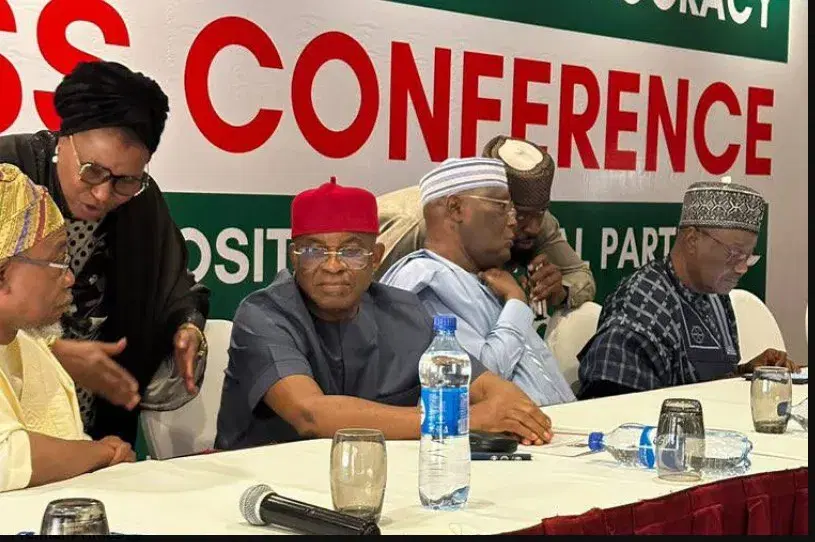
Abuja — Nigeria’s leading opposition figures have launched a coordinated political campaign against President Bola Tinubu’s administration and the APC-led government, criticizing the recently amended Electoral Act 2026 and warning it could threaten the credibility of the 2027 general election.

The coalition, uniting prominent opposition leaders, described the new electoral law as a serious test of Nigeria’s democratic integrity. They urged urgent revisions and called on citizens, civil society groups, and the international community to monitor the situation closely.

The statement was read by Ajuji Ahmed, national chairman of the New Nigeria Peoples Party (NNPP), and endorsed by figures including former Vice President Atiku Abubakar, former governors Peter Obi, Rotimi Amaechi, and Liyel Imoke, Senators David Mark, Dino Melaye, Ireti Kingibe, and other opposition leaders.
Concerns Over Transparency and Electoral Credibility
The coalition said several provisions of the amended law, especially those affecting electronic transmission of results, could undermine election transparency. Section 60(3), in particular, was singled out for giving excessive discretion to presiding officers and potentially enabling manipulation of results under the pretext of network failures.

They pointed to past assurances that the BVAS equipment functions offline with over 90% success nationwide, dismissing the “network failure” argument as unsubstantiated.
Dispute Over Party Primaries
The opposition also opposed amendments to Section 84, which restrict political parties to selecting candidates through direct primaries or consensus. They described this as unconstitutional interference with party autonomy and warned it could destabilize opposition parties ahead of future elections.
FCT Elections as Warning
The coalition cited irregularities in the recent Federal Capital Territory Area Council elections as evidence supporting their concerns, noting inflated APC vote counts and historically low voter turnout as signs of declining public confidence in the electoral system.

Political Violence Condemned
The group condemned the gun attack on African Democratic Congress (ADC) leaders in Edo State, describing it as part of a wider pattern of political intimidation. They appealed to citizens to actively defend democracy, with Buba Galadima stressing that protection of democratic values is a responsibility for all Nigerians, not just politicians.
Calls for Opposition Unity
Leaders like Rotimi Amaechi and Dino Melaye emphasized that the opposition must address internal weaknesses, coordinate better, and act decisively to safeguard Nigeria’s democratic process. Peter Obi highlighted worsening socio-economic and security conditions, calling for national mobilization to protect the country’s democratic future.
International Attention Urged
Atiku Abubakar called for the coalition’s concerns to be communicated to foreign embassies, warning that democratic decline in Nigeria could have implications for Africa as a whole.

Presidency Responds
The Presidency, through Special Adviser Bayo Onanuga, dismissed the opposition’s claims as “reckless and baseless,” stating that the 2026 Electoral Act improves upon the previous law, allowing real-time transmission while providing Form EC8A as a valid backup in case of network issues. The administration emphasized that the law strengthens transparency, ensures party autonomy, and aligns Nigeria’s system with international practices, such as direct primaries used in the United States.

APC on Alleged Violence
The APC rejected allegations of involvement in the Edo State attack, attributing the unrest to internal conflicts within the ADC. The party called for law enforcement to swiftly investigate while urging the opposition to reflect on its own electoral performance.




