

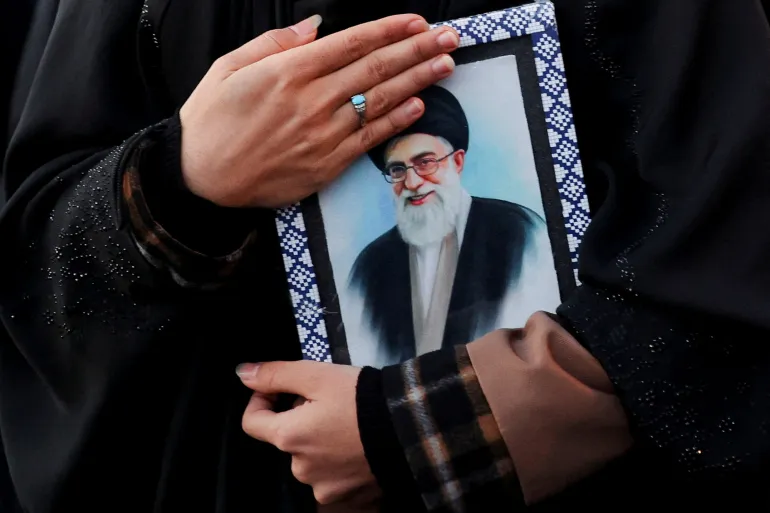
Iranians will gather for a farewell ceremony to mourn late Supreme Leader Ayatollah Ali Khamenei at Tehran’s Imam Khomeini Prayer Hall, starting at 10pm (18:30 GMT) on Wednesday, March 4, 2026, and continuing for three days.

Hojjatoleslam Mahmoudi, head of Iran’s Islamic Propagation Council, announced the arrangements, stating the prayer hall would receive visitors and allow the public to participate in large numbers.
The ceremony is expected to draw huge crowds — similar to the 10 million who attended Ayatollah Ruhollah Khomeini’s funeral in 1989 — raising concerns about potential US-Israeli attacks on the gathering.

Khamenei, aged 86, was killed on Saturday in joint US-Israeli air strikes in Tehran that also claimed family members and senior officials. Iran declared 40 days of national mourning for the leader who ruled since 1989.
Ayatollah Ahmad Khatami, a senior cleric and member of the Guardian Council and Assembly of Experts, said a successor is close to being chosen.

“The Supreme Leader will be identified in the closest opportunity, we are close to a conclusion, however the situation in the country is a war situation,” he told state TV.

The 88-member Assembly of Experts, elected every eight years, appoints the supreme leader. Candidates must be vetted by the Guardian Council. A simple majority is required, and the candidate must be a senior Shia jurist with deep knowledge of jurisprudence, political judgement, courage, and administrative capability.
Khamenei’s second son, Mojtaba Khamenei, is among the top contenders and has reportedly survived the attacks, according to two Iranian sources.

Israel’s Defence Minister Israel Katz threatened on Wednesday to assassinate any successor chosen by Iran’s leadership.
“Any leader selected by the Iranian terror regime to continue leading the plan for Israel’s destruction, threatening the United States, the free world and countries in the region, and suppressing the Iranian people, will be a certain target for assassination, no matter his name or where he hides,” Katz posted on X.
US President Donald Trump, speaking on Tuesday, mused about preferred leadership in Iran post-Khamenei, calling the current regime a “worst-case scenario.”

Luciano Zaccara, a Gulf politics expert at Qatar University, told Al Jazeera that Iran’s political system was prepared for such a scenario.
“The structures remain, the line of power [and] the line of command remain in place,” he said.
The conflict continues to escalate, with ongoing US-Israeli strikes and Iranian retaliation across the region, raising fears of a broader war.




