

The Federal Government of Nigeria has announced plans to expand targeted programmes aimed at improving the lives of women across the country, focusing on areas such as energy access, digital inclusion, agriculture, health, education and leadership development.
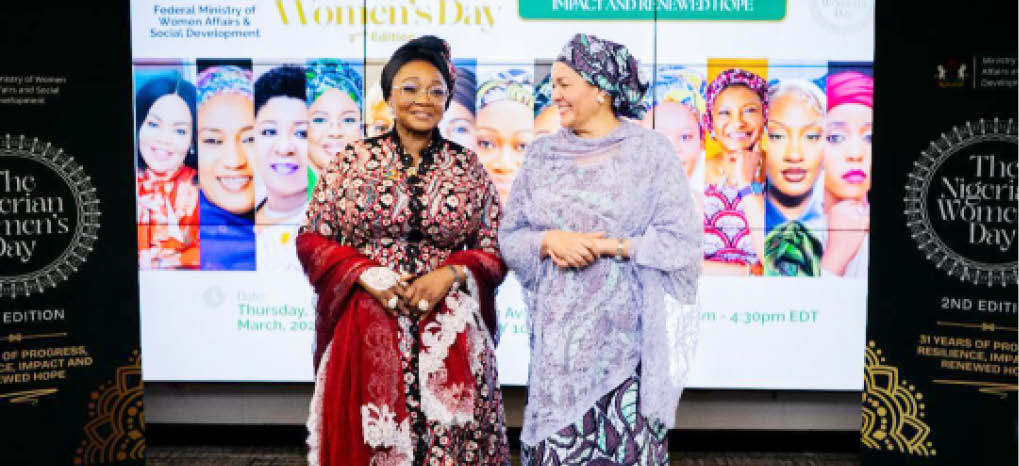
The Minister of Women Affairs, Imaan Sulaiman-Ibrahim, disclosed this during the Nigerian Women’s Day celebration held alongside the 70th Session of the United Nations Commission on the Status of Women in New York.
The event, organised by the Federal Ministry of Women Affairs and Social Development, brought together global leaders, diplomats, ministers, gender advocates and members of the Nigerian diaspora to discuss ways to strengthen women’s empowerment and family resilience.
Among the dignitaries present was the Deputy Secretary-General of the United Nations, Amina J. Mohammed, who joined Nigerian officials and international stakeholders to explore strategies for advancing gender equality and increasing women’s participation in economic development.

Speaking at the event themed “31 Years of Progress, Resilience, Impact and Renewed Hope,” Sulaiman-Ibrahim explained that the government is implementing a broad national strategy through the Renewed Hope Social Impact Interventions 774 (RH-SII-774) framework.
According to her, the initiative is designed to reach women in all 774 local government areas of the country through programmes focusing on energy access, agriculture, digital inclusion, healthcare, protection, innovation, education, child development and family resilience.
She stressed that empowering women requires more than policy declarations, noting that real progress depends on sustained investment and practical programmes capable of delivering measurable impact.
“Transforming women’s lives at scale requires sustained investment, strong partnerships and coordinated action,” she said. “Women’s empowerment is not just a social programme; it is an economic strategy, a security strategy and a development imperative.”
The minister also presented a six-point call to action urging governments, development partners and civil society organisations to increase funding and strengthen collaboration to accelerate programmes that support women and girls.

A major highlight of the event was a fireside conversation between Sulaiman-Ibrahim and the UN Deputy Secretary-General, where they discussed how Nigeria’s gender policies align with global efforts to promote women’s empowerment.
Participants also engaged speakers on challenges facing women and girls across Africa and explored ways to strengthen women’s leadership in governance, peacebuilding and economic development.
The celebration featured three panel discussions focusing on Global Leadership, Peace and Security for Social Impact; Women, Institutions and the Economy; and Positive Masculinity, examining the role of women in global institutions and the importance of engaging men as allies in advancing gender equality.
Other notable participants included the Minister of State for Labour and Productivity, Nkeiruka Onyejeocha; Chairman of the National Population Commission, Aminu Yusuf; and Assistant Inspector-General of Police Aisha Abubakar Baju.
Also present were former Minister of Women Affairs Pauline Tallen, Country Director of ActionAid Nigeria Andrew Mamedu, and Executive Secretary of the National Human Rights Commission of Nigeria, Tony Ojukwu.
The event also featured cultural performances, including a presentation by internationally recognised Nigerian artist and human rights advocate Laolu Senbanjo, who demonstrated how art can challenge stereotypes and inspire social change through his signature live body-painting performance.
Organisers said the Nigerian Women’s Day celebration reflects the country’s commitment to placing women, children and families at the centre of national development and economic policy, while strengthening global partnerships to advance gender equality and sustainable development.




