

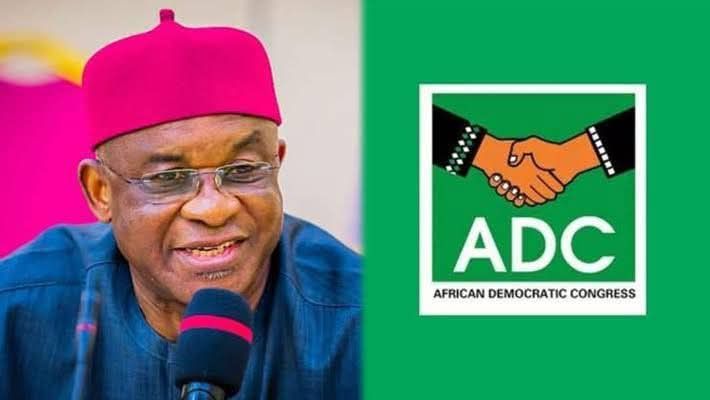
From Opposition Hope to Internal Chaos: ADC’s Self-Inflicted Crisis.
The African Democratic Congress (ADC) has been plunged into one of the most severe internal crises in its history, as chairmen from all 36 states and the Federal Capital Territory have taken the party’s National Working Committee (NWC) to court in a sweeping legal confrontation that now threatens to destabilize its entire political structure.
What began as internal dissatisfaction has now erupted into open institutional rebellion.
The coordinated legal action signals not just disagreement, but a complete breakdown of trust between the party’s national leadership and its grassroots machinery.
At the center of the storm are decisions taken by the NWC under the leadership of former Senate President, David Mark—particularly the constitution of committees to oversee state primary elections slated for April. State chairmen allege that these committees were imposed without consultation, in clear violation of the party’s constitution and established democratic processes.
The language emerging from within the party is telling.
Several stakeholders describe the move as “centralized imposition” and “procedural ambush,” warning that the NWC’s actions effectively sidelined state structures and undermined the very foundation of internal party democracy.

This is not a minor dispute—it is a systemic rupture. For all 36 state chairmen to align in legal opposition against the national leadership reflects a crisis of legitimacy at the highest level of the party.
Crucially, this development dismantles any attempt to attribute the ADC’s instability to external political interference.
The evidence is stark: this is a self-inflicted crisis.
The fractures within the party are the direct consequence of internal decisions, leadership style, and a failure to build consensus in a politically sensitive period.
Observers note that the timing could not be worse. With primary elections around the corner, the party should be consolidating its structures and energizing its base. Instead, it is entangled in legal battles that could stall preparations, create parallel leadership claims, and weaken its standing ahead of critical electoral engagements.
Legal experts suggest that the outcome of the court cases could have far-reaching implications, potentially nullifying decisions already taken by the NWC and forcing a reset of the party’s primary election framework. In the interim, uncertainty looms large over the legitimacy of any process conducted under the current arrangement.
Beyond the legal dimension, the crisis speaks to a broader governance failure within the ADC. Political parties are built on negotiation, inclusion, and respect for institutional frameworks. When these are abandoned, fragmentation becomes inevitable.
For a party that has positioned itself as an alternative platform in Nigeria’s political space, the ADC now faces a credibility test of its own making. The question is no longer whether it can challenge external opponents, but whether it can survive its internal contradictions.

The coming days will be decisive. The ADC must choose between confrontation and correction—between deepening internal fractures or restoring order through dialogue, legality, and respect for its own constitution.
At this point, one reality is unavoidable: the ADC is not under attack from outside forces—it is battling the consequences of its own decisions.
The National Patriots note with concern that the unfolding turmoil within the ADC reflects a failure of internal leadership and process management, not external interference. When party organs are sidelined and consensus is ignored, conflict becomes inevitable. Sustainable political relevance demands transparency, inclusion, and strict adherence to party rules. This situation underscores a simple truth—no platform can position itself as an alternative while struggling to manage its own internal affairs effectively.
Dr. G. Fraser. MFR
The National Patriots.
Dr. Imran Khazaly
Headlinenews.news Political Desk.




