By Princess Gloria Adebajo-Fraser MFR.
On March 29, Nigeria marks the 74th birthday of President Bola Ahmed Tinubu—a leader whose presidency sits at the intersection of courage, controversy, and consequential reform.
It is a moment not merely for celebration, but for reflection—on leadership, on sacrifice, and on the burden of remaking a nation long constrained by structural inefficiencies and accumulated distortions.

In the annals of political history, transformative leaders are rarely understood in real time.
They are often resisted, questioned, and, at times, vilified—only to be vindicated by history. President Tinubu appears firmly cast in that mould.
A PRESIDENT MISUNDERSTOOD, A REFORMER UNYIELDING
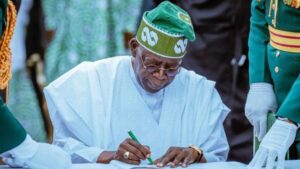
There is a compelling argument that President Tinubu may yet be one of the most misunderstood leaders in Nigeria’s political evolution.
Not for lack of clarity in vision, but due to the complexity of the problems he has chosen to confront head-on—and the inevitable discomfort that accompanies deep structural reform.
From the outset, his administration signaled an unambiguous departure from incrementalism.
The removal of fuel subsidy—long described as a fiscal black hole—was not merely an economic decision but a political risk of the highest order. Likewise, the unification of exchange rates sought to restore credibility and transparency to Nigeria’s monetary system.
These were not populist moves.
They were corrective surgeries.
As President Tinubu himself once remarked: “We must be bold enough to take tough decisions today if we are to secure a prosperous tomorrow.”
That philosophy defines his leadership—decisive, strategic, and anchored in long-term national interest.
THE ACCOUNTANT’S MIND, THE STRATEGIST’S INSTINCT
Trained as a professional accountant, President Tinubu brings to governance a rare analytical discipline—one that prioritizes root-cause diagnosis over superficial fixes. Where others might manage symptoms, he has chosen to confront systemic imbalances.
Nigeria’s economic distortions did not emerge overnight. They are the cumulative outcome of decades of policy compromises, fiscal leakages, and structural neglect.
To correct them requires not just political will, but technical clarity—and a tolerance for short-term pain.
This is where many critics falter in their assessment.
Reform, by its very nature, disrupts comfort zones.
It demands patience from citizens and discipline from institutions.
It also requires a leader willing to absorb criticism while staying the course.
Tinubu has demonstrated that capacity.

FEDERALISM IN PRACTICE: POWER AND RESPONSIBILITY
One of the least appreciated aspects of this administration is its fidelity to constitutional federalism.
Rather than centralizing power, President Tinubu has respected the constitutional roles of subnational governments. Increased allocations to states—driven by revenue reforms—have significantly expanded the fiscal capacity of governors.
This is not incidental. It is deliberate.
The responsibility for delivering immediate social interventions—palliatives, local infrastructure, primary healthcare, and community security—lies primarily with state and local governments. Yet, in public discourse, the burden of accountability is often disproportionately placed on the presidency.
This disconnect has created a cycle of misdirected expectations.
The reality is straightforward: funding has been provided. Delivery must now follow at the appropriate tiers of governance.
True accountability must reflect this structure.
GLOBAL CONTEXT: REFORMERS ARE RARELY CELEBRATED IN REAL TIME
History offers powerful parallels.
Margaret Thatcher implemented sweeping economic reforms in the United Kingdom that were deeply unpopular in their early years. Industrial unrest, unemployment spikes, and social resistance defined her tenure.
Yet decades later, her policies are widely credited with reshaping Britain’s economic trajectory.
Lee Kuan Yew governed with a firm, reform-driven approach that demanded discipline and sacrifice from citizens.
Today, Singapore stands as a model of economic transformation and governance efficiency.
Franklin D. Roosevelt faced intense opposition for his New Deal reforms.
At the time, critics labeled his policies radical.
History, however, recognizes them as foundational to America’s recovery and long-term stability.
The pattern is consistent: transformational leaders are often judged harshly in the moment and fairly only in retrospect.
President Tinubu’s trajectory increasingly aligns with this historical pattern.
As Winston Churchill famously observed: “You have enemies? Good. That means you’ve stood up for something, sometime in your life.”

NAVIGATING A TURBULENT GLOBAL LANDSCAPE
Leadership does not exist in a vacuum. Tinubu’s presidency has unfolded amid global economic volatility, geopolitical tensions, and supply chain disruptions.
External shocks—from energy market fluctuations to international conflicts—have compounded domestic challenges.
Yet, even within this environment, the administration has maintained policy direction without capitulating to populist reversals.
That consistency is not accidental. It reflects strategic clarity.
THE HUMANITARIAN DIMENSION: LISTENING AND ADAPTING
Contrary to popular narratives, this administration has not ignored the human impact of reform.
On the contrary, it has sought to mitigate hardship through fiscal transfers, social safety frameworks, and engagement with subnational actors.
A listening government is not one that avoids difficult decisions—it is one that adapts its implementation to reduce pain without abandoning purpose.
Recent policy adjustments and engagements with stakeholders suggest precisely that.
A POLITICAL PHILOSOPHY ROOTED IN PATRIOTISM
At its core, President Tinubu’s political ideology is grounded in reformist pragmatism and national cohesion.
He has consistently demonstrated a pan-Nigerian outlook—building alliances across ethnic, religious, and regional lines throughout his political career.
This is not incidental.
It is foundational to his identity as a leader.
He is not a sectional figure. He is a national strategist.
DESTINY, DISCIPLINE, AND THE BURDEN OF HISTORY
There is also a cultural dimension to leadership narratives in Nigeria—one that blends destiny with duty. Born in March, a month that has produced influential figures such as Obafemi Awolowo and Enoch Adeboye, President Tinubu’s journey is often framed within a broader sense of purpose.
Whether one subscribes to that perspective or not, the undeniable truth is this: his ascent was not accidental. It was built on decades of political engagement, strategic positioning, and resilience.
THE NATIONAL PATRIOTS HONOUR
In recognition of his leadership, reformist courage, and unwavering commitment to national transformation, the National Patriots confers upon President Bola Ahmed Tinubu the distinguished honour:
“The Architect of Renewed Hope and National Rebirth”
A statesman whose courage to reform today secures the prosperity of tomorrow.
Presenting the award, Princess Gloria Adebajo-Fraser, MFR, remarked:
“History does not remember those who chose comfort over courage. President Tinubu has chosen the harder path—the path of reform, sacrifice, and national rebirth. In time, the results will speak louder than the resistance.”

A CALL FOR PERSPECTIVE
Nations are not transformed by sentiment. They are rebuilt through difficult decisions, sustained effort, and collective responsibility.
Nigeria stands in the midst of that process.
The temptation to judge prematurely is understandable—but it is also dangerous. Reform is not an event; it is a process. And processes demand time.
At 74, President Bola Ahmed Tinubu represents not just leadership, but a test of national patience, institutional accountability, and collective vision.
There is, as many would argue, no vacancy in the Presidential Villa—not because of politics, but because of continuity. Reform, once begun, must be seen through.
The work is ongoing.
The outcome is unfolding.
And history, as always, will deliver the final verdict.
Princess Gloria Adebajo-Fraser MFR.
President, the National Patriots.