
Headlinenews.news Special Report
A quiet but consequential shift is unfolding within the Western alliance system—one that raises fundamental questions about the relevance of the North Atlantic Treaty Organization (NATO) in its current form.
In an extraordinary turn, several traditional allies of the United States have reportedly restricted access to their airspace for U.S. military operations linked to escalating tensions with Iran.
The move, widely interpreted as a deliberate effort to de-escalate conflict in the Middle East, signals a rare but unmistakable divergence from Washington’s strategic posture.

For an alliance built on collective defence and strategic alignment, this is not a routine disagreement. It is a structural tremor.
A 77-Year Alliance Under Strain
Established in 1949 in the aftermath of World War II, NATO was designed as a bulwark against Soviet expansion. Its founding principle—Article 5—enshrined the idea that an attack on one member is an attack on all.
For decades, NATO functioned not just as a military alliance, but as a symbol of Western unity, anchored by U.S. leadership.
From the Cold War through interventions in the Balkans, Afghanistan, and Libya, the alliance maintained a degree of cohesion—even when disagreements emerged.
But cohesion has always had limits.
The Iraq War in 2003 exposed deep fractures, with key European powers refusing to back the U.S.-led invasion.
What is unfolding today appears to be a more advanced version of that same tension—only this time, it is playing out across a broader coalition landscape and in real time.
Europe Draws a Line
The refusal by several European nations to grant airspace access is not merely procedural; it is political.
It reflects a growing reluctance within Europe to be drawn into another Middle Eastern conflict—particularly one perceived as avoidable or escalatory.
This posture is reinforced by domestic pressures across Europe, where publics remain wary of prolonged military engagements and their economic consequences, including energy instability and migration pressures.
The message is clear: support for the United States is no longer automatic.

Compounding this shift are reports of sharp rhetoric from Washington, including characterizations of European hesitation as weakness. Such language, while not unprecedented, appears to have deepened the divide rather than bridged it.
The Emergence of a Parallel Coalition
In what may prove to be a defining geopolitical development, the United Kingdom is said to be leading the formation of a 35-nation coalition aimed at developing alternative, non-hostile strategies for navigating critical global chokepoints such as the Strait of Hormuz.
This is significant for several reasons.
First, the Strait of Hormuz remains one of the world’s most strategic maritime corridors, with roughly 20% of global oil supply passing through it daily.
Any disruption carries immediate global economic implications.

Second, the formation of a coalition explicitly positioned as “non-hostile” suggests a deliberate attempt to separate strategic access from military confrontation.
It is diplomacy and logistics over deterrence and force.
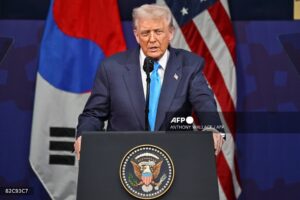
Third—and most importantly—this coalition reportedly excludes the United States.
If sustained, this represents a profound recalibration of Western strategic coordination: a move from U.S.-centric leadership to a more distributed, interest-based alignment.
Is NATO Becoming Obsolete?
It would be premature to declare NATO irrelevant.
The alliance still maintains substantial military capabilities, institutional depth, and operational experience. It continues to play a central role in European security, particularly in relation to Russia.
However, relevance is not defined by existence—it is defined by cohesion and purpose.
What we are witnessing is not the collapse of NATO, but a fragmentation of strategic consensus within it.
Alliances endure when interests align.
They weaken when national priorities diverge.
Today, energy security, economic stability, domestic political pressures, and differing threat perceptions are pulling NATO members in different directions.
The emergence of parallel coalitions—especially those excluding the United States—suggests that member states are increasingly willing to pursue alternative frameworks when NATO consensus proves elusive.
A New Era of Flexible Alliances
The broader implication is the rise of what might be called “modular alliances”—coalitions formed around specific issues, interests, and timeframes, rather than permanent, all-encompassing blocs.
This is not entirely new.
The post-Cold War era has seen “coalitions of the willing” emerge in various conflicts.
What is different now is the scale and the strategic intent.

When 30 NATO members cannot align on a critical issue, but 35 nations can align outside of NATO, the question is no longer about disagreement—it is about structural evolution.
Implications for Global Order
For countries like Nigeria and others in the Global South, these developments carry important lessons.
First, global power is becoming more fluid. Traditional alliances are no longer monolithic. This creates both uncertainty and opportunity.
Second, strategic autonomy is gaining value. Nations are increasingly seeking to protect their interests without being locked into rigid alliance structures.
Third, diplomacy is reasserting itself as a counterweight to military escalation. The focus on non-hostile access to the Strait of Hormuz underscores a recognition that global stability cannot always be enforced through force.

Conclusion: A Moment of Recalibration
NATO is not disappearing. But it is changing—perhaps more fundamentally than at any point since its creation.
The current divergence between the United States and key European allies is not an isolated disagreement. It is part of a broader recalibration of power, priorities, and partnerships in a rapidly evolving world.
Whether this leads to a weakened NATO, a reformed NATO, or a parallel system of alliances remains to be seen.
What is clear is this: the era of unquestioned alignment is over. And in its place, a more complex, multipolar, and interest-driven global order is taking shape.
Dr. G. Fraser. MFR
Headlinenews.news Special Report