

By Headlinenews.News Special Desk
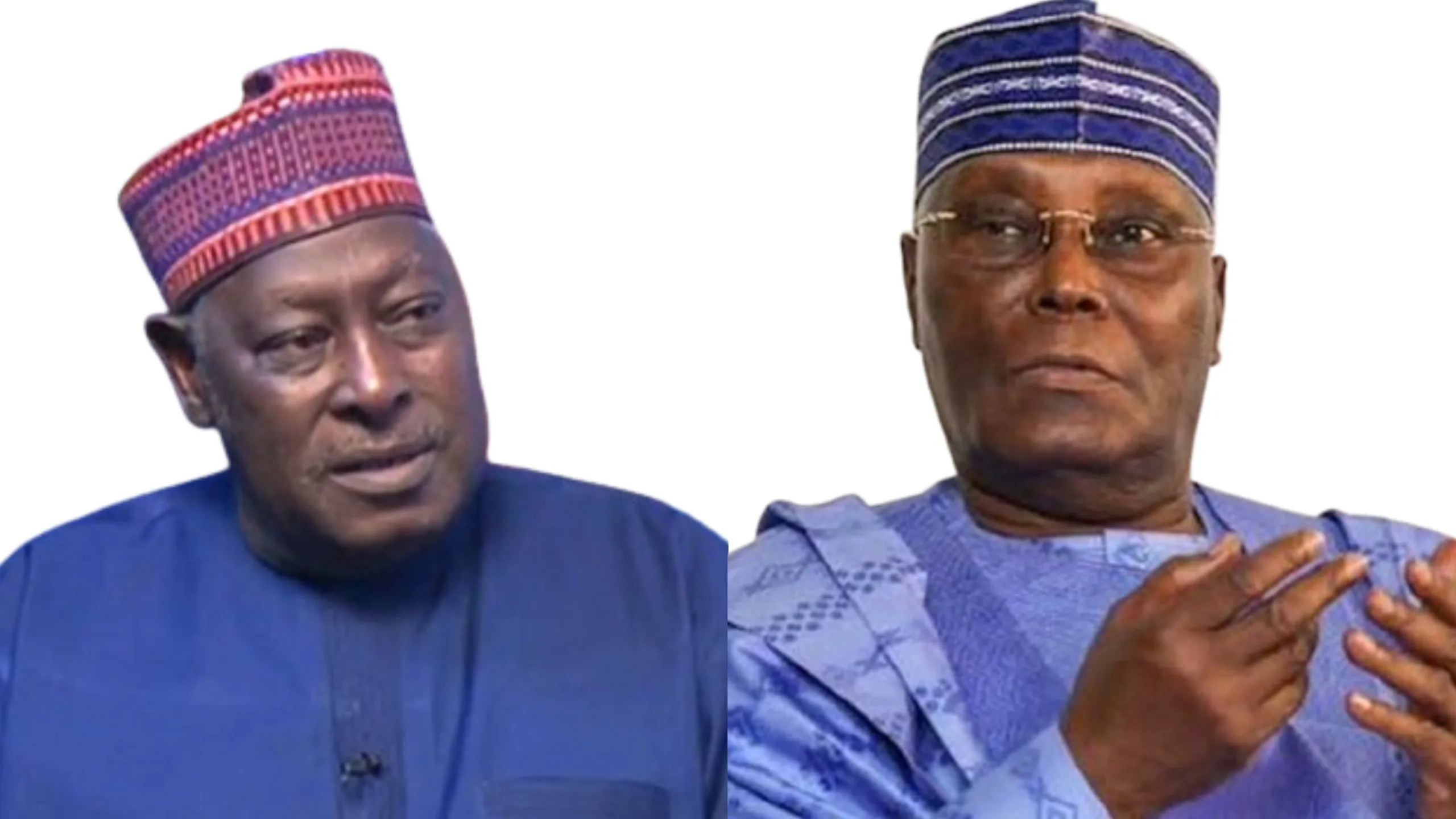
A political tremor has rippled through Nigeria’s opposition landscape following the dramatic announcement by the Adamawa State factional Chairman of the African Democratic Congress (ADC), Mohammed Suleiman Raji Zumo, suspending key national figures including Atiku Abubakar and Babachir David Lawal.

The announcement, made during a tense press conference in Yola, also extended to Barrister Sadiq Dasin, described by the faction as a “purported Chairman,” underscoring deepening internal fractures within the party.
At the heart of the development lies a familiar but destabilising pattern in Nigerian party politics—parallel leadership claims, disputed congresses, and competing legitimacy narratives.
While Zumo’s faction insists the suspensions followed recommendations from a disciplinary committee, the opposing bloc is expected to challenge both the authority and legality of the action.
A Party in Crisis
The ADC, long positioned as a third-force alternative in Nigeria’s crowded political space, now finds itself grappling with internal discord at a critical pre-election moment.
The timing is particularly consequential given the proximity to electoral cycles and the legal framework governing party participation.
Under Nigeria’s electoral regulations, particularly those enforced by the Independent National Electoral Commission (INEC), political parties are required to maintain clear and undisputed leadership structures to validly nominate candidates.
Prolonged internal disputes—especially those involving court cases—can jeopardise a party’s eligibility to field candidates or even lead to exclusion from ballots in extreme scenarios.

This raises immediate questions: which faction does INEC recognise?
And more critically, will the dispute be resolved before statutory deadlines for party primaries and candidate submissions?
Implications for Atiku Abubakar
For Atiku Abubakar, a veteran of Nigeria’s political arena and a serial presidential contender, the implications are both strategic and existential.
Having contested multiple elections across parties—from the PDP to the APC and back—his political trajectory has often been defined by timing and platform.
This latest development introduces a compressed decision window.
If the suspension is upheld—either internally or through judicial affirmation—Atiku may be forced to consider alternative platforms within a tightening electoral calendar.
Historically, party switching in Nigeria is not unusual.
However, the Electoral Act imposes strict timelines. Candidates must emerge through duly conducted primaries, and parties must submit their lists to INEC within defined periods.
Any delay or uncertainty could effectively shut the door on participation.

In practical terms, Atiku faces three immediate pathways:
First, to challenge the suspension within the party structure or through the courts, seeking reinstatement and consolidation of control.
Second, to align with a recognised faction of the ADC that retains INEC’s backing—if such clarity emerges.
Third, to initiate negotiations with another political party, though this option carries risks of integration, acceptance, and compliance with nomination timelines.

None of these options are without complications.
Babachir Lawal and the Northern Political Equation
The inclusion of Babachir Lawal in the suspension list adds another layer of complexity.
As a prominent Northern political figure and former Secretary to the Government of the Federation, Lawal has been a visible voice in opposition alignments and coalition-building efforts.
His suspension signals that the crisis is not merely administrative but deeply political—potentially tied to control of party structures ahead of future contests.
More broadly, this development could reshape alignments within the North-East, a region that has historically played a decisive role in presidential elections.
Adamawa State, in particular, carries symbolic and strategic weight as Atiku’s political base.
A fracture within the ADC in this region weakens its credibility as a unified platform and could fragment opposition votes if not resolved swiftly.

A Familiar Nigerian Political Cycle.
Nigeria’s democratic evolution has repeatedly witnessed similar episodes.
From the factional crises in the PDP to leadership disputes within the APC, internal party conflicts have often spilled into courts, delayed primaries, and, in some cases, altered electoral outcomes.
What distinguishes the current ADC situation is its timing and the calibre of individuals involved.
With less room for procedural delays, the stakes are significantly higher.
A prolonged crisis could render the party ineffective in the upcoming electoral cycle, reducing it to a peripheral player rather than a competitive alternative.
What Happens Next?
The coming days will be critical.
Legal challenges are almost inevitable.
Both factions are likely to seek judicial validation of their claims, potentially leading to conflicting court orders—a scenario that has previously complicated INEC’s decision-making.
INEC, for its part, will be guided by documentation, court rulings, and established protocols in determining which leadership to recognise.
For Atiku Abubakar and his allies, time is the most unforgiving variable.
Political capital, no matter how extensive, cannot substitute for compliance with electoral timelines.
The Larger Picture
Beyond individual ambitions, this episode reflects a broader structural challenge in Nigeria’s party system—weak internal democracy, fragile institutional frameworks, and the persistent struggle for control over party machinery.

Until these foundational issues are addressed, such crises will remain cyclical, undermining both party credibility and voter confidence.
For now, what began as a state-level announcement in Yola has escalated into a national political development with far-reaching implications.
Whether it marks a temporary disruption or a decisive turning point in the opposition’s configuration remains to be seen.
The National Patriots note with concern the unfolding crisis within the African Democratic Congress (ADC) and its implications for political stability, particularly following the suspension of Atiku Abubakar and Babachir David Lawal. While internal party discipline remains a legitimate process, politics must never be reduced to a do-or-die affair. We urge all actors to act with restraint, uphold democratic principles, and prioritise national interest above personal ambition. True patriotism demands unity, civility, and respect for due process.
Nigeria must always come before politics, and peace must always prevail over power.
Headlinenews.news Special Investigative Report.




