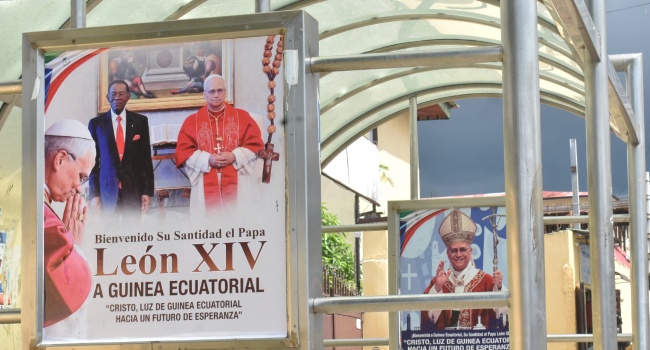
Pope Leo XIV is set to conclude his African tour on Tuesday with a visit to Equatorial Guinea, a country often criticised for its human rights record and tight political control.
The pontiff arrived from Angola and is expected in the Central African nation around midday, where he will be received by President Teodoro Obiang Nguema Mbasogo, Africa’s longest-serving non-monarchical leader, who has been in power since 1979.

The visit carries added attention due to the Pope’s increasingly outspoken messages on tyranny, inequality, and social injustice during his tour. Observers say his tone has grown more direct, moving away from his earlier reserved style.
Equatorial Guinea, though rich in oil, has long faced criticism from international rights groups over corruption allegations, restrictions on free speech, and the exile of many opposition figures.
Despite this, the country remains deeply Catholic, with about 80 percent of its population belonging to the Church, a legacy of Spanish colonial influence. Streets in the capital Malabo have been decorated with Vatican flags, banners, and large portraits of the Pope ahead of his arrival.

Local residents have expressed hope that the visit will have a positive impact. One resident, Juan Raul, described it as a moment of unity and reflection, saying it could encourage more people to reconnect with their faith.
During his stay, Pope Leo XIV is expected to address government officials, diplomats, and representatives of civil society in Malabo before travelling to Mongomo, where he will celebrate Mass and visit a technology school.
He will also stop in Bata, the country’s economic hub, where he is scheduled to pray for victims of a deadly 2021 explosion and visit a local prison known for harsh conditions.
The Pope will conclude his 11-day, 18,000-kilometre journey across Africa with a final Mass in Malabo on Thursday, bringing an end to a tour closely watched for both its spiritual message and its political undertones.