

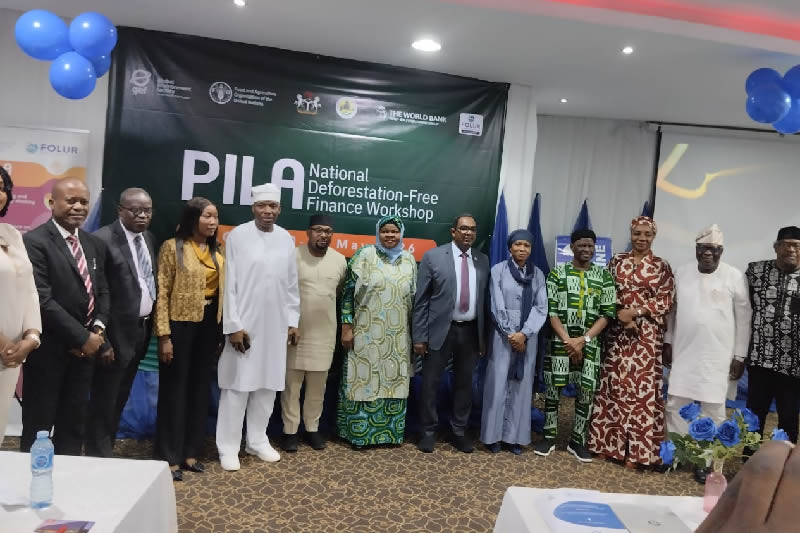
The Food and Agriculture Organization (FAO) has stepped up initiatives aimed at encouraging deforestation-free financing practices in Nigeria, with a special focus on cocoa and oil palm production in the Niger Delta region.
This effort was highlighted during a two-day workshop held in Lagos starting Wednesday, themed “Advancing Deforestation-Free Finance in Nigeria’s Banking Sector: From Roadmap to Implementation.”

The workshop is organized under the Global Environment Facility Food Systems, Land Use and Restoration Impact Programme, which is funded by the Global Environment Facility and implemented by FAO alongside national stakeholders.
The programme is designed to support integrated landscape management, sustainable food systems, biodiversity protection, and the restoration of degraded ecosystems across key agricultural value chains, especially cocoa and oil palm.

At the opening session, the FAO Representative in Nigeria and to the Economic Community of West African States, Dr Hussein Gadain, described the workshop as a transition from discussion to real implementation.
He noted that agriculture, trade, investment, and environmental sustainability are increasingly interconnected, with financial institutions playing a decisive role in how agricultural commodities are produced and funded.
Gadain explained that Nigeria, as one of Africa’s top producers of cocoa and oil palm, has a strong opportunity to align agricultural growth with environmental protection.

He warned that while these commodities support jobs, food security, and economic development, their expansion continues to put pressure on forests and biodiversity.
He added that FAO will continue providing technical support, policy guidance, capacity building, and stakeholder engagement to help Nigeria become a regional leader in sustainable agricultural financing.
He also emphasized that banks influence land-use patterns through lending decisions, investment strategies, and sustainability requirements.
According to him, global finance trends are shifting toward ESG principles, climate-aware investment, and sustainability-linked lending models.

He pointed out that Nigeria’s Sustainable Banking Principles, introduced by the Central Bank of Nigeria, already provide a strong base for responsible financial practices.
Participants at the workshop are expected to review regulatory frameworks, findings from a national financial sector study, and global best practices in traceability and accountability systems.
He stressed that deforestation-free finance is becoming both an environmental necessity and a market requirement, as international buyers and investors increasingly demand sustainable supply chains.
He further called for the inclusion of smallholder farmers, women, youth groups, cooperatives, and SMEs in the transition toward sustainable financing systems.
He added that financial solutions must be practical, affordable, scalable, and adapted to local conditions.

The Director-General of the Forestry Research Institute of Nigeria, Dr Zacharia Yaduma, also addressed the workshop, noting the urgency of turning policy goals into real financing mechanisms.
He said Nigeria must balance agricultural expansion, economic growth, and environmental protection simultaneously.
He explained that while research institutions provide knowledge for sustainable forestry, financial and policy decisions ultimately determine land-use outcomes.
He added that access to global markets, climate funding, and investment is increasingly dependent on sustainability performance and traceability.
Yaduma noted that although Nigeria’s Sustainable Banking Principles are a solid foundation, more practical financial tools are needed to support farmers and agribusinesses.
He concluded that without sustainable financing, even well-designed environmental policies may fail in practice.
The workshop brought together stakeholders from the Central Bank of Nigeria, Federal Ministry of Agriculture and Food Security, Federal Ministry of Environment, National Task Force on the European Union Deforestation Regulation, Forestry Research Institute of Nigeria, and the European Union Delegation.




