


A series of violent incidents and escalating geopolitical tensions have been reported across Russia and its neighbouring conflict zones, including a car explosion in the Moscow region that reportedly killed a senior Russian military figure responsible for overseeing heavy ammunition supplies.

According to reports, the blast occurred in Balashikha, where a vehicle detonated and killed its driver, identified in some accounts as Damir Davydov, who was said to head the missile and artillery division within Russia’s defence ministry. Authorities later reportedly discovered and safely detonated a second explosive device in south-west Moscow.
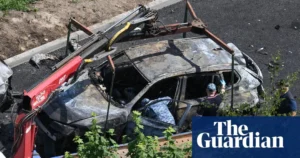
The incident adds to a growing pattern of targeted attacks on individuals linked to Russia’s war operations, with previous cases often attributed by Moscow to Ukrainian-linked security activity.

In separate developments, fuel supply disruptions have triggered widespread panic buying in Russia’s Krasnodar region, according to local officials. The regional governor, Veniamin Kondratyev, said residents rushed to stockpile gasoline due to shortages linked to continued Ukrainian strikes on energy infrastructure in southern Russia and Crimea.
Emergency services also confirmed the extinguishing of a major oil depot fire in Ust-Labinsk following a reported drone strike over the weekend.
Further south, the governor of Russia’s Rostov region, Yuri Slyusar, reported that a Ukrainian drone attack caused a fuel tank fire in the Millerovsky district near the Ukrainian border, though no casualties were immediately confirmed.

In Dagestan, explosions were reported in Kizilyurt after a gas pipeline blast, with local authorities saying a fire likely affected a gas distribution station.
Meanwhile, the Samara region came under drone attack, with officials confirming disruptions near the Novokuibyshevsk oil refinery, a key facility operated by Russian energy company Rosneft. Airspace in the region was temporarily closed.

On the diplomatic front, the European Union is preparing a new sanctions package targeting Russia, including proposals to restrict entry for Russian soldiers, tighten controls on banks and cryptocurrency firms, and cap Russian oil prices at $44 until 2027. The package also includes measures against “shadow fleet” tankers used to transport oil and new restrictions on metals, fish imports, and industrial materials linked to defence production.
EU officials also confirmed plans to advance Ukraine and Moldova’s accession process, with negotiations expected to open on key governance chapters in the coming week as part of broader integration efforts.

Ukrainian President Volodymyr Zelenskyy met with Nordic and Baltic leaders in Estonia, where discussions focused on defence cooperation and counter-drone strategies following recent incidents involving Russian electronic warfare.
In contrast, Bulgaria signaled a policy shift by halting future arms deliveries to Ukraine, with its leadership calling instead for renewed negotiations to end the war.
Meanwhile, Kremlin officials stated there are currently no plans for direct talks between Donald Trump and Vladimir Putin, though informal diplomatic contacts involving US intermediaries continue.




