

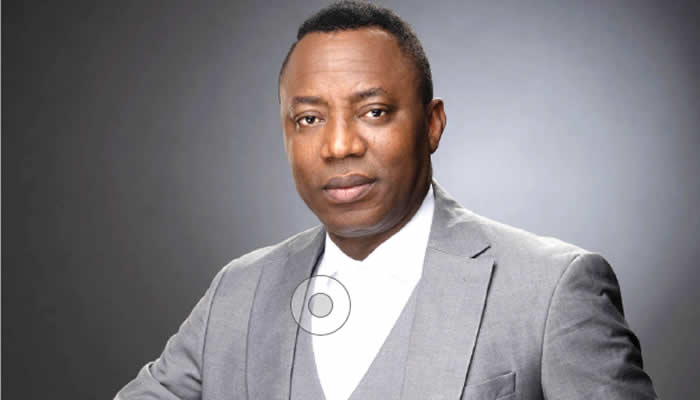
The trial of activist and publisher Omoyele Sowore was adjourned on Monday after a heated exchange between senior lawyers representing the defence and the prosecution disrupted proceedings at the Federal High Court in Abuja.
The disagreement began when Sowore’s lead counsel, Adeyinka Olumide-Fusika (SAN), asked the court for an adjournment. He explained that documents the court approved for release on July 27 were only made available to him on Monday, leaving him with little time to prepare for the cross-examination of the next defence witness, a Department of State Services (DSS) official.
Counsel for the DSS, Akinlolu Kehinde (SAN), opposed the request, arguing that the defence was deliberately delaying the trial. He urged the court to close the defence’s case, insisting that enough opportunities had already been given.

His submission triggered a sharp exchange between both senior advocates.
Fusika rejected the allegation, accusing the prosecution of acting more like “persecutors” than prosecutors. He told Justice Mohammed Garba Umar that although the DSS had produced a witness in response to a subpoena issued to its Director-General, the defence could not proceed because it had only just received the certified true copies of court records needed for the case.
According to him, the defence applied for the documents on July 22 but was repeatedly told by court officials that the judge had not approved the request. He later discovered that Justice Umar had actually approved it on July 27.
“The problem was with the court registry, not the court,” Fusika argued, adding that the documents were essential for the defence.

Kehinde, however, maintained that the defence should have followed up more actively with the registry instead of waiting until the hearing date. He insisted the prosecution had fulfilled its own part by ensuring the DSS witness was present in court.
He argued that the court had already granted several adjournments at the request of the defence and asked Justice Umar to foreclose the defence’s case, saying the Constitution guarantees an opportunity to be heard, not endless delays.
Responding, Fusika said the prosecution had ignored the facts and unfairly blamed the defence for circumstances beyond its control. He stressed that if the defence intended to delay the proceedings, it could have insisted that the DSS Director-General personally appear in court to testify.
He also dismissed claims that the defence was intentionally stalling the trial, describing the accusation as insulting, considering the cost and effort involved in attending court.

Justice Umar noted that since the prosecution closed its case, the defence had called only one witness and had sought about four adjournments. Fusika then outlined the steps the defence had taken since he assumed responsibility for the case on June 22, 2026, to show it had acted diligently.
The situation became more tense when Kehinde attempted to make further submissions and Fusika interrupted him, saying he was behaving like a “persecutor” rather than a prosecutor.
Justice Umar immediately cautioned Fusika over the remark, warning that any further misconduct could lead to him being reported to the appropriate disciplinary authorities.
Following the exchange, the judge decided not to continue with the hearing and adjourned the case until September 20, 2026, for the continuation of the defence. Before ending proceedings, he warned both senior lawyers to maintain professionalism, saying any further disruption would notbe tolerated.




