

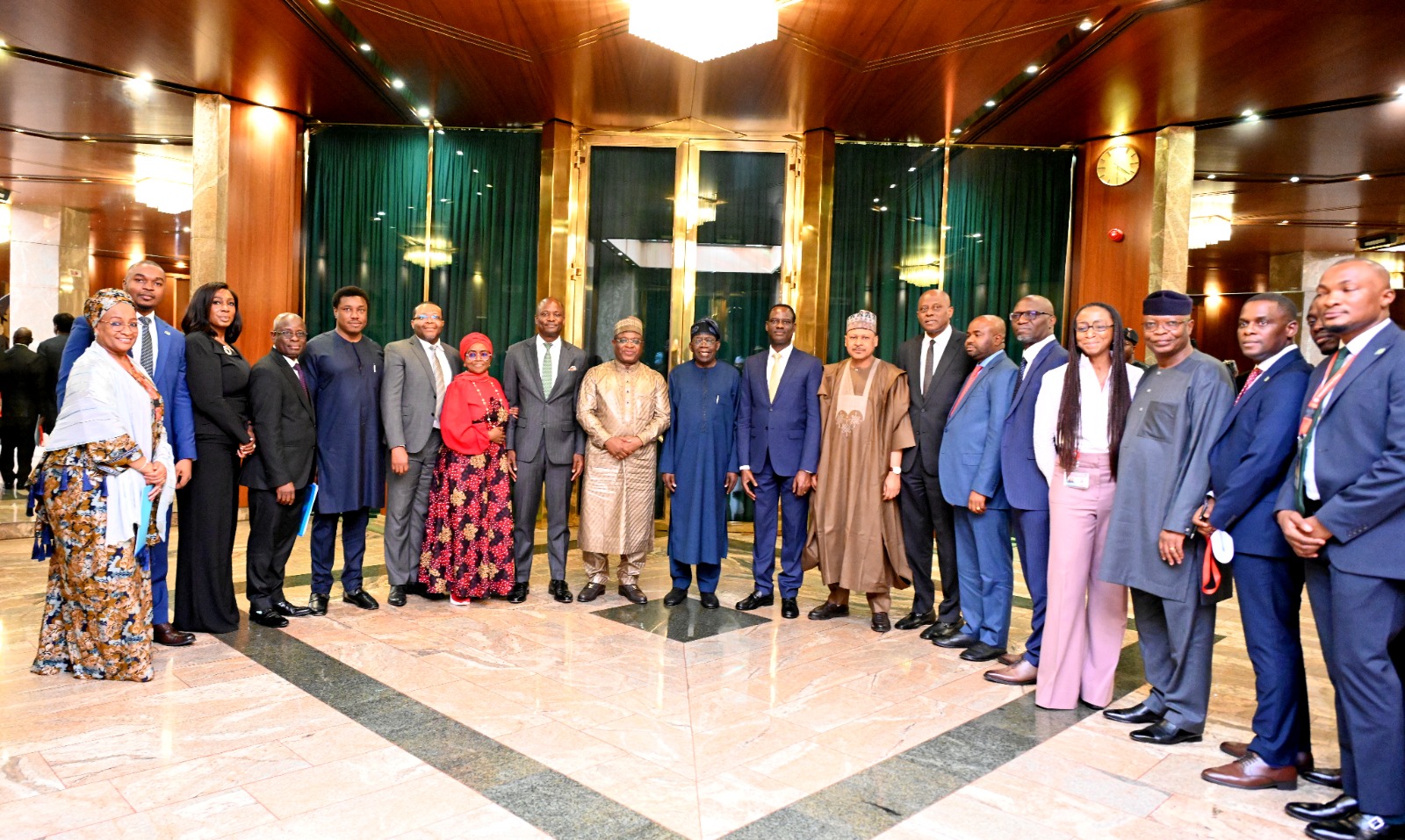
President Bola Tinubu says Nigeria can achieve greater prosperity if the country’s stock market continues to perform strongly, following a significant rise in the market value of the Nigerian Exchange (NGX).
Tinubu made the remarks on Thursday when he received the board and management of NGX Group at the State House in Abuja.
The NGX delegation, led by its chairman, Umaru Kwairanga, and managing director and chief executive officer, Temi Popoola, briefed the president on the performance of the capital market since he took office in May 2023.

Popoola said the total value of listed companies on the exchange has risen from about N30 trillion in 2023 to N160 trillion. He also noted that the NGX All-Share Index has climbed from around 52,000 points to about 244,000 points.
Reacting to the figures, Tinubu said the strong performance of the stock market was an indication that the wider economy was also moving in the right direction.
“If the stock market is doing well, then we are doing well,” the president said.
He added that economic growth should ultimately improve the lives of ordinary Nigerians, particularly young people and students who often struggle with the cost of education and other basic needs.
Tinubu also expressed confidence in the direction of his administration’s economic reforms, saying the improving economic indicators and positive assessments from experts suggest that Nigeria has a better economic outlook.

The president praised Central Bank of Nigeria Governor Olayemi Cardoso and members of his economic management team for their roles in implementing the reforms.
He said the government still has a responsibility to prove that Nigeria can build a prosperous economy through its own resources and capabilities.
According to Tinubu, the private sector will remain central to achieving the administration’s ambition of building a $1 trillion economy. He said the government would continue to encourage and support private investment.
The president also disclosed that the Nigerian National Petroleum Company Limited would be reformed and eventually listed on the capital market.
He commended Finance Minister and Coordinating Minister of the Economy Taiwo Oyedele, Minister of Budget and Economic Planning Atiku Bagudu, CBN Governor Olayemi Cardoso and National Revenue Service Chairman Zacch Adedeji for their roles in the ongoing economic reforms.
NGX targets N230 trillion market value
Popoola said the growth of the Nigerian stock market could continue throughout the year, with the value of listed equities expected to reach N230 trillion before the end of 2026.
He attributed the expected increase largely to new companies coming to the market through fresh listings.
Popoola recalled that the value of listed equities was just below N30 trillion when Tinubu assumed office in 2023. According to him, the figure has now reached N160 trillion and could rise significantly further before the end of the year.
He also said the market’s growth had created substantial wealth for investors, estimating that between 500,000 and 900,000 millionaires had been created through gains linked to the reforms and stock market performance.
The NGX chief executive said the progress recorded by Nigeria’s capital market has also attracted attention from other African countries, with some exchanges looking to Nigeria as an example of how capital markets can be developed.
Kwairanga said the government’s economic reforms had contributed significantly to the market’s performance. He added that Nigeria has the potential to achieve its $1 trillion economic target before 2030.
Finance Minister Taiwo Oyedele also described the Nigerian capital market as one of the strongest-performing markets globally. He said the growth recorded over the past three years was closely linked to the economic reforms introduced by the administration.
Oyedele described the capital market as an important avenue for creating wealth for millions of Nigerians. He urged the NGX and the Securities and Exchange Commission to make the process of listing companies simpler and encourage more young Nigerians to participate in the market rather than focusing mainly on speculative investments.
Cardoso, meanwhile, said the successful recapitalisation of Nigeria’s banking sector had helped strengthen investor confidence. He noted that domestic investors provided about 75 percent of the capital raised during the exercise.
The CBN governor said greater economic stability would encourage more investment, which in turn could help expand businesses and stimulate growth across the real sector of the Nigerian economy.




