

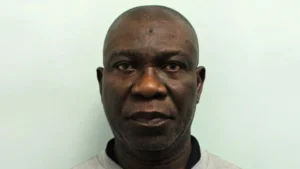
Former Nigerian Deputy Senate President, Senator Ike Ekweremadu, remains in a United Kingdom prison more than four years after his arrest over an organ-trafficking case, with available sentencing records pointing to late 2028 as the likely point at which he could become eligible for automatic release.
Ekweremadu was sentenced to nine years and eight months in prison by the Central Criminal Court, popularly known as the Old Bailey, after he was convicted of conspiring to arrange the travel of a young Nigerian man to Britain with a view to exploiting him for his kidney.

The court directed that Ekweremadu serve two-thirds of his sentence in custody, with the remainder to be served on licence. The sentencing remarks also confirm that time spent in custody before sentencing counts towards the sentence.
This means claims suggesting that the former senator could be released around mid-2027 appear to be based on a different release calculation and do not reflect the specific two-thirds custody direction imposed by the judge.
However, the late-2028 date should be regarded as an estimated release window rather than a confirmed official release date from the UK Prison Service.

HOW THE SENTENCE WAS CALCULATED
Ekweremadu’s nine-year, eight-month sentence amounts to 116 months.
Two-thirds of that term is approximately 77 months, or about six years and five months in custody. Since his time on remand from June 2022 counts towards his sentence, calculations based on the publicly available sentencing information place the two-thirds point around November or December 2028.
The exact administrative release date can only be confirmed by the relevant UK authorities.
After the custodial period, the remaining portion of the sentence would ordinarily be served under licence, meaning that release would not necessarily mark the complete end of his sentence.
THE CASE THAT ENDED EKWEREMADU’S POLITICAL CAREER
The case began after British authorities uncovered an attempt to arrange a kidney transplant for Ekweremadu’s daughter, Sonia, who was suffering from serious kidney disease.

Prosecutors told the court that a young Nigerian man was brought from Lagos to Britain in 2022 and presented as a potential kidney donor for Sonia.
The prosecution argued that the man was vulnerable because of his age and financial circumstances and had been brought to the UK for the purpose of organ exploitation.
The planned transplant, reportedly valued at about £80,000, did not go ahead after concerns were raised by medical professionals at the Royal Free Hospital in London.
The young man later went to the police, triggering an investigation that eventually led to the arrests of Ekweremadu and his wife, Beatrice, at Heathrow Airport in June 2022.
Following a trial at the Old Bailey, Ike Ekweremadu, Beatrice Ekweremadu and Dr Obinna Obeta were convicted in March 2023. Sonia Ekweremadu was acquitted.
The case became the first successful organ-trafficking conviction under the UK’s Modern Slavery Act.

JUDGE DESCRIBED EKWEREMADU AS THE “DRIVING FORCE”
During sentencing, Mr Justice Jeremy Johnson said there were substantial aggravating features in Ekweremadu’s case.
The judge said Ekweremadu knew about the young man’s vulnerability and had played a leading role in the arrangements.
The court ultimately imposed a sentence of nine years and eight months on him.
His wife, Beatrice, received four years and six months, with half of that sentence to be served in custody, while Dr Obinna Obeta was sentenced to 10 years and ordered to serve two-thirds in custody.
Beatrice has since completed the custodial portion of her sentence and returned to Nigeria.
NIGERIA’S ATTEMPT TO BRING HIM HOME
Nigeria previously sought to have Ekweremadu transferred from the UK to Nigeria to complete his sentence.
In November 2025, a Nigerian government delegation led by Foreign Minister Yusuf Tuggar met UK Ministry of Justice officials over the matter.
The UK rejected the request, with officials reportedly concerned about whether there were sufficient guarantees that Ekweremadu would continue serving his sentence if transferred to Nigeria.
The UK government said prisoner transfers are discretionary and depend on whether such a move would be considered to be in the interests of justice.

As of September 2026, there has been no publicly confirmed decision reversing that refusal.
WHAT HAPPENS NEXT?
For now, Ekweremadu remains in British custody.
Unless his circumstances change through an approved legal or administrative process, the publicly available sentencing calculation points towards a late-2028 custodial release window.
There could, however, be changes arising from future decisions by UK authorities, including any prisoner-transfer arrangement, changes in release rules, or other lawful mechanisms that could affect the timing.
A transfer to Nigeria would require approval by the relevant UK authorities and cannot be assumed simply because the Nigerian government has previously requested it.

Ekweremadu’s case therefore remains a matter between the Nigerian and British authorities, while his sentence continues to be governed by the terms imposed by the UK court.
The former senator, who represented Enugu West in the Nigerian Senate for several years and served as Deputy Senate President between 2007 and 2019, has remained in prison since his conviction.
For now, the key point from the court record is clear: Ekweremadu was sentenced to nine years and eight months, and the judge directed that two-thirds of the sentence be served in custody.



