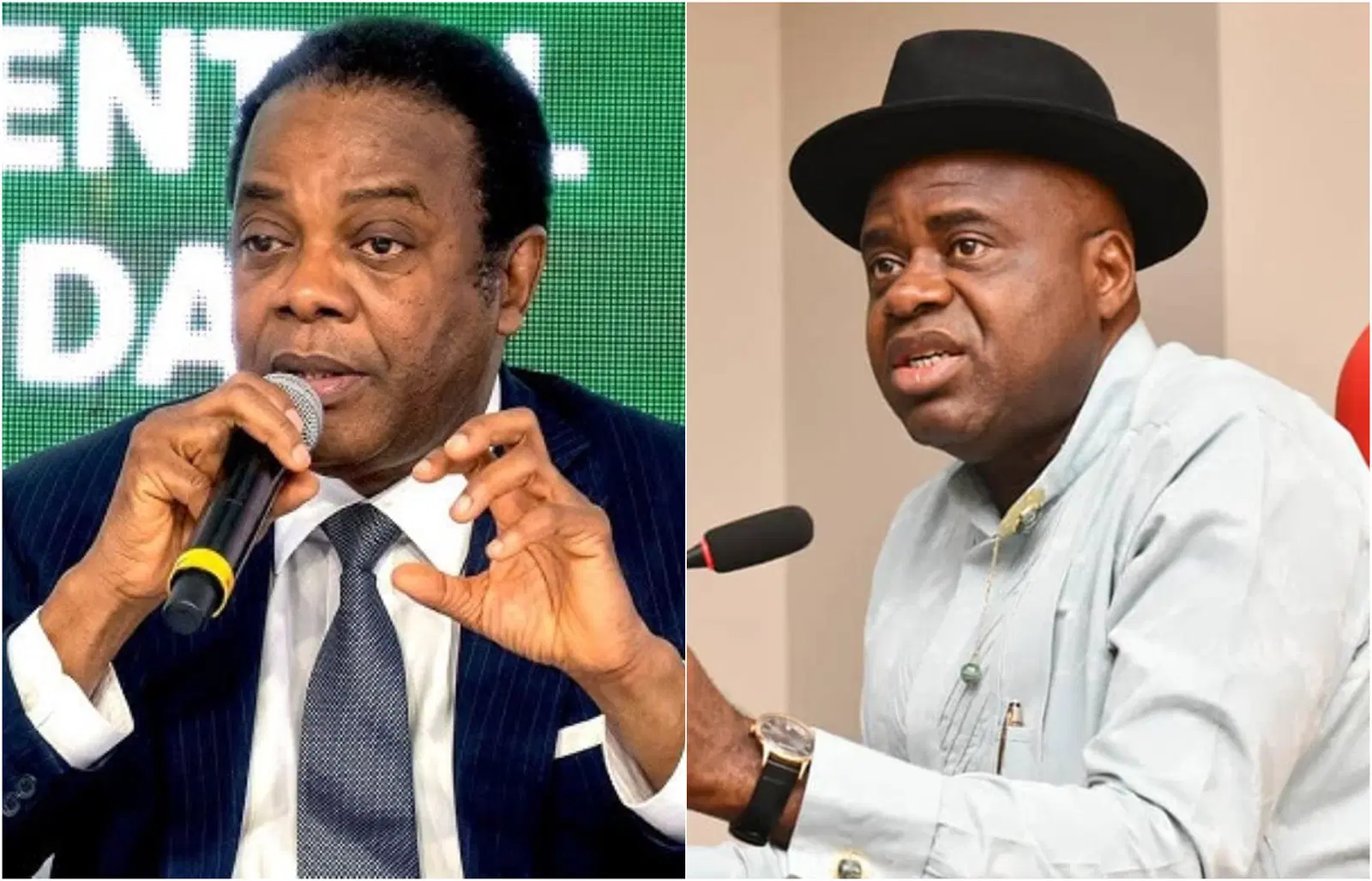
Former Cross River State Governor and Peoples Redemption Party (PRP) presidential candidate, Donald Duke, has criticised Bayelsa State Governor Douye Diri over his defence of the Lagos-Calabar Coastal Highway, describing him as a “local champion”.
Duke made the remarks during an interview on Arise Television’s The Morning Show on Thursday, insisting that the proposed highway raised serious questions about affordability, route planning and Nigeria’s ability to finance the project.

The disagreement followed Diri’s response to Duke’s earlier claim that constructing the highway through Bayelsa State would be impractical because of the area’s swampy terrain.
Diri, through his Chief Press Secretary, Daniel Alabrah, had accused Duke of being unfamiliar with recent infrastructure developments in Bayelsa. He pointed to roads and bridges constructed across swamps and mangrove areas to demonstrate that such terrain would not make the project impossible.
Responding, Duke argued that the governor was considering the issue primarily from the perspective of Bayelsa State rather than examining its implications for the country as a whole.

“I’m from the South-South. I’m a Nigerian. South-South just happens to be where I originated from. But I’m looking at the totality of Nigeria,” Duke said.
DUKE QUESTIONS THE PROJECT’S AFFORDABILITY
The former governor maintained that Nigeria could not comfortably afford the coastal highway, particularly given the government’s reliance on borrowing to finance infrastructure projects.
He argued that the country’s financial constraints should be considered before committing substantial public funds to the project.

Duke also questioned the decision to redirect part of the proposed highway towards the East-West Road, asking why the existing route had not been adequately considered during the initial planning stages.
He further challenged the project’s proposed connection to Calabar, suggesting that the highway might not reach its advertised destination. He argued that the project should instead be called the Lagos Coastal Highway.
Beyond the route and cost, Duke raised concerns about the government’s spending priorities, questioning whether the highway represented the most appropriate use of public resources amid competing national needs.

He also alleged that land reclamation and sand-filling activities associated with the project raised concerns about whether the development was serving its stated transportation purpose.
DIRI DEFENDS BAYELSA’S INFRASTRUCTURE RECORD
Diri had expressed disappointment with Duke’s assessment, arguing that the former governor had overlooked infrastructure achievements in Bayelsa.
According to the governor, the state has successfully constructed roads, bridges and causeways across difficult swampy and mangrove terrain.

He cited projects including the Nembe-Brass Road, the Sagbama-Ekeremor-Agge Road and the Yenagoa-Oporoma Road. He also highlighted the 630-metre bridge across River Nun at Angiama community in Southern Ijaw Local Government Area.
Diri maintained that these projects demonstrated that road construction across challenging terrain was achievable and that the coastal highway should not be dismissed on geographical grounds alone.
The governor also described the coastal road as a project of importance to the Ijaw people, noting that the community had advocated for it for decades.

A WIDER DEBATE OVER NATIONAL PRIORITIES
The exchange has intensified debate over the Lagos-Calabar Coastal Highway, a major federal infrastructure project championed by President Bola Tinubu’s administration.
Supporters argue that the highway could improve transport connections, encourage investment and stimulate economic development in communities along Nigeria’s coastline.
Critics, however, have questioned its financial sustainability, environmental implications, route planning and overall value at a time when the country faces competing demands for public spending.

Duke’s position is that the government must assess the project according to Nigeria’s wider economic circumstances rather than regional interests. Diri, meanwhile, has defended its feasibility by pointing to Bayelsa’s experience with infrastructure construction in similarly difficult terrain.
The disagreement therefore reflects a broader question facing policymakers: how should Nigeria balance ambitious infrastructure development with limited public resources and other pressing national priorities?