

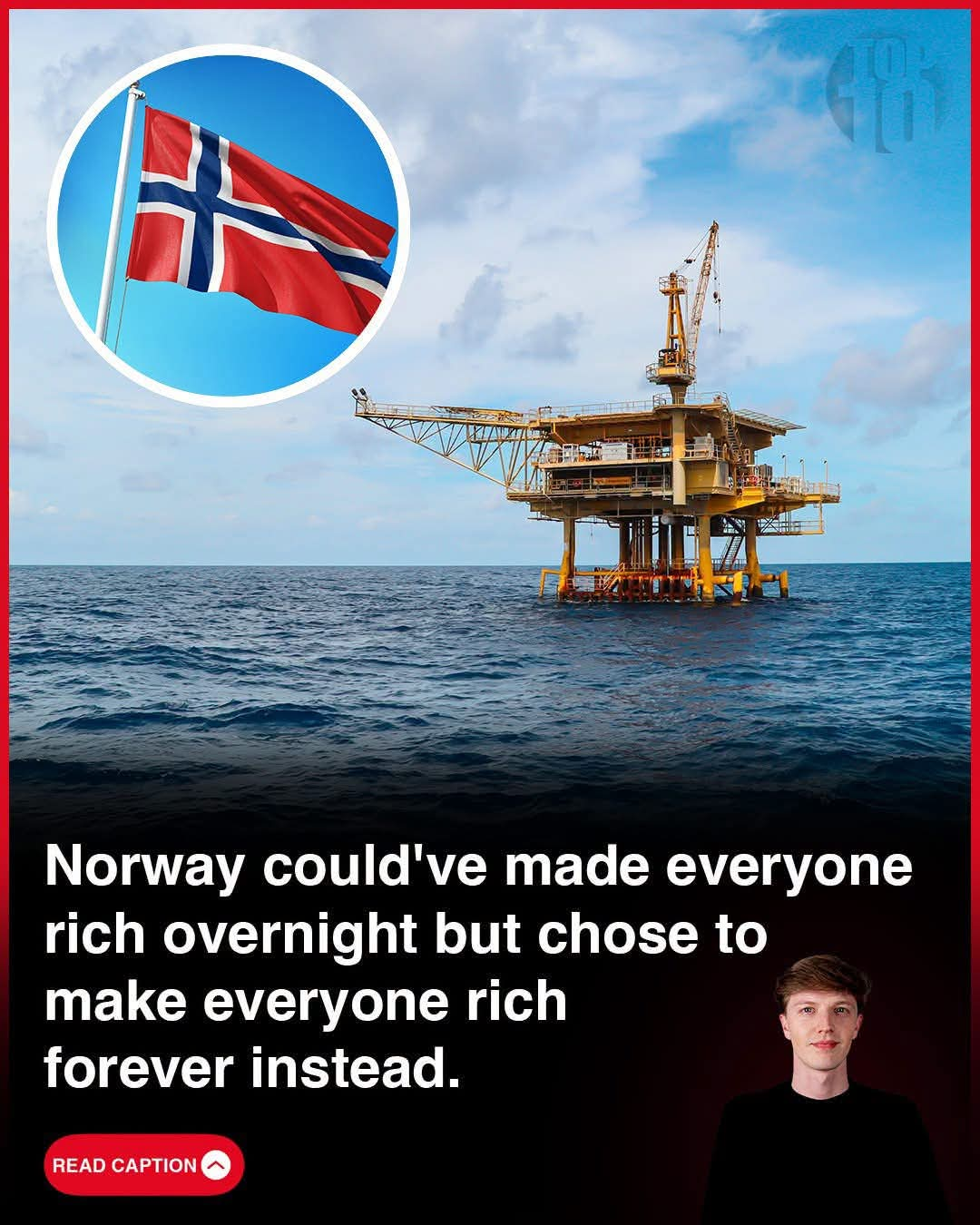
NORWAY discovered enormous oil reserves and could have spent its fortune immediately, but instead chose to invest the money for future generations. Today, its national wealth fund is worth over $2 TRILLION!
Back in 1969, massive oil reserves were discovered beneath the North Sea, transforming Norway into one of the world’s most resource-rich nations.
Suddenly, the country had access to billions of dollars in potential wealth.
But Norwegian leaders recognised something important.
Oil wouldn’t last forever.
Rather than spending all the money as it arrived, Norway established a national investment fund in 1990, designed to preserve the country’s petroleum wealth for future generations.
The government began investing oil revenues into thousands of companies, bonds, and properties around the world.

And the results have been extraordinary.
Today, Norway’s sovereign wealth fund is worth more than $2 TRILLION, making it the largest of its kind in the world!
That’s equivalent to hundreds of thousands of dollars for every person living in Norway.
But here’s the remarkable part.
Instead of giving everyone their individual share, the government uses a carefully managed portion of the fund’s returns to help finance public services and national spending.
The aim is to ensure that even when Norway’s oil reserves eventually run out, future generations can continue benefiting from the wealth they created.
Of course, the fund doesn’t guarantee riches forever, but it represents one of history’s most ambitious examples of long-term financial planning.

Norway turned a natural resource that will eventually disappear into investments designed to last for generations.
A powerful reminder that sometimes the greatest wealth isn’t what you spend today, but what you preserve for tomorrow.
Norway’s Smaller Population, Strong Institutions and Disciplined Investment Strategy Explain Its Success — Nigeria Must Strengthen Its Own Sovereign Wealth Fund Rather Than Embrace Misleading Comparisons.
By Gloria Fraser, MFR. MIoD, FIPMD
A widely circulated social media report claims that “Norway could have made every citizen wealthy overnight following its petroleum discoveries but wisely chose to make everyone rich forever.”
The accompanying narrative celebrates Norway’s sovereign wealth fund, reportedly exceeding $2 trillion, and presents the Scandinavian country as an example Nigeria should emulate.
The achievement is impressive. However, the comparison requires historical accuracy, economic context and an understanding of the fundamental differences between the two countries.
NORWAY DID NOT BECOME WEALTHY OVERNIGHT
Norway discovered substantial North Sea petroleum reserves in 1969. However, it did not immediately establish a multitrillion-dollar investment fund.
Its Government Petroleum Fund was established in 1990, with the first capital transfer occurring in 1996.
The fund subsequently accumulated wealth through petroleum revenues, investment returns and decades of disciplined financial management.
By June 2026, its value had reached approximately NOK 22.7 trillion, equivalent to more than US$2 trillion.
Importantly, much of its accumulated value reflects investment returns rather than petroleum deposits alone.
Therefore, suggesting that Norway could have distributed its present wealth overnight is misleading. That wealth did not exist in its present form when petroleum was discovered.
Nor does the fund guarantee that every Norwegian will remain wealthy forever. Investments fluctuate, markets decline, and governments must continually manage fiscal risks.

THE POPULATION DIFFERENCE IS FUNDAMENTAL
Norway has approximately 5.6 million people, compared with Nigeria’s population of more than 230 million.
Nigeria consequently has over 40 times Norway’s population.
A hypothetical $2 trillion fund divided among 5.6 million Norwegians represents approximately $357,000 per person.
The same amount divided among 230 million Nigerians represents approximately $8,700 per person.
These figures illustrate population differences; they do not represent money available for individual distribution.
Even more importantly, Norway’s economy was already relatively prosperous, industrialised and institutionally developed before petroleum revenues transformed its public finances.
Nigeria faces substantially greater infrastructure requirements, unemployment pressures, poverty and developmental demands.
Comparing both countries without acknowledging these differences creates unrealistic expectations.
HOW NORWAY’S SOVEREIGN WEALTH FUND ACTUALLY WORKS
Norway’s success rests on a carefully designed institutional framework.
Petroleum revenues are channelled into the Government Pension Fund Global, which invests predominantly in international equities and bonds, alongside property and renewable-energy infrastructure.
The government follows a fiscal guideline permitting spending over time in line with the fund’s expected real return, estimated at approximately 3% annually.
This framework helps prevent excessive domestic spending, protects against petroleum price volatility and preserves wealth for future generations.
Norway also benefits from transparent public accounts, professional investment management, strong legislative oversight and broad political agreement concerning the fund’s objectives.

The lesson is therefore institutional discipline, not simply saving money.
NIGERIA ALREADY HAS A SOVEREIGN WEALTH FUND
An important fact frequently omitted from these comparisons is that Nigeria established its own sovereign wealth fund in 2011.
The Nigeria Sovereign Investment Authority commenced investment operations in 2013 with initial capital of $1 billion.
It manages three distinct investment vehicles.
The Stabilisation Fund provides financial protection during economic difficulties.
The Future Generations Fund preserves and invests wealth for Nigerians yet unborn.
The Nigeria Infrastructure Fund supports commercially viable investments in essential infrastructure, including power, healthcare, transportation and agriculture.
Nigeria therefore possesses an institutional framework addressing both present developmental needs and future financial security.
Indeed, the NSIA reports that its Future Generations Fund achieved a 15.44% investment return in 2025, exceeding its stated performance benchmark.
This deserves recognition.
Nevertheless, investment performance alone cannot compensate for inadequate capital contributions or inconsistent fiscal savings.
WHAT SHOULD NIGERIA DO DIFFERENTLY?
President Bola Ahmed Tinubu’s administration has an opportunity to strengthen the NSIA as an enduring national institution.
First, Nigeria should establish clearer, predictable arrangements for transferring genuinely surplus petroleum revenues into sovereign investments, while respecting constitutional revenue-sharing requirements.

Second, the Future Generations Fund should receive stronger protection against politically motivated withdrawals.
Third, the Infrastructure Fund should expand investment in financially sustainable projects capable of improving electricity supply, agricultural productivity, transport efficiency and healthcare.
Fourth, investment decisions must remain professionally managed, independently audited and publicly accountable.
Fifth, Nigeria should strengthen non-oil revenues and diversify its economy. Petroleum wealth alone cannot sustainably finance the needs of a rapidly expanding population.
Finally, sovereign investment should complement, rather than replace, responsible spending on education, security and essential public services.

THE NATIONAL PATRIOTS POSITION
The National Patriots commends the establishment of Nigeria’s sovereign investment framework and recognises the importance of preserving its institutional continuity.
We encourage the Tinubu administration to strengthen the NSIA through improved capitalisation, transparent governance and carefully structured investment policies.
However, Nigerians should reject simplistic comparisons suggesting that Norway’s financial success resulted merely from saving petroleum revenues while Nigeria squandered everything.
Nigeria’s historical policy failures deserve scrutiny, but meaningful comparisons must consider population, economic development, institutions, public investment requirements and the timing of petroleum discoveries.
Norway’s experience offers valuable lessons, not a ready-made formula.
FOOD FOR THOUGHT
A wise nation must neither consume tomorrow’s inheritance today nor deny today’s children the education, infrastructure and opportunities necessary to create tomorrow’s prosperity.
Nigeria must pursue both objectives.
The ultimate ambition should be a sovereign wealth fund that protects future generations while contributing responsibly to the development of the present generation.
National prosperity requires more than petroleum reserves. It requires sound institutions, disciplined investment, accountable leadership and policies sustained beyond individual administrations.
Principal Sources: Norges Bank Investment Management; Norwegian Ministry of Finance; International Monetary Fund; Nigeria Sovereign Investment Authority.