

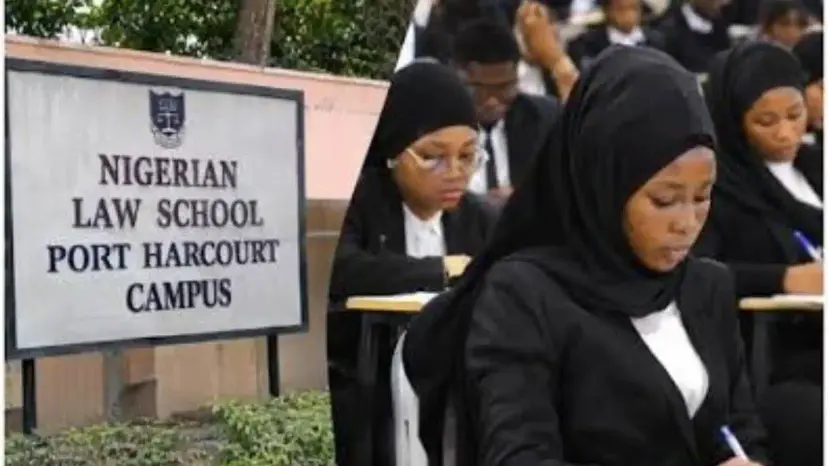
The Nigerian Law School has come under criticism following reports that some female Muslim candidates sitting the 2026 Bar Final Examinations were subjected to restrictions and harassment over their hijabs and modest clothing.
The controversy emerged on Saturday, October 31, 2026, as candidates began their examinations across various campuses of the institution.

Several Muslim candidates reportedly encountered difficulties gaining access to examination halls because they wore Islamic head coverings and long dresses, despite reports that the Law School had issued a circular permitting candidates to write their examinations while wearing hijab.
The development has raised questions about religious freedom, equal treatment and the consistent enforcement of examination regulations within an institution responsible for training Nigeria’s future legal practitioners.
FIRDAUSA AMASA REPORTS INCONSISTENT ENFORCEMENT
Barrister Firdausa Amasa, who previously made headlines after being denied participation in the 2017 Call to Bar ceremony because she refused to remove her hijab, has raised concerns about the latest incidents.

In an incident report dated October 31, Amasa disclosed that she visited five examination halls at the Nigerian Law School’s Bwari Campus to observe whether the institution’s directive permitting hijab was being respected.
She reported that candidates wearing hijab were allowed into four of the examination halls without any obstruction.
However, the situation was reportedly different at the Main Multipurpose Hall, where some female candidates were allegedly instructed to remove their hijabs and rearrange them like turbans before they could gain entry.
Amasa said she personally witnessed two female candidates crying at the entrance following the incident.

She described the treatment as unacceptable, particularly because the candidates were preparing to sit an important professional examination.
She consequently called on the Law School management to ensure that the directive permitting hijab was implemented consistently across all examination centres.
MUSLIM WOMEN ALSO FACE RESTRICTIONS OVER LONG DRESSES
The controversy reportedly extends beyond the wearing of hijab, with complaints that some Muslim candidates were also questioned about their long and modest dresses.
The Muslim Public Affairs Centre (MPAC) Nigeria disclosed that it had received complaints from candidates at the Bwari and Lagos campuses.

According to the organisation, some women wearing ankle-length dresses were allegedly stopped by examination officials and told that their outfits were too long.
Others were reportedly advised to wear shorter skirts or adjust their clothing before being allowed into examination halls.
MPAC’s Executive Chairman, Disu Kamor, questioned what it described as selective enforcement of dress regulations.
The organisation alleged that some candidates wearing shorter dresses or displaying long coloured nails were permitted to enter without facing similar scrutiny.
It also reported an incident in which a non-Muslim candidate allegedly intervened after witnessing the treatment of Muslim women.
The organisation called on the Law School authorities to investigate the complaints and ensure that no candidate suffers examination-related disadvantages because of religious attire.
MUSLIM ORGANISATIONS DEMAND INTERVENTION
The Muslim Public Affairs Centre and the Muslim Students’ Society of Nigeria, B-Zone, have condemned the reported treatment of Muslim female candidates.
Both organisations maintained that candidates should not be subjected to intimidation, humiliation or unnecessary restrictions because they choose to observe their religious beliefs.
They called on the Nigerian Law School management to issue clear instructions to examination supervisors and invigilators, ensuring that the approved hijab policy is respected across all campuses.

They also urged the Council of Legal Education, the Body of Benchers, the Nigerian Bar Association and other relevant authorities to intervene.
Among their demands are investigations into the reported incidents, appropriate action where misconduct is established and guarantees that affected candidates will not be academically disadvantaged.
WHAT DOES THE NIGERIAN LAW SCHOOL’S DRESS CODE SAY ABOUT HIJAB?
The controversy has also drawn attention to the Nigerian Law School’s own Code of Conduct for Students.
Part B, Rule 5, which addresses the dress code, expressly lists black shoulder-length hijabs and veils among the approved clothing for female students attending lectures and dinner functions.
However, the specific provisions concerning lectures and dinner do not automatically establish every requirement applicable to examination halls.

This makes it important for the institution to clarify whether separate examination-day instructions exist and how they relate to its general dress code.
The reported circular permitting candidates to sit their Bar examinations in hijab is also central to the dispute. Its precise wording and implementation need to be clearly communicated to examination personnel and candidates.
THE LEGAL POSITION ON RELIGIOUS FREEDOM
The dispute has renewed discussions about the constitutional protection of religious freedom in Nigeria.
Section 38 of the 1999 Constitution guarantees freedom of thought, conscience and religion, including the right to manifest and practise one’s religion.
Section 42 also protects citizens against discrimination on grounds including religion.

The Supreme Court addressed the issue of hijab in the case of Lagos State Government & Ors v. Asiyat Abdulkareem & Ors (SC/910/2016), delivered on June 17, 2022.
The judgment affirmed the constitutional protection of Muslim female students’ right to wear hijab in public schools.
Muslim rights organisations have relied on this decision in arguing that religious attire should not become a basis for discrimination or unfair treatment.
A RECURRING CONTROVERSY AT THE NIGERIAN LAW SCHOOL
The latest development has brought back memories of the 2017 controversy involving Firdausa Amasa.

At the time, she was prevented from participating in her Call to Bar ceremony because she insisted on wearing her hijab rather than removing it to comply with the prescribed courtroom attire.
The incident generated widespread public debate and attracted criticism from religious organisations and civil society groups.
In June 2018, the Body of Benchers reversed its earlier position, allowing Amasa to participate in a subsequent Call to Bar ceremony while wearing her hijab.
Against this background, the latest complaints have raised concerns about whether Muslim women continue to encounter unnecessary barriers when exercising their religious rights within the legal profession.
As of the latest reports, the Nigerian Law School had yet to issue an official response addressing the specific allegations surrounding the 2026 examinations.
The central concern remains whether candidates can participate in professional examinations without being forced to choose between their religious convictions and their academic or professional ambitions.




