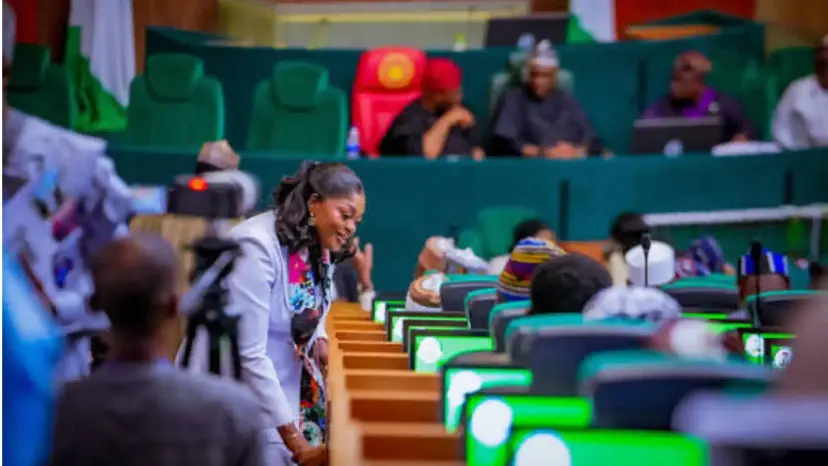
The National Assembly is considering a constitutional amendment that would create 74 additional legislative seats exclusively reserved for women as part of efforts to address their low representation in Nigeria’s political system.
The proposal, which is part of the ongoing review of the 1999 Constitution, is intended to give women greater access to political leadership and decision-making without removing or replacing existing elected lawmakers.
Senate Leader, Senator Opeyemi Bamidele, disclosed the development on Monday, November 2, 2026, while speaking at the 2026 Law Week organised by the International Federation of Women Lawyers (FIDA), Ekiti State Chapter.

Bamidele, who also serves as Vice Chairman of the Senate Committee on the Review of the 1999 Constitution, explained that the proposed arrangement followed consultations and discussions aimed at making Nigeria’s democratic institutions more inclusive.
HOW WILL THE 74 ADDITIONAL SEATS BE DISTRIBUTED?
Under the proposal, the Senate and House of Representatives would each receive 37 additional seats reserved exclusively for women.
This would bring the total number of proposed special seats in the National Assembly to 74.
The arrangement would ensure that every state, including the Federal Capital Territory, has one additional female representative in each chamber.
Beyond the federal legislature, the Constitution Review Committee has also proposed three additional seats for women in every State House of Assembly.

These positions would be created separately from existing constituencies, meaning that current lawmakers would not lose their seats as a result of the proposed arrangement.
WHY DOES THE NATIONAL ASSEMBLY WANT MORE WOMEN IN POLITICS?
The major reason behind the proposal is the persistent imbalance in women’s representation across Nigeria’s political institutions.
Although women make up a significant proportion of the country’s population, their participation in elective political positions remains relatively low.
Bamidele argued that a democratic system cannot adequately represent its citizens when a substantial portion of the population has limited access to legislative decision-making.
He described the proposed special seats as a constitutional intervention rather than a partisan political arrangement.

The Senate Leader also acknowledged the contributions of prominent advocates, including First Lady Senator Oluremi Tinubu, whose support has helped strengthen the National Assembly’s commitment to improving women’s political participation.
According to him, the initiative is designed to create more opportunities for women to contribute directly to lawmaking, governance and national development.
WILL THE ADDITIONAL SEATS BE PERMANENT?
The proposed arrangement is not intended to operate indefinitely.
According to Bamidele, the special seats would remain in place for 16 years, covering four electoral cycles, before undergoing a comprehensive review.
The proposed 16-year period is described as a sunset clause, intended to provide sufficient time to improve women’s participation and encourage a more inclusive political culture.
Following the review, the effectiveness and continued relevance of the arrangement would be assessed.

WHAT MUST HAPPEN BEFORE THE PROPOSAL BECOMES LAW?
The proposal has not yet become law. It is still undergoing consideration as part of the National Assembly’s constitutional amendment process.
Bamidele disclosed that the committee was engaging with State Houses of Assembly to secure the support required to complete the process.
Under Section 9 of the 1999 Constitution, a constitutional amendment generally requires approval by at least two-thirds of all members of the Senate and House of Representatives, alongside resolutions supporting the amendment from at least two-thirds of the State Houses of Assembly.
Consequently, the proposed special seats cannot be implemented until the necessary constitutional approval has been obtained.
SENATE LEADER ALSO CALLS FOR STRONGER PROTECTION OF WOMEN AND CHILDREN
Beyond political representation, Bamidele called for stronger legal and institutional measures to protect women and children from abuse, discrimination and other emerging threats.

He emphasised that victims of domestic violence and child abuse should have access to affordable legal assistance, medical treatment and psychological support.
He also maintained that justice must be accessible, timely and effective, with perpetrators held accountable in accordance with the law.
The FIDA Law Week, chaired by Ayobami Olowoyo-Richards, was organised under the theme, “Justice in a Changing World: Responding to New Challenges Affecting Women and Children.”
Other attendees included the Speaker of the Ekiti State House of Assembly, Adeoye Aribasoye, and the Chairman of the House of Representatives Committee on Information and National Orientation, Steve Fatoba.
If approved, the proposed constitutional amendment would introduce additional legislative representation for women at both federal and state levels, creating new opportunities for their participation in Nigeria’s political and governance processes.