

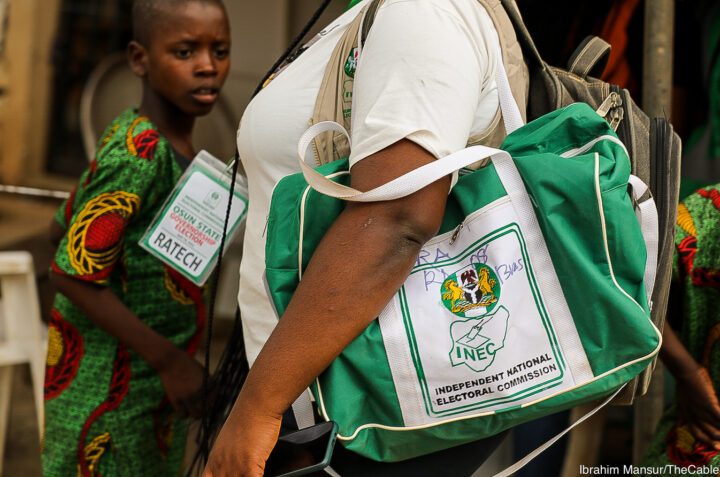
A political commentator, Nosa Osaikhuiwu, has argued that Nigeria’s electoral challenges go beyond the Independent National Electoral Commission (INEC), blaming the country’s political culture and the unwillingness of politicians and their supporters to accept electoral defeat.
In an opinion article published by TheCable on November 2, 2026, Osaikhuiwu said Nigerians have developed a tendency to attribute election losses to rigging, manipulation and conspiracies rather than examining their own political decisions and shortcomings.

He acknowledged that INEC, like every public institution, must remain accountable and that credible allegations of electoral malpractice should be investigated. However, he maintained that political parties should not automatically blame the electoral commission whenever they lose an election.
According to him, there is a difference between losing because an opponent performed better, losing because of poor political organisation and losing as a result of genuine electoral malpractice.
2023 ELECTION: OPPOSITION DIVISION CONTRIBUTED TO APC’S VICTORY
Reflecting on the 2023 presidential election, Osaikhuiwu argued that the division among opposition parties contributed to the electoral advantage enjoyed by the All Progressives Congress (APC).

He observed that several opposition parties fielded presidential candidates, splitting votes that might otherwise have strengthened a single challenger.
He suggested that a united opposition could have produced a different outcome, depending on voter preferences, turnout and the candidate presented.
Rather than adequately examining the consequences of their political divisions, he argued, opposition figures devoted much of their post-election criticism to allegations against INEC.
The writer stressed that political parties must take responsibility for their candidates, campaign strategies, grassroots structures and ability to mobilise voters.
Using football and academic examinations as examples, he said losing a match does not automatically mean the referee was biased, just as failing an examination does not always mean the teacher was responsible.

2027 ELECTION: OPPOSITION URGED TO BUILD A STRONG COALITION
With the 2027 general election approaching, Osaikhuiwu warned that opposition parties risk repeating the same mistakes if they continue to prioritise individual political ambitions over collective strategy.
He argued that dissatisfaction with the Tinubu administration, economic hardship, insecurity and public criticism of government policies would not automatically translate into electoral victory for opposition parties.
According to him, winning an election requires more than social media campaigns and public criticism of the ruling party.
He identified credible candidates, grassroots mobilisation, strategic alliances, effective organisation and the ability to bring supporters to polling stations as important factors in determining electoral success.

The writer urged opposition parties to set aside personal interests, build a credible coalition, agree on a broadly acceptable presidential candidate and present Nigerians with a convincing alternative to the APC.
APC ALSO HAS A RESPONSIBILITY TO NIGERIANS
Although critical of the opposition’s approach, Osaikhuiwu clarified that his argument should not be interpreted as an endorsement of the APC or President Bola Tinubu.
He maintained that electoral victory does not give the ruling party permission to govern without accountability.
According to him, the APC must fulfil its promises, address the country’s challenges and remain responsive to the concerns of Nigerians.

He argued that democratic responsibility extends beyond political parties that lose elections, adding that the ruling party must also demonstrate good governance and institutional accountability.
NIGERIANS MUST LEARN TO ACCEPT ELECTORAL OUTCOMES
Osaikhuiwu said Nigeria’s political challenges reflect a wider problem of demanding accountability from others while refusing to accept responsibility for personal actions.
He observed that citizens often demand fairness when disadvantaged but may abandon the same principles when circumstances favour them.
He therefore called for a political culture in which INEC performs its duties independently, the ruling party governs responsibly, opposition parties organise effectively and citizens demand accountability through lawful democratic channels.
The writer concluded that democracy should not be measured only by the ability to win elections but also by the willingness to accept defeat and learn from mistakes.
He maintained that losing an election should not be treated as a national tragedy, arguing that the greater problem is the refusal to examine the reasons behind electoral failure.