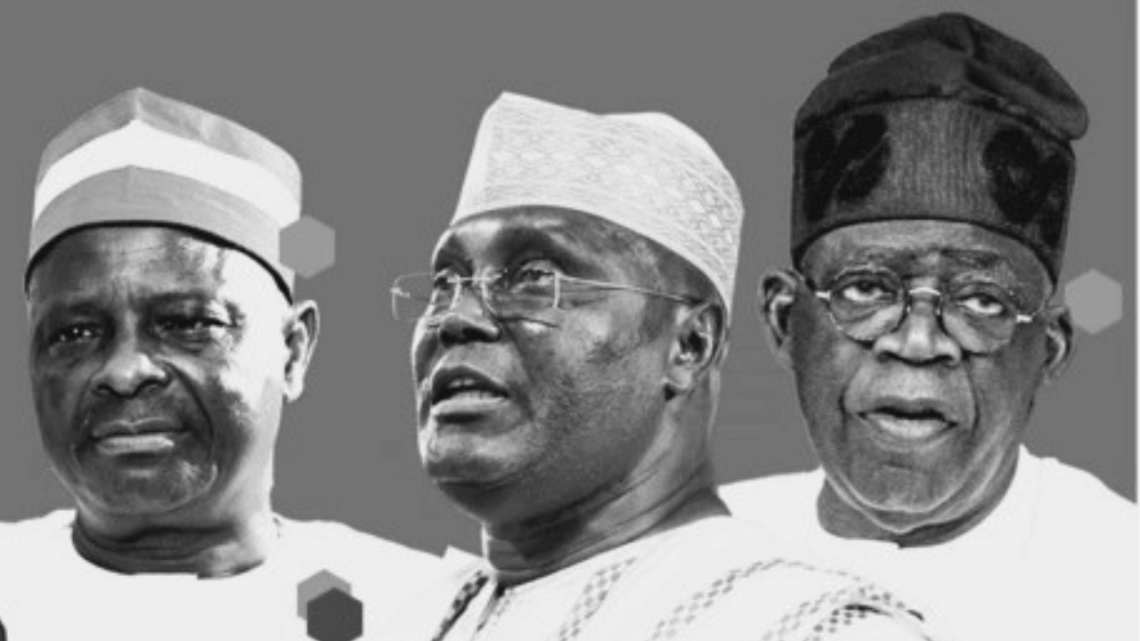
Nigeria’s 2027 presidential election campaigns are gathering momentum, with fresh disagreements emerging over electricity reforms, regional power-sharing, party leadership and campaign organisation.
Former Vice President Atiku Abubakar has criticised President Bola Tinubu’s handling of the electricity sector, while former Kano State Governor Rabiu Kwankwaso has urged him to withdraw from the presidential race and support Peter Obi.
The developments formed part of a series of political activities and controversies reported over the weekend as major political parties intensified preparations for the 2027 general elections.

ATIKU QUESTIONS TINUBU’S ELECTRICITY RECORD
The African Democratic Congress (ADC) presidential candidate, Atiku Abubakar, has challenged the All Progressives Congress (APC) over its defence of President Tinubu’s performance in the electricity sector.
The disagreement followed the APC’s response to criticism of Tinubu’s 2023 campaign promise to improve electricity supply and eliminate estimated billing.
In a statement issued by campaign spokesperson Dele Alake, the APC argued that the President’s electricity commitments should be assessed alongside his promise to explain any shortcomings before seeking another term.

The ruling party highlighted several interventions, including the Electricity Act 2023, metering initiatives, investments in electricity transmission, state-level regulatory reforms and a ₦4 trillion bond programme designed to settle verified outstanding debts in the power sector.
The APC also claimed that more than 1.5 million electricity customers had received meters under the current administration.
However, Atiku rejected the party’s explanation through Phrank Shaibu, Director of Strategic Communication of the ADC Presidential Campaign Council.
He accused the APC of celebrating administrative achievements while Nigerians continued to experience unreliable electricity supply and estimated billing.

Atiku also questioned the existing electricity tariff-band arrangement, under which consumers pay different rates depending on the expected duration of electricity supply.
He cited the Band A tariff, which he said stood at approximately ₦209.50 per kilowatt-hour before VAT, arguing that customers were sometimes charged premium rates despite receiving inconsistent electricity.
The former vice-president further expressed concern about the government’s reported intention to discontinue electricity subsidies from 2027, warning that the decision could increase the financial burden on households.
As an alternative, Atiku proposed working with state governments and regulatory authorities to introduce a pricing system that reflects the electricity actually supplied to consumers.
However, his campaign has yet to provide a detailed tariff formula, funding arrangement or financial assessment explaining how the proposed system would operate.

KWANKWASO ASKS ATIKU TO WITHDRAW FROM PRESIDENTIAL RACE
In another major political development, Rabiu Kwankwaso has questioned Atiku’s decision to seek the presidency in 2027.
Speaking to journalists in Kano on Sunday, the former governor urged Atiku to step aside and support Peter Obi, the presidential candidate of the Nigeria Democratic Congress (NDC).
Kwankwaso argued that Nigeria’s informal power-sharing arrangement between the North and South should be respected to maintain national unity.
According to him, the South has not completed its expected turn in the country’s political leadership rotation, making another northern presidential bid questionable.
He maintained that his decision to accept the NDC vice-presidential nomination was consistent with his position on regional power-sharing.
His remarks have introduced another potential challenge to efforts to unite opposition politicians ahead of the election.
Although zoning has influenced political negotiations in Nigeria, it is not a constitutional requirement. Atiku remains legally eligible to contest the presidency, subject to the relevant electoral provisions.
At the time of the report, neither Atiku nor the ADC had issued an official response to Kwankwaso’s latest remarks.

ATIKU’S CAMPAIGN FACES INTERNAL COMPLAINTS IN THE SOUTH-WEST
Meanwhile, concerns have emerged within the ADC over the organisation of Atiku’s presidential campaign, particularly the alleged sidelining of established party officials in the South-West.
A Sunday PUNCH investigation reported that some party leaders in the region were unhappy with the level of involvement given to them in campaign preparations.
The complaints were reportedly raised during a meeting with ADC National Secretary Rauf Aregbesola in Ibadan on September 4.
Following the concerns, Atiku reportedly held a virtual meeting with party officials and requested five nominees from each of the six South-West states for campaign appointments.

However, some members claimed that the consultations had not adequately addressed their grievances.
Adewole Ijaogbomo, chairman of ADC local government chairmen in Lagos State, alleged that recognised party officials were being excluded from important campaign activities.
Some local government chairmen who travelled to Abuja for a meeting on September 17 also reportedly complained about the absence of transport support.
Atiku’s campaign team, however, rejected claims that South-West officials had been deliberately excluded.
Phrank Shaibu explained that the campaign councils for the six states had not yet been formally inaugurated, making it inaccurate to suggest that members had been excluded from established councils.

He confirmed that the campaign had requested nominations during consultations but could not provide a complete record of submissions from all six states.
ADC South-West Chairman Akin Omole and Lagos State Chairman George Ashiru also dismissed suggestions that the party was experiencing a serious organisational crisis.
Shaibu subsequently reiterated that Atiku respected the party’s structures and was committed to working with its leadership and members across the country.
He maintained that building a successful campaign required cooperation among party officials, stakeholders and supporters.
However, the disagreement over campaign appointments and coordination remains an organisational issue the party will need to address as preparations intensify.
The ADC’s presidential campaign is expected to hold its launch in Sokoto on Wednesday, November 4, after the event was postponed from October 31.

SECURITY CONCERNS SURFACE AHEAD OF ADC CAMPAIGN LAUNCH
The preparations for the Sokoto campaign launch have also attracted attention following reports of alleged interference and a confrontation involving ADC governorship candidate Manir Dan’iya.
Atiku and former Sokoto State Governor Aminu Tambuwal condemned the reported incident and called for an investigation.
The Sokoto APC rejected allegations that the incident was politically motivated, while the police confirmed that investigations were ongoing.
The ADC has also faced a separate organisational challenge involving a faction associated with Nafiu Gombe, which announced a North-West campaign council on Saturday.
However, the announcement did not automatically alter the party leadership or the status of its recognised presidential candidate.
The developments have increased scrutiny of the party’s internal coordination and security arrangements ahead of its campaign activities.

COURT DECISIONS COMPLICATE PARTY NOMINATIONS
Legal disputes have also affected preparations for the 2027 elections in several states.
In Kano State, concerns emerged after the names of NDC governorship candidate Abdulsalam Gwarzo and his running mate, Rabiu Mustapha, were reportedly missing from the updated list published by the Independent National Electoral Commission (INEC).
A senior INEC official reportedly attributed the omission to a Federal High Court order issued on October 27.
According to the official, the commission had no objection to Gwarzo’s candidacy but was restrained from publishing the names following the court order.
The explanation differed from an earlier statement by the NDC, which had attributed the omission to a computer-related error.
The distinction is important because a court restriction on publishing candidates’ names does not necessarily amount to an outright rejection of their nominations.

In Cross River State, LEADERSHIP reported that Nkoyo Toyo and Magam Dino Ntui appeared on INEC’s updated list as the ADC’s governorship and deputy governorship candidates.
Another dispute has emerged within the APC in Zamfara State over the party’s senatorial primary for Zamfara North.
The disagreement followed a Federal High Court judgment nullifying the May primary, a decision subsequently upheld by the Court of Appeal.
A fresh primary was scheduled for Monday, November 2.
However, aspirant Sani Abdullahi Shinkafi expressed dissatisfaction with the arrangements, claiming that he only learnt about the timetable through social media.
He questioned the short notice, raised concerns about security arrangements and objected to the alleged involvement of former governor Bello Matawalle.
Shinkafi also referred to additional legal proceedings involving Senator Sahabi Ya’u.
The controversy has raised questions about the conduct of the fresh primary, the participation of aspirants and the role of INEC in monitoring the exercise.
CAMPAIGN VEHICLES AND POLITICAL DONATIONS
Political mobilisation continued across the country, with donations of vehicles and financial assistance forming part of activities supporting President Tinubu’s re-election bid.
In Osun State, the PBAT Door-to-Door Movement reportedly received 30 campaign vehicles donated by businessman Government Ekpemupolo, popularly known as Tompolo.
A similar donation of 30 vehicles had previously been reported in Imo State, bringing the total number of vehicles associated with the two reported donations to 60.
However, the purchase costs, ownership arrangements and relevant campaign-finance disclosures were not provided in the reports.
Other political initiatives involved financial assistance programmes and empowerment activities.
On October 29, First Lady Oluremi Tinubu announced support under the Renewed Hope Initiative for elderly citizens and persons with disabilities.
The programme reportedly allocated ₦110 million to each participating senatorial district, with APC senatorial candidates assigned coordination responsibilities.
The First Lady stated that beneficiaries should be selected without discrimination based on political affiliation.
The announced programme included two allocations of ₦55 million each. One component was expected to provide ₦200,000 to 500 beneficiaries, amounting to ₦100 million.
However, the published figures leave a difference of ₦10 million that requires further clarification.
In Kano State, the Leke Abejide Foundation announced a ₦600 million empowerment programme.
The initiative reportedly comprised ₦500 million in interest-free loans and ₦100 million in assistance for widows.
The programme was announced at an event associated with political mobilisation for Tinubu and APC candidates.
Kano State Governor Abba Kabir Yusuf reportedly pledged an additional ₦100 million during the gathering.
Organisers also discussed recruiting polling-unit coordinators from among the women participating in the programme.
The reports did not establish that the financial assistance was conditional on political support or that any electoral regulations had been violated.
POLITICAL DEFECTIONS CONTINUE IN JIGAWA
In Jigawa State, some members of the Peoples Democratic Party (PDP) and the Nigeria Democratic Congress reportedly defected to the APC during the inauguration of a grassroots campaign office supporting President Tinubu.
The event was led by Kashifu Inuwa Abdullahi, Director-General of the National Information Technology Development Agency (NITDA).
Some of the defectors reportedly cited development interventions associated with the agency as part of their reasons for joining the ruling party.
However, there was no established evidence that NITDA resources had been improperly used for political activities.
The development adds to the growing political realignments taking place ahead of the 2027 general elections.
POLITICAL PARTIES FACE GROWING PRESSURE AHEAD OF 2027
The latest developments highlight the challenges facing Nigeria’s major political parties as they prepare for the next presidential election.
While Atiku continues to challenge Tinubu’s economic and electricity policies, Kwankwaso’s call for him to step aside has exposed disagreements over regional power-sharing and opposition cooperation.
The ADC is also dealing with internal concerns over campaign appointments, party structures and security arrangements, while legal disputes continue to affect candidate nominations in some states.
At the same time, the APC and its supporters are expanding political mobilisation through endorsements, donations and empowerment initiatives.
With the 2027 election approaching, the ability of political parties to resolve internal disagreements, present credible policy alternatives and build effective campaign structures could play a significant role in determining the outcome of the contest.