

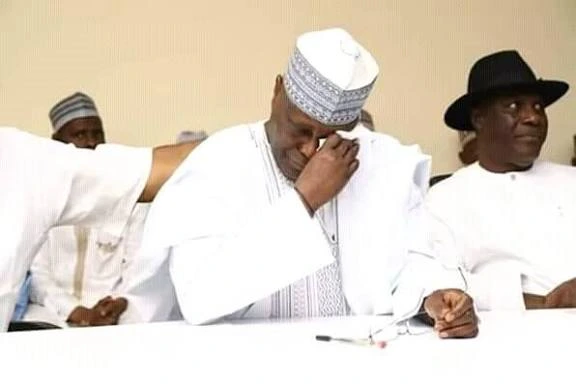
Court records reveal longstanding ADC leadership dispute as questions emerge over the coalition’s political and legal calculations.
ABUJA, NOVEMBER 5, 2026
Former Vice-President Atiku Abubakar has accused the ruling All Progressives Congress (APC) of attempting to frustrate his presidential ambition following Thursday’s Federal High Court judgment nullifying the David Mark-led leadership of the African Democratic Congress (ADC) and invalidating decisions taken under its authority.
In a statement issued through his campaign’s Director of Strategic Communication, Phrank Shaibu, Atiku described the judgment as a calculated attempt to undermine his political support, particularly in Northern Nigeria.
He linked the ruling to Wednesday’s ADC presidential campaign rally in Sokoto, suggesting that the turnout had alarmed the ruling party.
However, the accusation leaves several important questions unanswered.
Where is the evidence that the APC influenced Justice Peter Lifu’s judgment? How does the timing of a court decision establish political interference? And why did Atiku’s coalition adopt a party whose leadership was already the subject of litigation?

SOKOTO RALLY: POLITICAL MOBILISATION IS NOT AN ELECTORAL RESULT
Atiku argues that the Sokoto rally demonstrated the growing strength of his presidential campaign.
The event undoubtedly provided an opportunity to mobilise supporters and publicise his affordability agenda. However, rally attendance is not a substitute for verified voter support.
Nigeria’s presidential elections are decided through votes cast across the federation, subject to constitutional requirements concerning geographical spread.
A large gathering in Sokoto cannot establish electoral support in Lagos, Rivers, Oyo, Delta, Anambra or other states.

Nor does it demonstrate that attendees will necessarily vote for the candidate.
Atiku maintains that his political appeal extends beyond Northern Nigeria. That claim must ultimately be tested through electoral organisation, voter engagement and ballots across all six geopolitical zones.
His accusation that the APC panicked over the Sokoto gathering is therefore a political interpretation, not an established fact.
THE COURT DISPUTE DID NOT BEGIN AFTER SOKOTO
The strongest challenge to Atiku’s narrative is the litigation chronology.

The case was instituted in 2025 by Nafiu Bala Gombe, a former ADC National Deputy Chairman for the North-East, who challenged the leadership transition that produced David Mark and Rauf Aregbesola.
The dispute had already reached the Court of Appeal by March 2026.
In April, the Supreme Court set aside earlier preservation orders and directed expedited consideration of the substantive case.
These proceedings substantially predated Atiku’s November 4 rally.
The timing of Justice Lifu’s judgment may attract political comment, but it does not establish that the Sokoto event caused the ruling.

WHY DID THE COALITION ACCEPT THE LEADERSHIP RISK?
Atiku’s extensive political experience makes the coalition’s choice of platform an important question.
The ADC was already experiencing competing leadership claims when the opposition coalition adopted it.
Those disputes created foreseeable legal uncertainty concerning the authority of party officials, internal decisions and candidate nominations.
Atiku and his associates were entitled to choose the ADC. They must nevertheless confront the consequences of that decision.
Why was the existing leadership dispute not conclusively resolved before the coalition proceeded with its presidential nomination?
What legal assurances were obtained?

Were alternative platforms adequately considered?
The proposed All Democratic Alliance (ADA) was among the political associations seeking registration. Whether it could have become an available alternative depended on INEC registration and the applicable electoral timetable.
The existence of an alternative proposal does not prove that Atiku had an immediately usable registered party. It does, however, underline the importance of the coalition’s original strategic decision.
ATIKU’S ELECTORAL RECORD AND SOUTHERN SUPPORT
Atiku has contested several presidential elections without securing the presidency.
In 2023, he received 6,984,520 votes against President Tinubu’s 8,794,726 votes, according to INEC’s declared results.

His previous campaigns demonstrate substantial political experience, but also the importance of building support beyond established regional strongholds.
Atiku is correct that economic hardship affects Nigerians across geographical boundaries.
However, shared economic concerns do not automatically translate into votes for one candidate.
A national campaign must persuade voters through credible policies, organisation and demonstrable support across different regions.
The Sokoto turnout alone cannot answer those questions.

JUSTICE LIMAN’S EARLIER JUDGMENT
Atiku has also questioned Justice Lifu’s decision in light of Justice Musa Liman’s July 2, 2026 judgment concerning the ADC leadership.
He argues that the earlier ruling had already resolved the leadership controversy and that the subsequent decision improperly revisited the dispute.
This is a substantive legal objection.
However, the earlier case was brought by Leke Abejide, while the November judgment concerned Gombe’s asserted succession rights.
Whether the judgments conflict depends on their parties, issues, findings and operative orders.
That question belongs before the appellate courts.
An alleged conflict between judicial decisions does not, without further evidence, demonstrate interference by the APC.

THE RESPONSIBILITY OF POLITICAL LEADERS
Atiku has announced his intention to appeal and urged supporters to remain peaceful.
Those are appropriate steps within the constitutional process.
The ADC and its presidential candidate are entitled to challenge the judgment, seek lawful remedies and continue political engagement subject to applicable judicial orders.
But accusations of government manipulation should be supported by evidence.
The central issues remain the legality of the ADC leadership transition, the validity of decisions taken under that leadership and the relationship between the two Federal High Court judgments.
These matters cannot be resolved by campaign rhetoric or rally attendance.

The court dispute predates Sokoto. The legal questions remain unresolved on appeal. Allegations that the APC engineered the judgment require proof.
NATIONAL PATRIOTS POSITION
The National Patriots maintain that Atiku’s allegations of APC interference require credible evidence. The ADC leadership dispute predates the Sokoto rally, while crowd attendance cannot establish national electoral support. The opposition coalition must address its platform’s legal vulnerabilities through lawful appeals, respect judicial independence and avoid inflammatory accusations.
Princess Gloria Adebajo-Fraser, MFR
President, National Patriots
Member, APC-PCC Strategic Communications Team 2027




