


National Patriots forecasts a first-ballot victory for Tinubu, examining the importance of broad support, governance and effective electoral organisation
By Princess Gloria Adebajo-Fraser, MFR
Nigeria’s next presidential election will test the strength of political coalitions, the credibility of competing promises and the relationship between government decisions and citizens’ daily lives. It will also test something less visible than campaign crowds: whether political organisations can translate public support into participation across a sufficiently broad national map.

Enthusiastic supporters give a campaign energy. Geographical reach, public confidence and effective organisation give that support a pathway to electoral victory.
The contest will therefore involve several connected forces. Performance will influence persuasion. Persuasion will affect turnout. Organisation will determine how effectively parties engage supporters and document the votes they receive. National acceptance will determine whether those votes satisfy the constitutional requirements.
An assessment that isolates only one of these factors risks misunderstanding the election.
THE NATIONAL MAP MATTERS
Nigeria’s presidential system requires support beyond a narrow geographical stronghold.
Under Section 134 of the Constitution, where more than two candidates contest, victory requires the highest national vote total together with the prescribed geographical spread. An overwhelming result in a limited number of places cannot substitute for that wider requirement.
National competitiveness consequently involves both depth and breadth: substantial support where a candidate is strongest and meaningful acceptance elsewhere.
This explains why campaign visibility and electoral strength can differ. A candidate may dominate public discussion while remaining unevenly represented across the country. Another may attract less attention in particular media spaces while maintaining extensive local networks.
Credible analysis must examine the national picture alongside individual strongholds.
THE LESSON OF 2023
INEC’s official results recorded 8,794,726 votes for Bola Tinubu, 6,984,520 for Atiku Abubakar and 6,101,533 for Peter Obi in the 2023 presidential election. Each commanded substantial electoral support.

Those results provide a historical baseline. They do not permanently allocate voters to candidates.
Some citizens will remain loyal. Others will reconsider their choices. New voters, returning participants, changing alliances and differences in turnout can alter the balance.
Previous results deserve careful study, but communities should never be treated as the political property of any individual or party.
TINUBU’S POSITION: GOVERNANCE, EXPERIENCE AND NATIONAL ORGANISATION
President Tinubu approaches the contest with the platform of office, an established governing party and a record that voters can examine.
These provide important political opportunities. An incumbent can point to decisions taken, projects implemented and programmes introduced. He can explain the purpose of difficult reforms and present the next stages of implementation.
For Tinubu, the argument for continuity rests on connecting the reforms already undertaken with their intended long-term benefits and the practical work required to extend those benefits.
That explanation must reach beyond policy language. Citizens assess government through prices, income, employment, security, electricity and essential services.
The strongest case for another term will therefore combine evidence of progress with a credible programme for completing unfinished work and improving living conditions.
THE OPPOSITION’S TEST: PRESENTING A COHERENT ALTERNATIVE
Opposition candidates can attract citizens dissatisfied with current conditions. However, dissatisfaction does not automatically produce agreement on an alternative government.
Voters may share concerns while preferring different candidates, policies or alliances. Bringing those preferences together requires negotiation, organisational discipline and a convincing account of how the country would be governed.

For Atiku, Obi and other contenders, the questions extend beyond the enthusiasm of their existing followers. Can they broaden acceptance, sustain coherent organisations and explain the costs and practical consequences of their proposals?
A durable coalition needs sufficient common purpose to survive disagreements over leadership and policy priorities.
An electoral alliance becomes more persuasive when citizens understand both what its members oppose and what they intend to build together.
WHY ORGANISATION COUNTS
Effective political organisation is developed through sustained engagement, reliable communication and competent representation.
It includes trained polling agents, accurate record keeping, clear reporting procedures and the ability to pursue complaints through lawful channels.
Governors, legislators and local party leaders can contribute networks, visibility and organisational experience. Their endorsements matter politically, but their influence still has to be expressed through voter participation.
Party structures are most valuable when they connect leadership with communities, communicate policies clearly and sustain engagement beyond major campaign events.
Campaign finance can support lawful communication and logistics. Public institutions, electoral officials and security agencies retain their responsibilities to all citizens throughout the contest.
IDENTITY INFLUENCES POLITICS, BUT VOTERS MAKE CHOICES
Ethnicity, religion and regional attachment can influence political preferences. They do not explain every voter’s decision.
Within every community, citizens have different experiences, priorities and assessments of leadership. Economic interests, security concerns, credibility and expectations about the future intersect with identity in different ways.
Responsible analysis recognises these influences while respecting voters’ independence.
The claim to national leadership becomes stronger when citizens from different backgrounds can recognise their interests in a candidate’s programme.
NATIONAL PATRIOTS FORECASTS A FIRST-BALLOT VICTORY
National Patriots forecasts that President Tinubu will secure the highest national vote total and the required geographical spread on the first ballot, making a runoff unnecessary.
Our assessment places weight on the combination of his governing record, established political relationships, the APC’s organisational reach and the argument for continuity in implementing reforms.
Within this forecast, the decisive consideration is the capacity to sustain support across a broad national map. Strong performances in established areas of support, combined with competitive results elsewhere, can provide the combination of votes and geographical spread required for victory.
We therefore do not share the projection that the election will necessarily proceed to a second ballot. Our forecast is a first-ballot victory for President Tinubu.
This is National Patriots’ political assessment. The electoral outcome will ultimately be established by ballots lawfully cast, counted and declared.
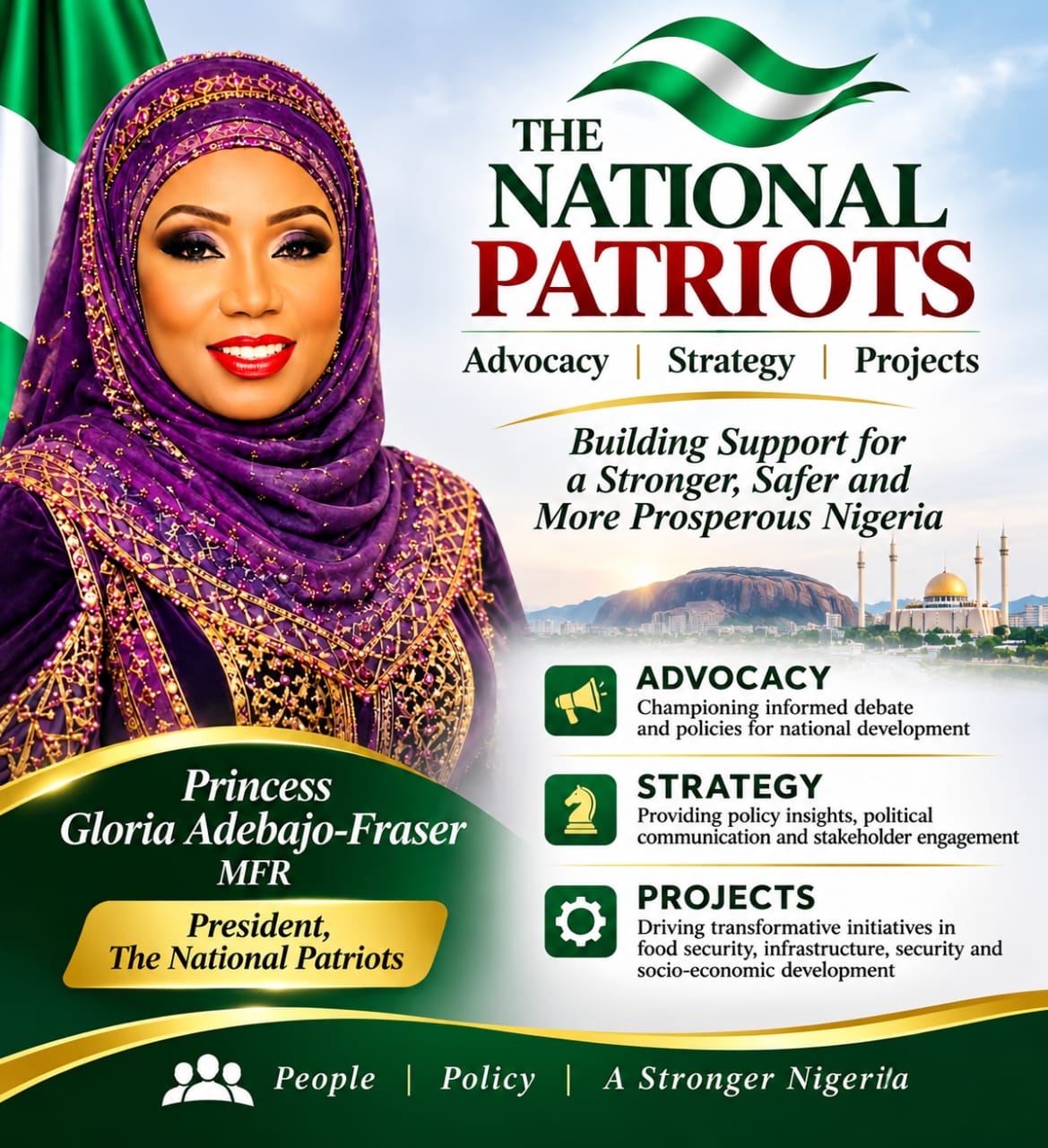
THE NATIONAL PATRIOTS POSITION
National Patriots believes the case for President Tinubu’s continuity should rest on a clearly explained record, demonstrable progress and a credible pathway towards improved living conditions.
Political structures matter, and their strength is best expressed through informed participation, constructive engagement and lawful conduct.
Campaign communication should explain policies in accessible language, answer legitimate questions and respect citizens’ freedom to choose. Electoral institutions should administer the process impartially, while parties prepare to scrutinise it responsibly.
The Latin expression Facta, non verba—“Deeds, not words”—provides a useful standard. Performance and practical plans give substance to the promises placed before the electorate.
For National Patriots, the task ahead is to explain the achievements, acknowledge the unfinished work and present the reasons continuity can advance Nigeria’s development.
Our forecast is clear: President Tinubu wins on the first ballot. The enduring responsibility is equally clear—to earn public confidence through performance, communicate with evidence and uphold the integrity of every lawful vote.
Princess Gloria Adebajo-Fraser, MFR, MIoD, FIPMD.
President, National Patriots
Member, APC-PCC Strategic Communications Team 2027



