

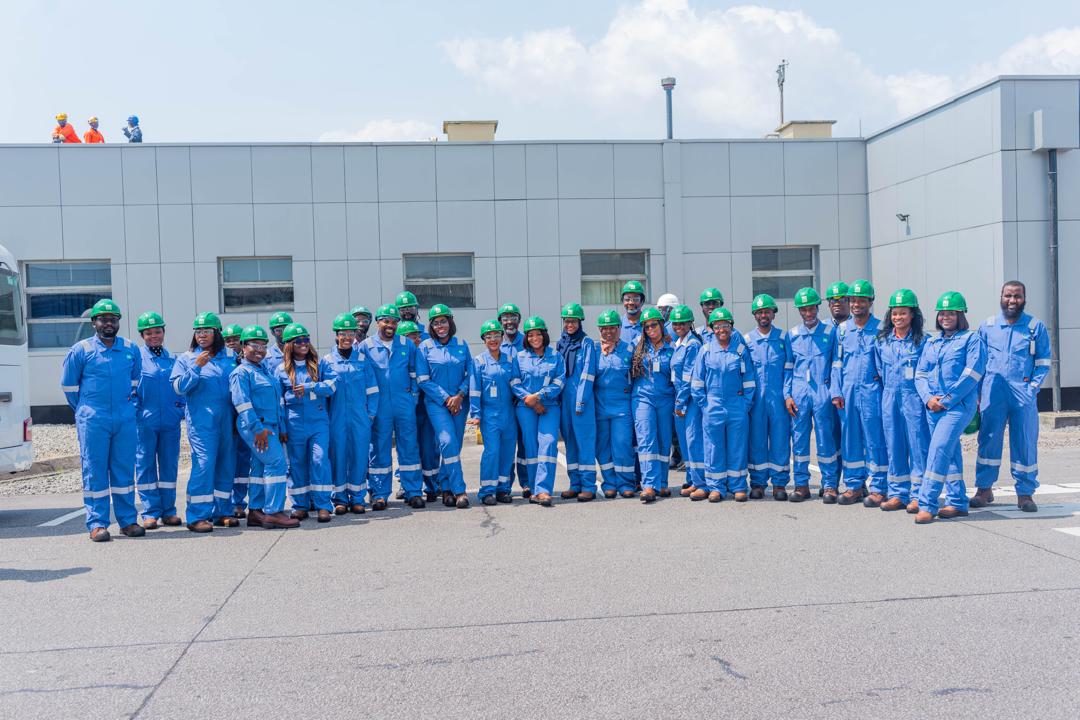
Nigeria LNG Limited (NLNG) has hosted 34 young professionals from across the country’s oil and gas industry at its facility on Bonny Island, Rivers State, as part of efforts to strengthen technical capacity and prepare the next generation of industry leaders.
The visit was organised under the Federal Government’s Decade of Gas Capability Building Programme to give participants practical exposure to gas processing, liquefaction, storage and export operations.

The delegation toured NLNG’s operational Trains 1 to 6 and the ongoing Train 7 expansion project, providing an opportunity to understand the processes involved in producing and exporting liquefied natural gas.
The group was led by the Coordinating Director of the Decade of Gas Secretariat, Ed Ubong, and received by NLNG’s Managing Director and Chief Executive Officer, Adeleye Falade, alongside members of the company’s management team.
Speaking during the visit, Ubong said the initiative was designed to equip young professionals with the practical knowledge and technical competence needed to support Nigeria’s ambition of developing a gas-powered economy by 2030.

He stressed that classroom training alone could not adequately prepare future industry leaders, noting that direct exposure to major gas operations was essential.
According to him, the programme seeks to build confidence and competence among participants by allowing them to understand how natural gas is processed, liquefied, stored and exported.
Ubong described NLNG as an example of Nigeria’s potential in gas development, adding that participants would return to their respective organisations with valuable industry experience.
He also disclosed that the programme aims to train more than 150 professionals by 2030. The target group includes engineers, geoscientists, commercial analysts and policymakers expected to contribute to gas-based industries, power generation, liquefied petroleum gas (LPG) penetration, compressed natural gas (CNG) adoption and gas-to-chemicals projects.
He explained that capacity building is one of the seven strategic pillars of the Decade of Gas Programme, which seeks to develop the skilled workforce required to transform Nigeria’s gas resources into economic growth and industrial development.
In his welcome address, Falade said NLNG was pleased to receive the participants, describing human capital development as critical to the sustainability of Nigeria’s gas industry and its broader energy ambitions.
He noted that the company’s operations, including the successful running of Trains 1 to 6 and the ongoing Train 7 expansion, demonstrated Nigeria’s ability to execute complex industrial projects through innovation, partnerships and commitment to excellence.
Falade encouraged the participants to see themselves as future leaders who would strengthen Nigeria’s position in the global gas industry.
He also urged them to maintain high standards of safety, environmental sustainability and local content throughout their careers.
The NLNG chief executive said the decisions made by the next generation of professionals over the coming decade would play an important role in determining how effectively Nigeria utilises its estimated reserves of more than 200 trillion cubic feet of natural gas.
He identified power generation, industrial development, employment creation and national prosperity as some of the areas that could benefit from better utilisation of the country’s gas resources.
The programme featured technical sessions covering LNG production processes, plant integrity, health, safety and environment, shipping and export logistics. Participants also interacted with NLNG engineers and management personnel.
Some members of the delegation described the experience as enlightening, particularly for those visiting an LNG liquefaction plant for the first time.
Speaking on behalf of the participants, one of them said the tour had broadened her understanding of the gas value chain, especially the technical operations behind the production and export of LNG.
She described the opportunity to tour Trains 1 to 6 and learn about the Train 7 expansion project as a career-defining experience.
The Decade of Gas Programme is aimed at positioning natural gas as a major driver of Nigeria’s energy transition, economic diversification and industrial growth.
The Secretariat disclosed that the Bonny Island visit was one of several practical learning engagements planned for the participating professionals. Future engagements will include exposure to industry regulators, upstream producers and gas infrastructure companies.