

By Princess Gloria Adebajo-Fraser, MFR
Governance & Perception Management Consultant, Strategist & Researcher.
Nigeria’s democratic evolution continues to present recurring lessons—none more important than the centrality of structure, legality, and institutional discipline in the pursuit of political power.
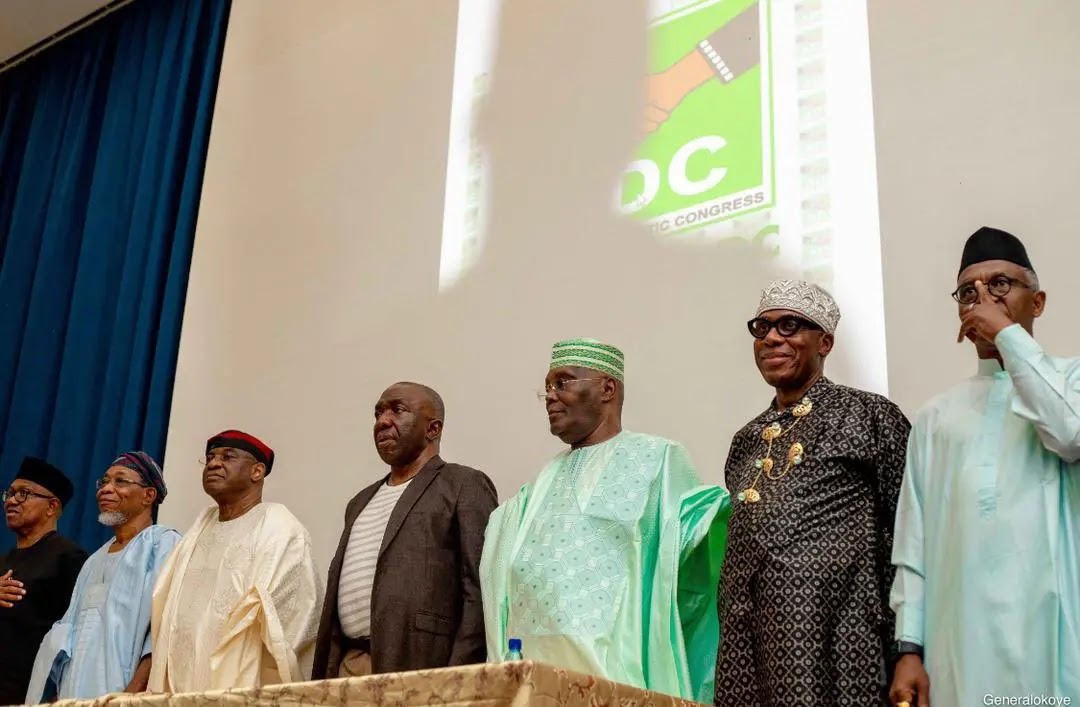
The current situation surrounding the African Democratic Congress (ADC), particularly its internal disputes and regulatory challenges, provides a timely opportunity to reflect on the difference between political aspiration and political capacity.

Founded in 2005 and formally registered in 2006, ADC emerged with a clear ideological positioning as a reform-driven alternative to Nigeria’s dominant political parties. It sought to appeal to citizens disenchanted with entrenched political practices, promising a new direction anchored on inclusivity, youth participation, and a departure from elite-driven politics.
Over time, the party gained modest visibility, particularly during periods of political realignment when segments of the political class explored alternative platforms.
One of its most notable moments came in 2018 when a prominent national coalition adopted it as a vehicle for broader political engagement.
That development temporarily elevated ADC’s profile, projecting it as a potential rallying point for a “third force.”
However, political visibility is not synonymous with electoral viability.
Electoral Performance: The Hard Data
Nigeria’s electoral system is one of the most demanding in Africa, requiring not just national presence but deep, coordinated structures at the ward, local government, and state levels.
Electoral success is determined by sustained grassroots mobilisation, financial capacity, party cohesion, and legal stability.
Measured against these criteria, ADC’s performance has remained modest.
In the 2019 presidential election, the party’s candidate secured fewer than 100,000 votes nationwide—placing it far behind the leading contenders.
While the party succeeded in winning a small number of seats in the House of Representatives, this represented only a marginal presence within a 360-member legislative body.
By the 2023 general elections, the party’s electoral standing had further declined.
Its presidential candidate polled just over 80,000 votes, and significantly, the party failed to secure representation in both the Senate and the House of Representatives.
These figures are not merely statistics; they reflect structural limitations.
Across multiple election cycles, ADC has demonstrated the ability to participate—but not to compete at scale.
National Spread Versus Electoral Penetration
ADC maintains a nationwide presence in terms of registration and candidate nomination.
It has positioned itself as a party with national reach and ideological clarity. However, the true measure of a political party is not its geographical listing, but its electoral conversion.
On this metric, ADC has struggled.
A party may exist in all states, but without the capacity to mobilise voters effectively, protect its votes, and sustain political engagement between election cycles, that presence remains largely symbolic.
This distinction—between presence and penetration—is where ADC’s limitations become most evident.

Internal Dynamics and Questions of Legitimacy
Beyond electoral performance, ADC has faced recurring internal disputes relating to leadership, control, and founding authority.
Such conflicts are not unique in Nigerian politics, but their persistence within a relatively small party raises deeper concerns about institutional stability.
Political parties function as vehicles of collective organisation.
When internal cohesion is weakened, the ability to coordinate national campaigns, conduct credible primaries, and maintain discipline across structures is compromised.
More importantly, internal disputes often spill into the legal arena, inviting regulatory scrutiny and judicial intervention. In such circumstances, the legitimacy of party actions—including conventions, leadership changes, and candidate nominations—can become contested.
This creates uncertainty not only for party members but also for prospective candidates and voters.
INEC’s Regulatory Framework and Historical Precedent
The Independent National Electoral Commission (INEC), as the constitutional regulator of political parties, is vested with significant powers to ensure compliance with legal and electoral standards.
Nigeria has previously witnessed decisive regulatory action.
In 2020, INEC deregistered 74 political parties for failing to meet constitutional thresholds relating to electoral performance. This action was subsequently upheld by the courts, reinforcing the Commission’s authority to enforce compliance.
The implication is clear: political parties operate within a regulated framework, and adherence to that framework is not optional.
Any party navigating internal disputes or legal challenges must exercise caution, particularly when undertaking major institutional activities such as national conventions. Actions taken in defiance of regulatory guidance or under conditions of legal uncertainty risk invalidation and potential sanctions.
Comparative Perspective: How Viable Platforms Emerge
Nigeria’s major political parties did not achieve national dominance by accident. They were built through deliberate processes—mergers, regional consolidation, sustained grassroots engagement, and years of organisational development.
The formation of dominant platforms in Nigeria’s Fourth Republic reflects a clear pattern: successful parties are those that combine ideology with structure, ambition with discipline, and visibility with operational capacity.
They are not improvised vehicles; they are engineered institutions.
In contrast, smaller parties often struggle to transition from advocacy platforms to electoral machines. They may attract attention during periods of political dissatisfaction, but without deep structural foundations, they rarely sustain momentum.
ADC’s trajectory fits this pattern.

The Strategic Miscalculation
The decision by some political actors to consider ADC as a platform for national electoral ambition reflects a broader misjudgment—confusing moral appeal with political strength.
ADC’s messaging resonates with a segment of the electorate seeking alternatives. Its reformist posture and outsider narrative offer a degree of credibility in public discourse.
However, elections in Nigeria are not determined by sentiment alone.
They require:
Extensive grassroots networks,
Strong financial and logistical capacity,
Cohesive leadership structures,
Legal clarity and institutional stability.
ADC has not consistently demonstrated these attributes at the scale required for national victory.
At its peak, it secured only a handful of legislative seats.
In its most recent outing, it secured none.
Its presidential vote share has remained marginal.
Its internal structure has been contested.
These realities suggest that the party, while relevant in discourse, has not evolved into a competitive national platform.

A Moment for Reflection
The current challenges facing ADC should not be viewed solely as a party-specific issue.
They offer broader lessons for Nigeria’s political class.
First, political ambition must be grounded in structural reality. Aspirations for national leadership require platforms capable of sustaining nationwide mobilisation and governance.
Second, institutional discipline matters.
Political parties must operate within the framework of the law, respecting regulatory guidance and judicial processes.
Third, strategic choices have consequences.
The selection of a political platform is not a symbolic act; it is a foundational decision that determines the trajectory of any political project.

Conclusion: Structure Over Sentiment
ADC remains part of Nigeria’s democratic landscape. It contributes to political plurality and offers an alternative voice within the system. However, based on its historical performance, structural capacity, and current challenges, it has not demonstrated the attributes required to serve as a viable vehicle for winning national power.
The lesson is neither partisan nor personal—it is structural.
In Nigeria’s democracy, elections are not won by rhetoric, visibility, or temporary coalitions.
They are won by organisation, discipline, and institutional strength.
Structure defeats sentiment. Always.
The National Patriots Reaction.
The National Patriots emphasise that nation-building requires discipline, foresight, and respect for institutional frameworks.
Political platforms are not mere vehicles of convenience; they are the foundation upon which governance is built. The unfolding situation within ADC highlights the consequences of misjudgment and lack of strategic clarity.
A party facing internal disputes, legal uncertainty, and limited electoral strength cannot credibly support a national leadership project.
Nigeria’s democratic process demands that political actors align ambition with structure and legality. Attempts to bypass these fundamentals risk undermining both the party and the broader system. The lesson is clear: strong nations are built on strong institutions, and strong institutions require order, transparency, and compliance with the rule of law. Political leaders must therefore prioritise stability over experimentation and credibility over convenience in their pursuit of national service.
Princess Gloria Adebajo-Fraser MFR.
President, the National Patriots.




