Terrorist groups operating in northern Nigeria are expected to face further airstrikes following Thursday night’s joint military operation conducted by Nigeria and the United States in parts of Sokoto State.
Officials from both countries confirmed that the coordinated strikes are ongoing, with a Nigerian security source describing Thursday’s operation as a preliminary or “test run.”
According to The New York Times, a U.S. military official disclosed that roughly a dozen Tomahawk cruise missiles were used in the operation, which targeted locations near the Niger Republic border. The affected areas are believed to host Islamic State–Sahel fighters who have been responsible for attacks on both civilians and security forces.
Nigeria’s Minister of Information, Mohammed Idris, however, placed the number of missiles fired at sixteen. In a detailed briefing, he explained that debris from the missiles caused explosions in Offa, Kwara State, and in Jabo, Tambuwal Local Government Area of Sokoto State, on Thursday night
 The Tomahawk cruise missile is a long-range, precision-guided, subsonic weapon deployed by the U.S. Navy and its allies. It can be launched from ships or submarines, travels at low altitude to evade radar, and has a range exceeding 1,600 kilometres, often carrying a 1,000-pound warhead.
Footage released by the Pentagon showed at least one missile being launched from a naval vessel. A U.S. defence official confirmed that the strikes targeted known ISIS camps and multiple militants. The U.S. Africa Command (AFRICOM) later stated that its preliminary assessment indicated that several ISIS fighters were killed.
The Chairman of Tangaza Local Government Area, Isa Saleh Bashir, said while the exact number of casualties could not yet be confirmed, the terrorists were “certainly injured.” He added that patrols from Niger Republic reportedly observed Lakurawa fighters fleeing the area following the strike.

Smoke was still visible yesterday afternoon at one of the impact sites in Tangaza LGA. U.S. officials commended Nigeria for its cooperation and intelligence support during the operation.
Residents of Tambuwal and Tangaza LGAs described scenes of panic as missiles struck their surroundings. Witnesses said the sky turned red before loud explosions shook their communities.
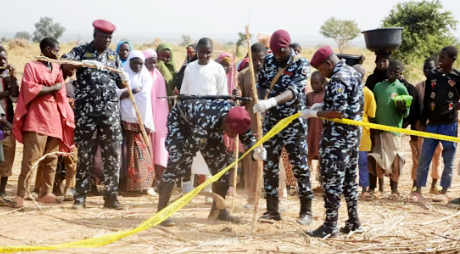
Police bomb disposal experts later cordoned off the affected area in Jabo, Tambuwal LGA, for safety and investigation.
Shortly after the strikes, U.S. Defence Secretary Pete Hegseth posted on social media, stating that ISIS had “found out” on Christmas night, while expressing gratitude for Nigeria’s support and cooperation. AFRICOM Commander, General Dagvin Anderson, also acknowledged Nigeria’s role, emphasizing strengthened counterterrorism collaboration to protect civilian lives.

Bauni Forest Was the Main Target — Information Minister
Minister Idris disclosed that the main targets were two major ISIS enclaves within the Bauni Forest axis of Tangaza LGA. He said intelligence confirmed the locations were being used by foreign ISIS fighters infiltrating Nigeria from the Sahel, in collaboration with local affiliates, to plan large-scale attacks.
The operation, conducted between 12:12 a.m. and 1:30 a.m. on Friday, December 26, 2025, was approved by President Bola Ahmed Tinubu. It was executed under Nigeria’s established command structures, involving the Armed Forces of Nigeria and supervised by the Ministers of Defence and Foreign Affairs, alongside the Chief of Defence Staff.

According to Idris, the strikes were launched from maritime platforms in the Gulf of Guinea after extensive intelligence gathering and reconnaissance. Sixteen GPS-guided precision munitions were deployed using MQ-9 Reaper unmanned aerial systems, successfully neutralising the targeted terrorist elements.
He confirmed that falling debris landed in Jabo, Sokoto State, and Offa, Kwara State, but stressed that no civilian casualties were recorded and the affected areas were promptly secured.
The Federal Government reiterated its commitment to eliminating transnational terrorist threats and assured Nigerians of its control over the nation’s security architecture.
How Nigeria and the U.S. Coordinated — Tuggar
Foreign Affairs Minister Yusuf Tuggar explained that the strike was a jointly agreed operation initiated by Nigeria. He revealed that Nigeria provided the intelligence and that he held discussions with U.S. Secretary of State Marco Rubio before and shortly before the strike, following presidential approval.

Tuggar emphasized that the operation was not religiously motivated and reaffirmed Nigeria’s commitment to protecting all citizens, regardless of faith, through international partnerships.
In a separate statement, the Ministry of Foreign Affairs confirmed Nigeria’s continued structured security cooperation with global partners, including intelligence sharing and strategic coordination, in line with international law and respect for sovereignty.
Military Confirms Joint Precision Operation
The Defence Headquarters stated that the Armed Forces of Nigeria, working with the United States, carried out precision strikes against ISIS-linked foreign elements in North West Nigeria. Major General Samaila Uba said the operation was based on credible intelligence and designed to minimise civilian harm.

Local Authorities React
Tangaza LGA Chairman Isa Salihu confirmed that the missiles struck known terrorist hideouts along routes frequently used by fighters crossing from Niger Republic. While assessments are ongoing, he said the strike caused panic among nearby communities.
The BBC reported that another strike occurred in a field in Jabo town, though no casualties were recorded. Traditional ruler Alhaji Abubakar Jabo warned residents against collecting metal fragments from the site.
In Offa, Kwara State, missile debris damaged buildings in the Yidi and Adeleke areas, including a hotel structure, though no lives were lost.
Sokoto State Government Welcomes Collaboration
The Sokoto State Government described the joint operation as a welcome development, supporting any global partnership aimed at curbing terrorism and cross-border crimes. Officials confirmed that no civilian deaths were reported, while assessments of the operation’s full impact remain ongoing.