

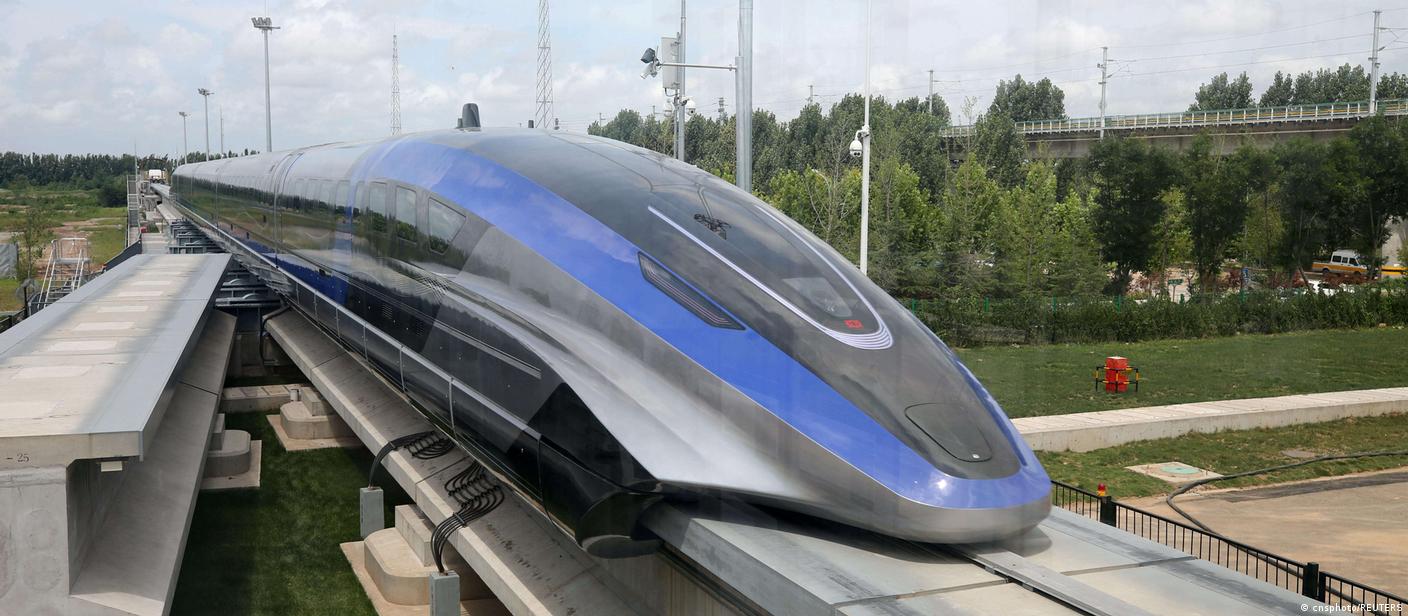
For years, the concept of a floating train seemed like science fiction—a train without wheels, gliding above the track at airplane speeds using magnetic forces instead of engines. China has now turned that vision into reality with its advanced maglev (magnetic levitation) trains, redefining high-speed rail in the 21st century. By floating above tracks, these trains eliminate friction, reduce noise, and reach extreme speeds.

China’s maglev system includes the operational Shanghai Maglev, launched in 2004, which connects Shanghai Pudong International Airport to the city at speeds of up to 431 km/h (268 mph), making it the world’s fastest commercially operating maglev. New prototypes developed by state-backed institutions are designed to reach 600 km/h (373 mph), bridging the gap between traditional high-speed rail and commercial aviation.
Maglev trains operate using powerful electromagnets. The train is first lifted slightly above the guideway, removing wheel-rail contact, and then propelled forward by alternating magnetic fields. With minimal friction, the main resistance becomes air drag, enabling sustained high-speed travel with less vibration, wear, and maintenance than conventional trains.

Engineering these trains involves advanced electromagnetic suspension, lightweight aerodynamic bodies, precision tracks, and sophisticated digital control systems. At ultra-high speeds, aerodynamic design is crucial, with train noses and bodies shaped to minimize drag and turbulence—similar to aircraft engineering.

China’s investment in maglev technology aims to enhance long-distance rail efficiency. Maglev offers faster city-to-city travel than conventional rail, while being more environmentally efficient and accessible than short-haul flights, potentially easing airport congestion.
Challenges remain, including high infrastructure costs, dedicated track requirements, and significant energy demands. Large-scale deployment depends on economic feasibility, passenger demand, and government support.

China’s floating train demonstrates that ultra-fast, frictionless rail travel is no longer science fiction but a real, evolving transportation system. If scaled effectively, maglev could transform intercity travel, shorten economic distances, and reshape national mobility, showcasing the future of high-speed rail.




