

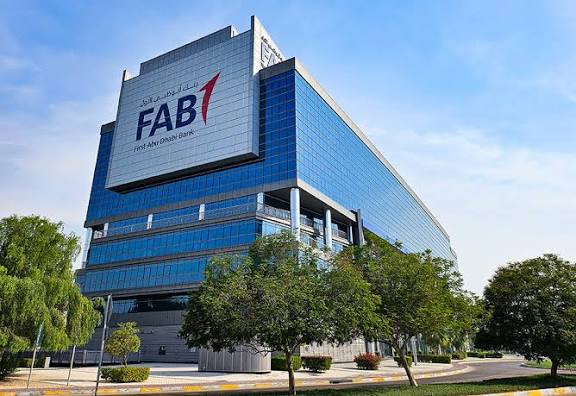
The First Abu Dhabi Bank (FAB) is set to establish a Nigerian branch, marking a significant milestone in the deepening economic and financial partnership between Nigeria and the United Arab Emirates under the administration of President Bola Ahmed Tinubu.
The planned entry of FAB—one of the Middle East’s largest and most capitalised banks—signals growing international confidence in Nigeria’s reform trajectory and its position as West Africa’s largest economy.
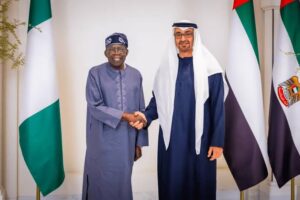
Industry analysts say the move reflects renewed investor optimism following Nigeria’s macroeconomic reforms, including exchange-rate liberalisation, fiscal restructuring, and efforts to improve the ease of doing business.
Strategic Financial Implications.
FAB’s Nigeria branch is expected to focus on corporate banking, trade finance, project financing, and structured investments—areas critical to Nigeria’s infrastructure, energy, aviation, agriculture, and manufacturing sectors. Its presence could unlock new funding channels for large-scale projects, particularly those requiring long-term capital and cross-border financing.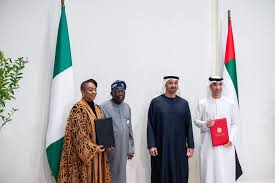
For Nigeria, this represents more than a new banking licence.
It strengthens access to Gulf-based liquidity and positions the country as a preferred African gateway for UAE capital flows.
For the UAE, Nigeria offers scale, market depth, and strategic reach across the ECOWAS region.
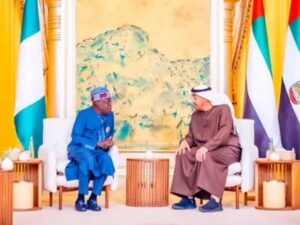
Comparatively, UAE banks have historically prioritised markets such as Egypt, Morocco, and South Africa—economies with clearer FX regimes and stable capital markets.
FAB’s decision to enter Nigeria now suggests that recent reforms are narrowing that gap and making Nigeria competitive once again for tier-one global financial institutions.
Unlike earlier foreign bank entries that focused primarily on retail banking, FAB’s model aligns with Nigeria’s current needs: deep capital, trade facilitation, and investment banking expertise.
This mirrors the UAE’s own development pathway, where strong banking institutions underpinned rapid infrastructure expansion and private-sector growth.

Tinubu’s Economic Diplomacy.
The development aligns with President Tinubu’s broader economic diplomacy strategy, which has prioritised stronger engagement with the Gulf states. Nigeria–UAE relations have expanded beyond aviation and real estate to include energy, logistics, agriculture, digital economy, and now financial services.
Government officials note that the FAB expansion complements ongoing bilateral initiatives aimed at boosting non-oil trade, attracting foreign direct investment, and integrating Nigeria more firmly into global financial networks.

What It Means Going Forward.
If effectively implemented, FAB’s Nigerian operations could enhance competition in the banking sector, improve access to dollar-denominated trade finance, and reduce financing bottlenecks for major projects.
It also sends a clear signal to other global financial institutions watching Nigeria’s reform process.
As Nigeria seeks sustainable growth and capital inflows, the planned entry of First Abu Dhabi Bank stands as a concrete outcome of strengthened Nigeria–UAE relations—demonstrating that economic diplomacy, when matched with credible reforms, can translate into real investment where it matters most.
Dr. G. Fraser. MFR
Headlinenews.news Special report.




