


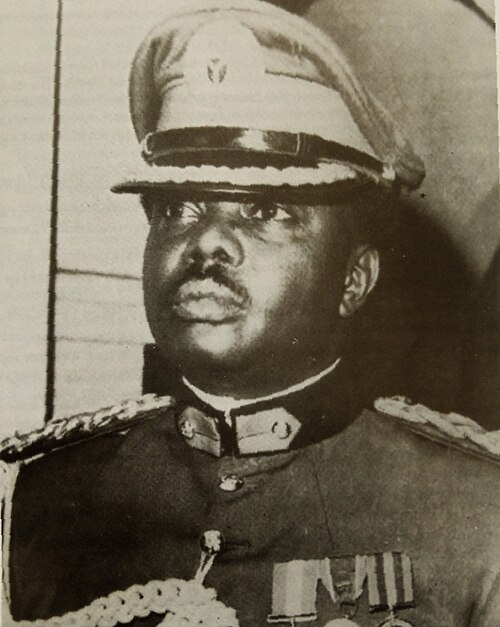
On 13 February 2026, Nigeria will mark 50 years since the assassination of General Murtala Ramat Muhammed, gunned down in Lagos while on his way to Jummat prayers.
Half a century after his death, the nation he led briefly but decisively is still grappling with how to properly honour one of its most principled leaders.
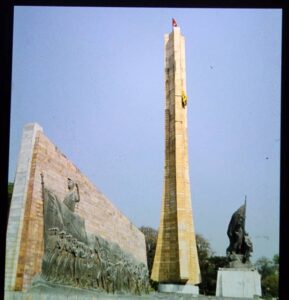
The Man and the Moment.
General Murtala Muhammed emerged as Head of State in July 1975 at a time of national fatigue, institutional decay, and moral drift.
In just six months, he redefined leadership in Nigeria’s public life.
He lived simply, rejected flamboyance, and demanded discipline across the civil service and armed forces.
His administration was marked by swift decision-making, a zero-tolerance posture on corruption, and a deep personal piety that shaped his public conduct.
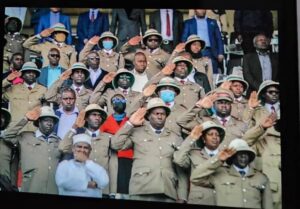
Beyond domestic reforms, Muhammed repositioned Nigeria as a fearless leader of Africa and the Black world.
His foreign policy rejected equivocation on apartheid, colonialism, and imperial domination, placing Nigeria firmly on the side of liberation movements across Southern Africa.
His blunt honesty, courage, and moral clarity earned him respect well beyond Nigeria’s borders.
The Assassination and Lingering Questions.
On 13 February 1976, Muhammed was assassinated in Lagos during a failed coup led by Lt. Col. Buka Suka Dimka. While the coup plotters were later apprehended and executed, the assassination raised enduring questions about intelligence failures, convoy security lapses, and the vulnerability of the Nigerian state at the time.
What remains indisputable is that Nigeria lost a reformer at the height of moral authority—one whose leadership trajectory suggested a lasting transformation of governance culture.

Scholarly Clarification.
General Murtala Ramat Muhammed’s enduring relevance lies not in the length of his rule but in the moral clarity and historical purpose that defined it. His legacy is rooted in his uncompromising defence of Nigeria’s unity, his corrective role after the January 15, 1966 coup, his distinguished command of the 2 Division during the civil war, his decisive steps toward restoring democratic governance, and his principled projection of Nigeria as a leader of Africa and the global Black community.
This legacy is further illuminated by Murtala Ramat Muhammed: Unveiling the Ancestral Roots of a Nigerian General, authored by his immediate younger sister, Balaraba Ramat Yakubu. The book provides authoritative clarification of his lineage, decisively correcting long-standing politically motivated distortions by confirming that both of his parents were Fulani from Kano. Beyond genealogy, the work enriches Nigerian historiography by situating personal history within national destiny, making it a fitting intellectual memorabilia for the 50th anniversary of his martyrdom.
An Investigative Visit to Kano.
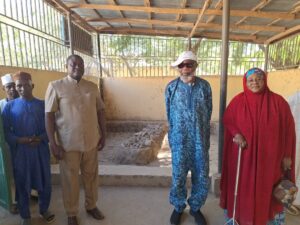
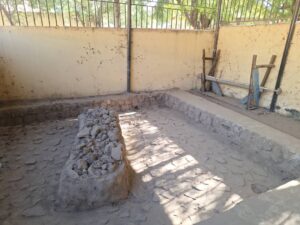
As part of its 50th-anniversary investigations, the National Patriots Movement examined the condition of General Muhammed’s final resting place in Kano.
A fact-finding visit led by General I.O. Williams (Rtd.), accompanied by I. Sani and Mrs. Balaraba Ramat, revealed a deeply troubling reality.
The gravesite and the mosque built beside it are in a dilapidated and neglected state, unbefitting a former Head of State who died in service to the nation.

The inspection team expressed dismay that, fifty years after his assassination, Nigeria has failed to preserve even the most basic symbols of honour for a leader of such stature.
For many observers, the neglect represents not just physical decay but a broader institutional amnesia about values, sacrifice, and national gratitude.
How Other Nations Honour Their Fallen.
Globally, nations treat fallen leaders as moral anchors and custodians of national memory.
Turkey maintains Atatürk’s mausoleum as a national shrine.
India preserves Mahatma Gandhi’s memorial as a living civic classroom.
South Africa institutionalised Nelson Mandela’s legacy through museums, military honours, and annual state rituals.
As Nelson Mandela once observed, “A nation that does not honour its heroes is a nation that forgets the foundations of its freedom.”
Nigeria’s treatment of General Murtala Muhammed stands in stark contrast to these global standards.
Why Murtala Muhammed Still Matters.
Muhammed’s governance style—decisive, austere, values-driven—remains profoundly relevant in today’s Nigeria.
His intolerance for corruption, insistence on service over privilege, and willingness to confront entrenched interests offer a benchmark against which contemporary leadership is inevitably measured.
Many analysts believe that had he lived, Nigeria’s institutional culture and leadership ethics might have evolved along a markedly different path.
What Must Be Done—Now.
As the 50th anniversary approaches, symbolic gestures are no longer sufficient.
Immediate actions are required:
Construction of a befitting national mausoleum at his final resting place in Kano, supported jointly by the Federal Government and Kano State Government.
Full reconstruction of the adjoining mosque, restoring it as a dignified place of worship and remembrance.
Institutionalisation of an annual military remembrance parade every 13 February, led by the Armed Forces of Nigeria, distinct from general Armed Forces Remembrance Day ceremonies.
A national leadership lecture series on integrity, discipline, and service, inspired by Muhammed’s values.
Formal participation of surviving former leaders, military institutions, and civic bodies in the annual remembrance.
A Test of National Conscience.
Fifty years after his assassination, how Nigeria honours General Murtala Ramat Muhammed is a test of its seriousness about history, reform, and moral leadership. Honour delayed is honour denied. With the anniversary fast approaching, the responsibility now lies with the authorities to act decisively—not merely to remember a fallen leader, but to reaffirm the values he lived and died for.
Dr. G. Fraser. MFR.
The National Patriots Movement.



