

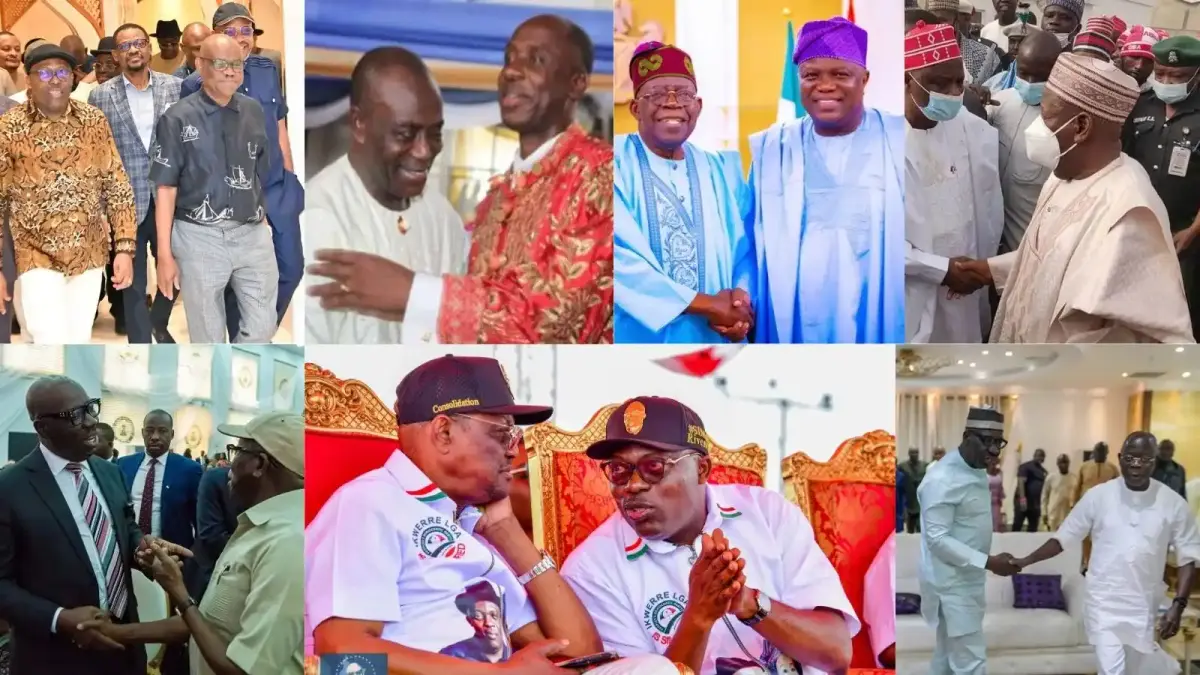
Political godfatherism remains a defining feature of Nigeria’s political landscape, with influential figures continuing to wield power long after leaving office. Across states such as Lagos, Oyo, Kogi, and Rivers, many governors have risen to power through the backing of political godfathers rather than solely by personal political strength.
However, history shows that several of these relationships collapse once the protégés secure power. Below is a compilation of notable cases where former governors eventually fell out with their political benefactors.

1. Governor Siminalayi Fubara and Nyesom Wike (Rivers State)
Rivers State witnessed intense political tension in 2025 following a prolonged rift between Governor Siminalayi Fubara and his predecessor, Nyesom Wike, now Minister of the Federal Capital Territory (FCT). The crisis stemmed from a power struggle between the governor and his former political mentor.
Despite intervention efforts by President Bola Tinubu, the conflict escalated, prompting the declaration of a State of Emergency in Rivers State. As part of the proclamation, Governor Fubara, his deputy, and members of the State House of Assembly were suspended, while retired Vice-Admiral Ibok-Ete Ibas was appointed Sole Administrator for six months.
After the emergency period elapsed, the suspended officials were reinstated and pledged to work together. However, tensions resurfaced shortly after, with both camps trading accusations publicly.

Governor Fubara later defected from the Peoples Democratic Party (PDP) to the All Progressives Congress (APC) following a meeting with President Tinubu in Abuja. Most lawmakers also joined the APC, but despite the defection, the House of Assembly on January 8, 2026, initiated impeachment proceedings against the governor and his deputy, Ngozi Ordu.
Citing Section 188 of the 1999 Constitution (as amended), impeachment notices were read during plenary. While rumours suggested the move was orchestrated by Wike, lawmakers denied the claim, insisting the process followed constitutional provisions. They accused the governor and his deputy of lacking the capacity to discharge their duties.
During plenary, Speaker Martin Amaewhule declared that the Assembly would see the impeachment process through. Meanwhile, Wike maintained that Fubara’s defection to the APC does not guarantee him a governorship ticket in 2027.

2. Rabiu Kwankwaso and Abdullahi Ganduje (Kano State)
Former Kano State Governors Rabiu Kwankwaso and Abdullahi Ganduje were once close political allies. Ganduje served twice as Kwankwaso’s deputy and later worked closely with him during Kwankwaso’s tenure as Minister of Defence.
Their relationship began to deteriorate after Ganduje assumed office as governor in 2015. Tensions rose when Ganduje submitted his cabinet list, which many Kwankwaso loyalists claimed sidelined them from key roles.
Attempts at reconciliation failed, and the rivalry intensified during the 2019 governorship election when Kwankwaso-backed candidate Abba Kabiru Yusuf lost to Ganduje under controversial circumstances. The political feud resurfaced again in 2023, with both men supporting rival candidates. Although Yusuf was initially declared winner, the election outcome was later overturned by a tribunal, a decision currently under appeal.
3. Godwin Obaseki and Adams Oshiomhole (Edo State)
The political alliance between former Edo State Governor Godwin Obaseki and his predecessor, Adams Oshiomhole, eventually collapsed after years of cooperation. Obaseki, who served in Oshiomhole’s administration, secured Oshiomhole’s backing to win the 2016 governorship election.
Their relationship soured when Obaseki defected to the PDP after being disqualified from the APC primaries ahead of his re-election bid. Oshiomhole, reportedly instrumental in the disqualification, backed another candidate, Osagie Ize-Iyamu.
Despite losing his party’s support, Obaseki went on to win re-election, effectively ending his political relationship with Oshiomhole.

4. Peter Odili and Rotimi Amaechi (Rivers State)
Former Rivers State Governor Dr. Peter Odili later expressed regret over backing Rotimi Amaechi to become governor. Odili accused Amaechi of dismantling the PDP’s political structure in the state after assuming office.
Amaechi, who governed from 2007 to 2015, was once Odili’s trusted ally. Reflecting on their fallout, Odili admitted that supporting Amaechi was a political miscalculation and vowed to correct it during subsequent elections.
The breakdown of their relationship reshaped Rivers State politics and eventually strengthened the alliance between Odili and Nyesom Wike, paving the way for Wike’s emergence as governor.
5. Akinwunmi Ambode and Bola Tinubu (Lagos State)
Former Lagos State Governor Akinwunmi Ambode fell out with the political camp of Bola Tinubu ahead of the 2019 APC governorship primaries. The disagreement led to Ambode losing the party’s ticket to Tinubu’s preferred candidate, Babajide Sanwo-Olu.
The episode was widely viewed as a struggle over loyalty and political control in Lagos State. Although Ambode challenged the process, he ultimately lost the primary and exited office.
In recent years, tensions appear to have eased, with Ambode publicly reaffirming his loyalty to Tinubu and the APC, including endorsing President Tinubu for a second term in 2027.



