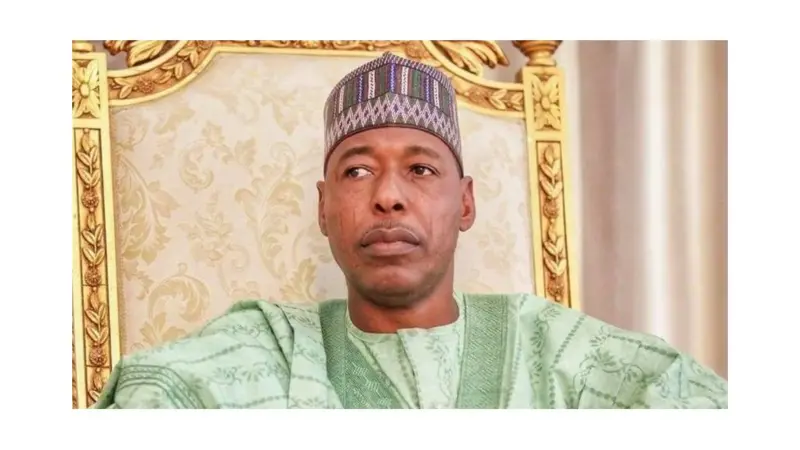
A review of Borno State’s 2026 budget has drawn attention to significant allocations within the Government House, including a planned N900 million expenditure on furniture items such as tables and cushioned chairs.
Details from the capital expenditure breakdown show that the amount is earmarked for the purchase of 60 sets of tables, 40 visitors’ chairs, and 10 cushioned chairs, placing office furnishings among the high-value items in the Government House spending plan.
The furniture allocation is part of a broader budget focused on upgrades, procurement, and construction within the Government House complex in Maiduguri.
Other major provisions include N800 million for the purchase of eight Toyota Hilux vehicles designated for security operations, as well as N1 billion for the procurement of 18 units of 500KVA generators to support power supply.

In addition, N1 billion has been allocated for the construction of a new guest house, while N1.8 billion is set aside for building 60 office blocks within the premises.
Further spending plans show N100 million budgeted for a 100-bedroom apartment project and another N100 million for additional staff quarters. The government also allocated N791.9 million for the rehabilitation of 20 office buildings and N50 million for completing two staff clinics. Solar installations are expected to cost N20 million.
Beyond infrastructure, the budget reflects notable spending on administrative and operational items. These include N50 million for kitchen equipment and N500 million for celebrations such as Eid, Children’s Day, and New Year events.
Security and communication needs are also captured, with N100 million allocated for gadgets, CCTV systems, and protective equipment, alongside N50 million for fire-fighting tools and N5 million for tree planting within the Government House.

The Office of the Deputy Governor also features in the spending plan, with N100 million set aside for executive furniture, further highlighting the emphasis on furnishing government offices.
Separate findings from earlier budget reviews indicate that the state spent N378 million on generators between January and September 2025. The 2026 budget also includes N150 million for feeding livestock—specifically sheep and goats—within the Government House, translating to an estimated daily feeding cost of over N400,000.
In another development, the state’s 2025 budget performance report revealed that N4.3 billion was spent on livelihood support for repentant Boko Haram members under the Disarmament, Demobilisation, and Reintegration (DDR) programme.
The figure exceeds capital expenditure recorded for key health institutions in the state during the same period, including the Primary Healthcare Development Board, the State University Teaching Hospital, and the Hospital Management Board.
The spending patterns have sparked debate over budget priorities, particularly when compared to allocations for critical sectors such as healthcare and public services.