

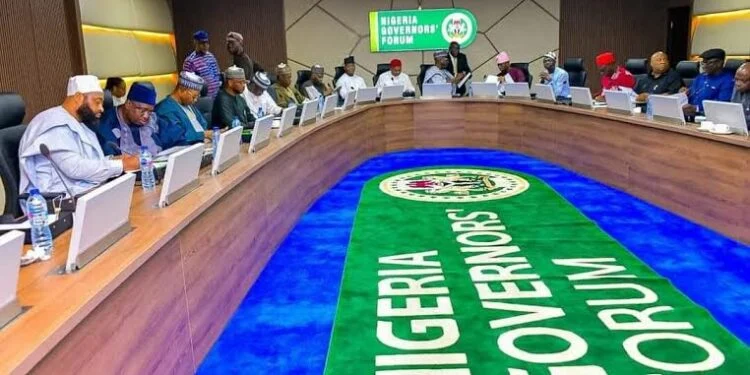
Despite receiving an estimated N9 trillion from the Federation Account Allocation Committee (FAAC) in 2025, state governors are under mounting criticism from labour unions, civil society organisations, and opposition parties over the perceived lack of improvement in citizens’ welfare.

FAAC allocations to states surged by over N2 trillion in a single year, according to data from the National Bureau of Statistics analysed. The rise in inflows has been met with concerns that higher revenues have not translated into visible development or improved public services.
The Nigeria Labour Congress (NLC) warned that weak governance, misplaced priorities, and corruption at the state level have prevented federal allocations from benefiting citizens.

“Very few states are doing well in terms of how they deploy what they receive,” said Onyeka Christopher, Assistant Secretary-General of the NLC. “The idea behind federal allocations is to bring the government closer to the grassroots, but this has not translated into the desired results.”

Civil society groups echoed these concerns. Debo Adeniran, Chairman of the Centre for Accountability and Open Leadership, said, “The increase in allocations to states has increased financial opportunity for governors, but not for the people who are supposed to benefit.” Similarly, Auwal Musa Rafsanjani, Executive Director of CISLAC, noted the absence of tangible evidence showing the impact of federal allocations on healthcare, infrastructure, and agriculture.

Economists cautioned that reliance on federally shared revenues continues to undermine sustainable development. Dr. Ayodeji Ebo of Optimus by Afrinvest highlighted the volatility of these funds and their susceptibility to oil price fluctuations. Dr. Aliyu Ilias of CSA Advisory recommended “counterpart funding” to incentivize states to boost internally generated revenue (IGR).

Data from the Federation Account show that states received N7.315 trillion in direct FAAC allocations in 2025, up from N5.186 trillion in 2024, a 41 per cent increase. When the 13 per cent derivation revenue for oil-producing states is included, total inflows to states reached N8.934 trillion, compared with N6.533 trillion in 2024.
While allocations rose, the proportion of total FAAC funds going to states slightly declined, reflecting increases across all government tiers. Monthly disbursements in 2025 were consistently higher than in 2024, peaking at N727.17 billion in October.

Despite these gains, opposition parties argue that development remains uneven. In Sokoto State, the PDP accused the government of focusing spending on two metropolitan areas while neglecting the remaining 21 local governments. In Bauchi State, the Peoples Redemption Party alleged that state spending prioritised luxury projects over healthcare and education. In Zamfara, Kebbi, and Gombe states, opposition figures raised similar concerns over inadequate investment in citizens’ welfare.

In contrast, the Labour Party in Nasarawa State commended Governor Abdullahi Sule for infrastructure projects, including the Lafia flyover and ongoing road works.
The BudgIT State of States Report also highlighted the heavy dependence of many states on FAAC allocations, with at least 30 states relying on the funds for more than 60 per cent of recurrent revenue. Analysts warned that this dependence discourages the development of local revenue sources, limiting long-term fiscal sustainability.
Overall, while 2025’s FAAC windfall expanded states’ fiscal space, critics argue that mismanagement, poor prioritisation, and weak oversight have hindered its translation into tangible benefits for citizens.




