

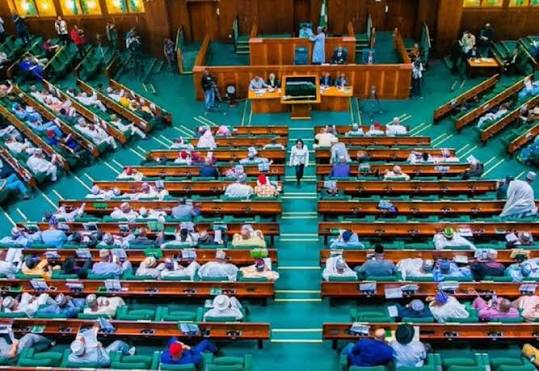
The House of Representatives descended into a chaotic session on Tuesday, February 17, 2026, as lawmakers clashed over a motion to revisit and potentially amend key provisions of the Electoral Act Amendment Bill 2025.

The controversy centres on safeguarding the integrity of the upcoming 2027 general elections, particularly the transmission of election results.
Francis Waive, Chairman of the House Committee on Rules and Business, moved a motion during plenary to reverse the House’s earlier decision on the bill, which was passed on December 23, 2025. He called for the House to rescind that decision and recommit the bill to the Committee of the Whole for fresh deliberations.

When Speaker Tajudeen Abbas put the motion to a voice vote, the “nays” appeared louder than the “ayes.” However, the Speaker ruled that the “ayes” had carried the motion.
The ruling immediately triggered loud protests from opposing lawmakers, who shouted in objection and disrupted proceedings. Speaker Abbas then proposed moving the House into an executive session to resolve the matter, but that suggestion was also overwhelmingly rejected by voice vote.

Despite the resistance, the Speaker proceeded to move the House into executive session.
Key background on the Electoral Act Amendment Bill:

– When the House passed the bill in December 2025, it included a provision mandating real-time electronic transmission of election results from each polling unit to the Independent National Electoral Commission’s (INEC) Result Viewing Portal (IReV).

– The approved clause requires the presiding officer to transmit results electronically in real time after Form EC8A has been signed, stamped, and, where available, countersigned by candidates or polling unit agents.
– In contrast, the Senate, when it passed its version earlier this month, rejected real-time electronic transmission.

– Following public outcry and protests, the Senate on Tuesday rescinded its earlier decision and approved electronic transmission to IReV, with a fallback clause allowing manual collation if technology fails.
Due to the differences between the two chambers, a conference committee has been constituted to harmonise the versions of the bill.

Civil society organisations (CSOs) have urged the National Assembly to adopt the House’s stronger position on mandatory real-time transmission of results.
The rowdy session highlights the intense debate surrounding electoral reforms ahead of the 2027 elections, with lawmakers divided over how best to ensure transparency, credibility, and public confidence in the electoral process.




