

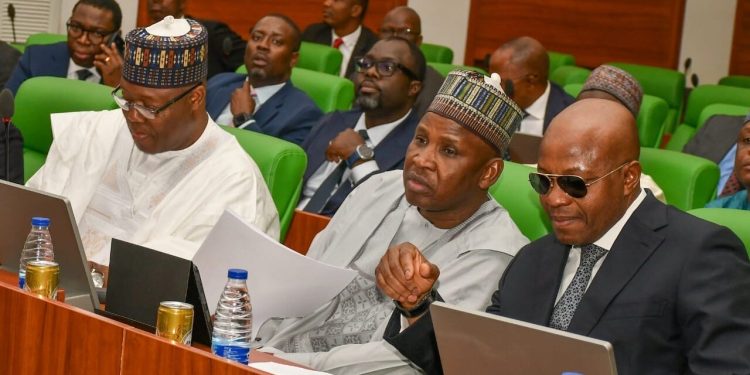
The House of Representatives Committee on National Security and Intelligence has criticised the funding allocated to the intelligence sector in the 2026 budget, describing it as inadequate and inconsistent with President Bola Tinubu’s repeated pledges to strengthen national security.

The committee raised the concern during the 2026 budget defence session with agencies under its oversight on Wednesday, February 18, 2026.
President Tinubu presented a ₦58 trillion Appropriation Bill to the National Assembly in December 2025, proposing ₦5.41 trillion for defence and security. In his address to a joint session of the legislature, he vowed to modernise the armed forces, strengthen intelligence-driven policing, enhance border security, and overhaul the country’s counter-terrorism framework.

However, the committee argued that the figures presented do not reflect these stated priorities.
Chairman Ahmed Satomi (APC, Borno) noted that the intelligence sub-sector—including the Office of the National Security Adviser (ONSA) and its centres, the State Security Service (SSS), the National Intelligence Agency (NIA), the Presidential Air Fleet, and the National Institute for Security Studies—received allocations that appear insufficient.

According to him, the proposed 2026 funding covers:
– Personnel costs: ₦245.94 billion
– Overhead: ₦131.27 billion
– Capital expenditure: ₦286.90 billion
Satomi described the overall funding profile as “abysmal” and misaligned with the administration’s declared security objectives.
He also expressed concern over actual releases under the 2025 budget, stating that available records do not indicate that security and intelligence have been treated as priority areas in disbursements.

“If indeed the provision of welfare and security is the primary purpose of governance, then releases to the security sector should not be treated trivially,” he said.
The committee appealed to President Tinubu to review and significantly increase funding for intelligence agencies to enable them to effectively address escalating threats, including terrorism, banditry, kidnapping, and other forms of insecurity.

Satomi further cautioned security agencies against resisting legislative oversight, stressing that the Constitution empowers the National Assembly to make laws and supervise agencies responsible for their implementation.
He clarified that oversight is not an act of hostility but a constitutional tool to ensure transparency, accountability, and value for money.
Presenting the 2025 budget performance report and the 2026 proposal, Permanent Secretary (Special Services), ONSA, Mohammed Sanusi highlighted major operational constraints facing the intelligence community.

He cited irregular release of overhead funds, non-release of capital allocations, and foreign exchange volatility as key challenges.
Sanusi explained that many service agreements are denominated in foreign currency, with exchange rate fluctuations significantly inflating operational costs. He also noted that maintaining the Presidential Air Fleet abroad—rather than at its local hangar—has further driven up expenses.

Despite these constraints, he outlined the intelligence community’s 2026 priorities, which include:
– Intelligence-led operations against terrorism, banditry, and kidnapping
– Protection of oil and gas assets
– Strengthening maritime and border security
– Enhancing cybersecurity
– Curbing the proliferation of small arms across the West African sub-region
In light of the recent declaration of a state of emergency on national security, Sanusi called for improved and timely releases—including the possibility of a supplementary budget—to enable rapid response to emerging threats.




