

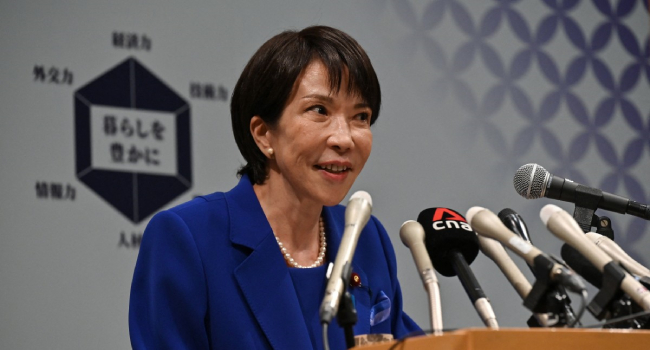
Japanese Prime Minister Sanae Takaichi dissolved parliament on Friday, setting the stage for a snap election on February 8, as she seeks to capitalize on her cabinet’s strong approval ratings to boost support for her struggling ruling party.
Takaichi, Japan’s first female prime minister, had announced her plan on Monday, appealing to voters with proposals to shield households from rising living costs and increase defense spending.
The lower house was officially dissolved when the parliament speaker read her letter on Friday, prompting lawmakers to chant the traditional “banzai” rallying cry.

Her ruling coalition of the Liberal Democratic Party (LDP) and Japan Innovation Party (JIP) holds only a slim majority in the lower chamber. Takaichi hopes her cabinet’s popularity will translate into a stronger mandate, despite the LDP’s low approval ratings and recent scandals.
“It’s uncertain if support for the cabinet will translate into backing for the LDP,” said Hidehiro Yamamoto, political science professor at the University of Tsukuba. “Voters are focused mainly on measures to tackle inflation.”
Government data released Friday showed inflation slowed to 2.4 percent in December, down from 3 percent in November, largely due to subsidies on electricity and gas. However, the rate still exceeds the central bank’s 2 percent target.

The public’s concern over rising prices, especially food staples like rice, which surged over 34 percent in December compared to last year, played a key role in the fall of Takaichi’s predecessor, Shigeru Ishiba.
To address the cost-of-living crisis, Takaichi’s cabinet approved a record 122.3-trillion-yen ($770 billion) budget for fiscal year 2026. If re-elected, she has promised a two-year cut on the sales tax for food to ease the financial burden on households.
Opposition parties, including the Constitutional Democratic Party (CDP), support tax relief but warn that delaying the budget due to the election could “sacrifice livelihoods.” Analysts caution that Takaichi’s proactive fiscal spending could increase Japan’s already massive debt, expected to exceed 230 percent of GDP in 2025-26.

The bond market reacted nervously to the stimulus and potential tax cuts, pushing Japanese government bond yields higher, reflecting investor concerns. Meanwhile, the Bank of Japan (BOJ) kept its key interest rate at 0.75 percent, projecting inflation will fall below 2 percent in the first half of 2026.
The LDP has dominated Japanese politics for decades, though leadership changes are frequent. The CDP has allied with Komeito to form the Centrist Reform Alliance, hoping to attract swing voters. Analysts predict the election could be tight, with younger and middle-aged voters potentially deciding the outcome. Polls indicate Takaichi enjoys around 90 percent support among voters under 30.




