

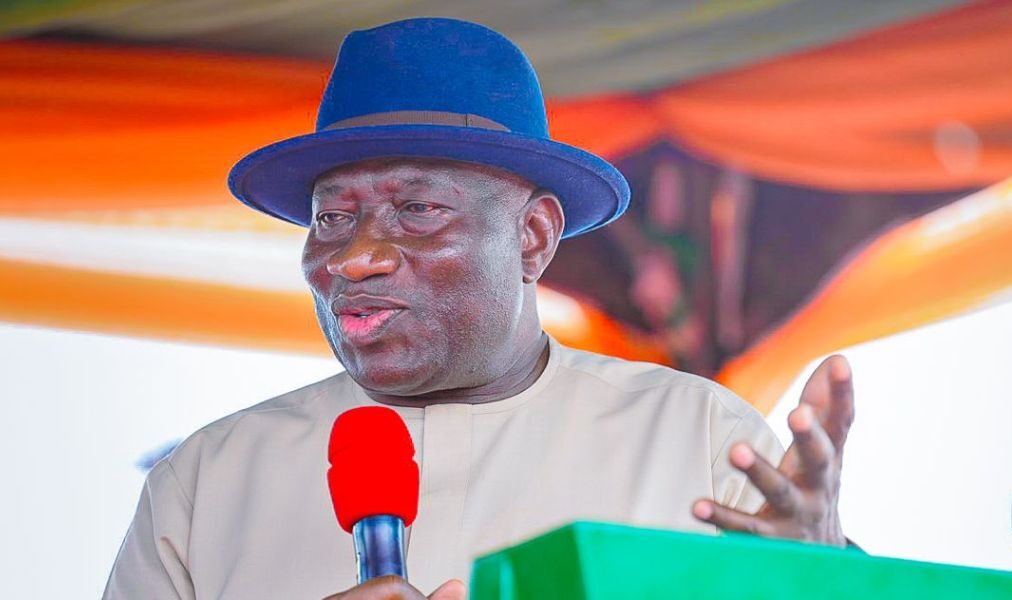
Former President Goodluck Jonathan appeared to take a veiled jab at Senate President Godswill Akpabio, Speaker of the House Tajudeen Abbas, and current lawmakers as he lauded previous National Assembly members for standing firm against presidential authority when necessary.
Speaking on Wednesday at the Champions of Nigerian Content Awards Dinner organized by the Nigerian Content Development and Monitoring Board (NCDMB) in Yenagoa, Bayelsa State, Jonathan reflected on the importance of a robust and independent legislature.


While receiving the Nigerian Content Lifetime Achievement Award, the former president recalled how he eagerly signed the Nigerian Oil and Gas Industry Content Development Bill into law in 2010 as Acting President—a bill driven by Senator Lee Maeba and other legislators.
“That was a period when the National Assembly truly lived up to its name,” Jonathan said. “When the bill was presented, I wasted no time in signing it, and we quickly set up a monitoring body. Credit must also go to Lee Maeba and his colleagues.”
Jonathan also cited the Niger Delta Development Commission (NDDC) Act as another example of legislative courage. He recalled how the Assembly overrode then-President Olusegun Obasanjo’s refusal to assent to the bill.
“In 2000, the National Assembly vetoed Obasanjo’s refusal. They reconvened and, by a two-thirds headcount—not a voice vote—passed the NDDC bill into law,” he explained. “That’s how the NDDC came into existence—thanks to a vibrant, independent legislature.”
While Jonathan refrained from directly criticizing the current 10th National Assembly, observers saw his comments as a subtle critique of a body often perceived as subservient to the executive.


The current Senate, led by Akpabio, has faced criticism for being too compliant. Detractors frequently describe the lawmakers as a “rubber stamp” assembly, echoing the Executive’s every move without resistance.
Responding to such criticisms in a recent documentary marking two years of President Bola Tinubu’s administration, Akpabio defended the legislature’s cooperative stance.
“You’re not given boxing gloves when elected into the National Assembly,” Akpabio said. “It’s not a fight. We are there to collaborate in the interest of Nigeria.”
According to a statement by Presidential Adviser Bayo Onanuga, Akpabio argued that the current harmony between both arms of government stems from shared goals and the unique fact that the President, Vice President, and First Lady are all former senators.
“If you spend all your energy fighting the Executive, who will work for Nigeria?” Akpabio asked.

He also revealed that the National Assembly is working on legislation to prioritize the purchase of locally assembled vehicles by government agencies over imported ones—a move aimed at boosting local industries.
Jonathan’s remarks, while wrapped in praise for the past, served as a pointed reminder of the legislature’s duty to act as a check—not an extension—of executive power.




