

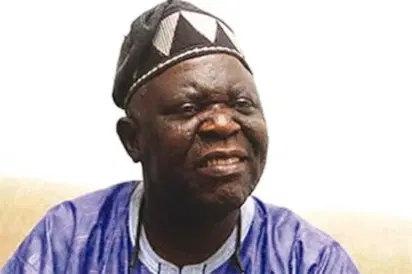
At my installation as Grand Patron of the Christian Association of Nigeria (CAN) in Offa, Kwara State, I stated — and I emphasize again — that the ongoing wave of killings and violence in Nigeria is not accidental. It is deliberately orchestrated and funded by opponents of the government. A former North-West governor once revealed how bandits were used during the 2014/2015 political period. After serving their purpose, the violence did not stop. We have seen this pattern repeat itself. With the 2027 elections approaching, it is imperative for the government to restore peace. The credibility of any election depends on a secure and governable nation where citizens can freely cast their votes. — Chief Ayo Opadokun

The Gun, Politics, and Insecurity: An Interview with Chief Ayo Opadokun
Chief Ayo Opadokun, a veteran lawyer and former assistant director of the Unity Party of Nigeria (UPN) during the Second Republic, was deeply involved in the struggle against military rule as national publicity secretary of the National Democratic Coalition (NADECO). In this interview, he discusses the state of the nation, insecurity, and his new book, The Gun Hegemony.
On the inspiration behind The Gun Hegemony
“My experiences in detention shaped this book. I spent 33 months at DSS headquarters in Abuja and 16 months at Kano Central Prison. During this time, I resolved to write about two major issues: first, my prison memoirs, and second, the overwhelming influence of the gun in politics and society.
“The book stems from the observation that violence has become normalized as a tool of power globally, especially in fragile democracies like Nigeria. The dominance of armed force — by the state, criminal networks, or insurgents — has displaced dialogue, justice, and moral authority. The Gun Hegemony interrogates this dangerous trajectory and calls for serious national and global reflection.”

Key argument of the book
“The central argument is that societies that surrender moral authority and democratic accountability to the gun inevitably undermine their own stability. Militarisation of politics, security, and civic life erodes institutions, deepens fear, and weakens citizenship. Sustainable peace cannot be built on coercion alone; it must rest on justice, inclusion, and accountable governance.”
Scope and relevance
“While Nigeria provides a compelling case study, the book has global relevance. The dominance of guns — whether through military might, proxy wars, or internal repression — has reshaped societies in Africa, the Middle East, and parts of the West. Nigeria’s experience demonstrates how failure to control violence can threaten national and regional cohesion.
“The book also traces the historical discovery and impact of the gun, exploring its role in shaping nations and conflicts. Without it, perhaps, Nigeria would not exist in its current form.”
On the role of force in security
“Security is essential, but force without accountability becomes oppression. The book does not argue against legitimate security forces. It warns against elevating force above law, ethics, and civilian oversight. History shows that when the gun becomes the final arbiter, even those who wield it eventually lose control.”

Target readers
“This book is for policymakers, security professionals, scholars, civil society actors, faith leaders, young people, and citizens who care about democracy and peace. It explains why violence persists and how societies can reclaim authority from fear and coercion.”
The 2027 election and current violence
“As I said at my CAN installation, the current wave of killings is deliberate. Opponents of the government have sponsored it. Bandits who were once employed during past elections refused to return to their previous hiding places, fueling continued violence.
“History shows how elections in Nigeria have been accompanied by bloodshed — remember the 2011 elections when candidate Buhari warned that blood would flow if he lost. Thousands were killed, and accountability was never enforced. With 2027 approaching, the government must act decisively to ensure a peaceful, governable environment for free and credible elections.”
Origins of insecurity in Nigeria
“The rise of groups like Boko Haram and the implementation of Sharia Law in Zamfara and other states worsened insecurity. These moves, often politically motivated, created environments where violence could thrive. Jobless individuals were armed and later abandoned, leading to repeated attacks on civilians.
“The problem has local and regional dimensions. Sahelian instability has spilled into Nigeria, with armed groups seeking green pastures, destroying farms, and attacking communities. Political manipulation has encouraged this culture of violence.
“However, President Bola Tinubu, unlike some predecessors, was not sponsored by the military. He is working to combine kinetic and non-kinetic approaches to build credible security structures. If successful, this could improve food security, employment, and overall governance.”
On economic reforms and fiscal federalism
“President Tinubu has made strides with tax reforms to strengthen fiscal federalism, despite resistance from those benefiting from previous systems. Nigeria’s tax-to-GDP ratio is among the lowest globally, and most citizens, apart from government workers, do not pay taxes. The law is clear: once passed and assented to, it becomes law. Objections should follow constitutional processes through the National Assembly.”
On Nigeria’s national question
“Nigeria’s challenges trace back to the 1966 military coup, which overthrew a democratically elected government and replaced the federal constitution with a centralized military system. To truly operate an egalitarian and stable society, Nigerians must address two fundamental questions:

-
Do we want to remain together as one nation?
-
If yes, on what terms and principles should we coexist?
These questions must be addressed within a renewed federal constitutional framework to ensure stability, justice, and inclusion.”



