

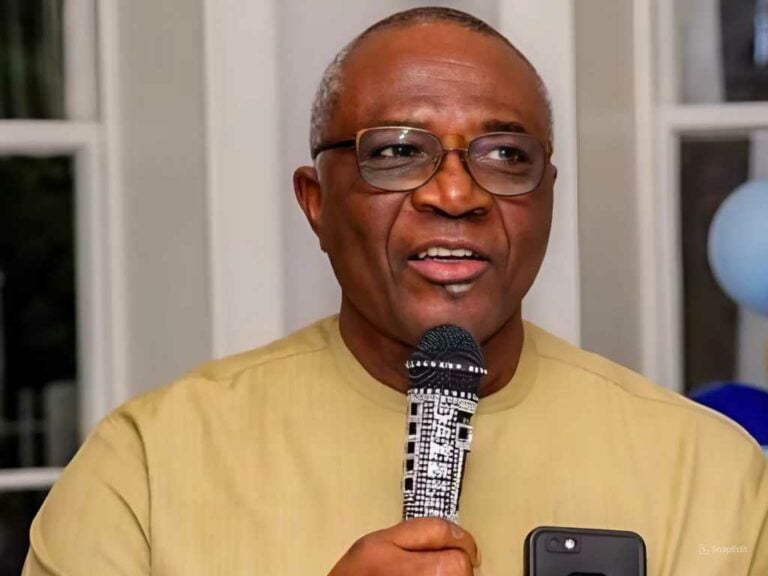
The Special Adviser to the President on Information and Strategy, Bayo Onanuga, says Nigeria’s swift military intervention in Benin Republic and the successful rescue of 100 abducted students in Niger State highlight President Bola Tinubu’s strong commitment to defending democracy and bolstering national security.

Speaking on Arise News on Monday night, Onanuga explained that Nigeria’s response to last week’s attempted coup in Benin Republic was coordinated, timely, and carried out strictly at the request of President Patrice Talon.
“What happened on Sunday and what happened today only showed that this government is committed to protecting democracy, not just in Nigeria, but also among our neighbours,” he said.

“And what you have also seen in the release of the Papiri children is that our security forces are up to the task.”
Onanuga revealed that Talon made two urgent requests for Nigeria’s support—first for fighter jets to dislodge coup plotters, and later for ground troops. He stressed that the intervention aligned with ECOWAS protocols and Tinubu’s long-standing advocacy for democratic governance in West Africa.

Responding to suggestions that Benin’s leader had not publicly acknowledged Nigeria’s role, Onanuga insisted that Talon had indeed expressed appreciation.
Comparing the Benin operation with Nigeria’s fight against terrorism and banditry, he noted that domestic security challenges are more complex due to the asymmetric nature of the conflict.

“You have ragtag bandits and terrorists sometimes holding our people as shields… You have to be very careful not to bomb those they are holding as collateral. It’s different,” he said, recalling how even the United States grappled with guerrilla warfare in Afghanistan.
He added that the National Security Adviser had already indicated that the release of the kidnapped students would occur in phases.
On speculation about which groups carried out the abductions, Onanuga said the perpetrators in that corridor are generally known terrorist elements, including factions linked to Ansaru.

He also commented on President Tinubu’s directive to withdraw police escorts from VIPs, confirming that the Inspector-General of Police had begun implementation.
“About 12,000 policemen were doing VIP work. I rarely see policemen outside like before,” he said, noting that many of the officers still seen around VIPs are “spy police,” not part of the official police workforce.

Onanuga said the administration’s recent actions at home and across the subregion demonstrate both capacity and resolve.
“This government is committed to protecting democracy… and our security people are up to the task of helping to protect this country.”




