

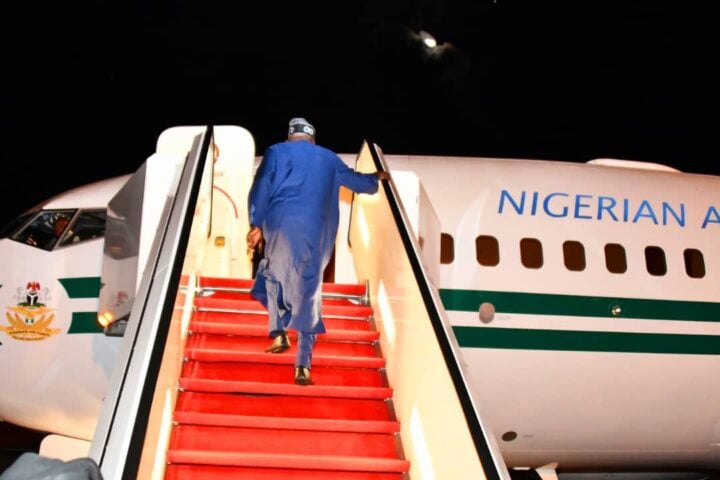
The Office of the National Security Adviser (ONSA) has informed the Senate that the cost of maintaining Nigeria’s Presidential Air Fleet has increased sharply in recent years.
The disclosure was made on Wednesday by the Permanent Secretary of the office, Mohammed Sanusi, during a budget defence session before the Senate Committee on National Security and Intelligence. He explained that the rising expenses are largely due to the fact that most maintenance work on the fleet is carried out outside the country rather than locally.

According to Sanusi, the 2026 budget proposal covers ONSA and its affiliated agencies, including national counterterrorism, cybersecurity, arms control centres, and the Presidential Amnesty Programme. However, he did not provide figures on how much was spent on maintaining the fleet in 2025 or since the current administration assumed office.

Beyond aircraft maintenance, Sanusi highlighted several operational difficulties confronting the intelligence community. These include shortages of operational vehicles for covert missions, irregular release of overhead funds, failure to implement the 2025 capital budget, funding gaps for foreign service personnel, and the effect of foreign exchange volatility on service agreements.
He stressed that reliance on foreign facilities for aircraft servicing has further increased costs, especially due to high exchange rates.

Nigeria’s Presidential Air Fleet is dedicated to transporting the president, vice president, and other senior officials on official duties. It is overseen by ONSA, which handles its funding, administration, and maintenance. The fleet is considered essential for national security, continuity of government, and rapid response to emergencies.

Over the years, the fleet has drawn public criticism over its usage and high upkeep costs, particularly when aircraft are perceived to be used for non-official purposes. Limited domestic capacity for specialised aviation maintenance has also forced continued dependence on foreign facilities, further driving up expenses.
During the session, Sanusi appealed to lawmakers to approve additional funding through a supplementary budget, citing the president’s recent declaration of a state of emergency on national security. He argued that adequate funding was critical to ensure swift and effective responses to security threats.

Responding after the session, the committee’s chairman, Senator Yahaya Abdullahi, said the National Assembly would review the concerns raised and explore possible solutions. He noted that lawmakers may seek direct engagement with the president to ensure the security emergency declaration is backed with sufficient funding.
Abdullahi also warned that 2026 would be a crucial year for Nigeria’s democracy, adding that inadequate funding of security agencies could pose serious risks as the country approaches another election cycle.
The committee has concluded its budget defence and is preparing a report for submission to the Appropriations Committee and the leadership of the National Assembly, after which further discussions with the executive are expected.




