

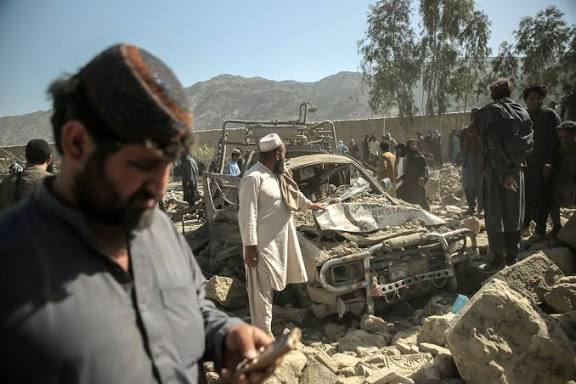
Afghanistan and Pakistan are engaged in renewed deadly cross-border fighting, with Islamabad’s defense minister declaring “open war” on the Taliban-run Afghan government after a series of airstrikes, shelling, and mortar exchanges.
The latest escalation threatens further instability in the region, pitting Pakistan’s well-equipped, nuclear-armed military against the battle-hardened Taliban fighters who defeated US and NATO forces in 2021.

WHAT HAPPENED IN THE LAST 24 HOURS?
Late Thursday night, Taliban forces launched attacks on Pakistani military positions along sections of their 1,600-mile porous and disputed border.

Kabul described the strikes as retaliation for Pakistani airstrikes over the weekend that targeted what Islamabad claimed were militant camps inside Afghanistan, killing at least 18 people.
Early Friday, Pakistan launched “Operation Righteous Fury” (Ghazab Lil Haqq), conducting airstrikes on Kabul, Paktia province in the southeast, and Kandahar — considered the spiritual birthplace of the Taliban and believed to be the location of its leader Hibatullah Akhundzada.

Pakistan’s military claimed its forces destroyed 73 Taliban posts and captured more than a dozen others along the border.
Casualty figures differ sharply between the two sides:
– Pakistan reported killing 274 Afghan Taliban fighters and injuring 400.
– Afghanistan said 13 of its soldiers were killed and 22 wounded in Friday’s attacks, while claiming 55 Pakistani soldiers were killed and others captured, with 19 Pakistani posts destroyed.

An Italian medical charity, Emergency, reported treating nine injured people in Afghanistan following the clashes and bombings.
Residents in Kabul described being woken by explosions and gunfire, with many unable to sleep amid fears of further strikes. In Pakistan’s Bajaur district, a Taliban mortar shell hit a house, injuring five people, including two children and a woman.

HAVEN’T WE BEEN HERE BEFORE?
Yes. The two countries share deep economic and cultural ties but also a long history of border tensions and conflict.
Last October marked their deadliest clashes in years, followed by a fragile ceasefire.
Pakistan supported the Afghan Taliban during their insurgency against the US-backed Afghan government after 2001. Many Taliban fighters found refuge across the border in Pakistan.
Since the Taliban’s return to power in Kabul in 2021 following the US withdrawal, Pakistan has faced a sharp rise in Islamist militant violence — much of it attributed to the Pakistani Taliban (TTP), which Islamabad accuses Kabul of sheltering.

More than 1,200 people, including military and civilians, were killed in militant attacks in Pakistan in 2025 — double the number recorded in 2021.
Pakistan’s Defense Minister Khawaja Asif told CNN in November that many Afghan Taliban figures still have property and families in Pakistan, describing the violence as “blowback.”
On Friday, Asif posted on X: “Our patience has run out. Now it is open war between us and you,” accusing Afghanistan of “gathering all the terrorists of the world” and “exporting terrorism.”
Taliban spokesman Zabiullah Mujaid responded by saying Afghanistan still prefers a peaceful solution through dialogue.

HOW DO THEIR MILITARIES STACK UP?
Pakistan maintains a modern, professional military with approximately 660,000 active-duty troops, plus nearly 300,000 paramilitary and police personnel. It operates a sophisticated arsenal, including US-made F-16s, French Mirage jets, and Chinese co-produced JF-17 fighters, backed by nuclear capabilities.
Afghanistan’s forces consist solely of the Taliban, estimated at under 200,000 personnel. They lack a functional air force, relying on a few aging Soviet-era helicopters, transport aircraft left behind during the US withdrawal, and quadcopter drones. Their strength lies in guerrilla tactics, ideological commitment, and decades of asymmetric warfare experience.
HOW BAD COULD IT GET?
Previous flare-ups have de-escalated after days of fighting, often with mediation from Saudi Arabia, Turkey, and Qatar.
Analysts warn that further escalation could be dangerous:
– Retaliation by Afghan Taliban forces could target Pakistan’s urban centers, creating opportunities for terrorist networks to exploit chaos.

– The Taliban’s use of drones and suicide bombers makes them unpredictable despite lacking conventional heavy weaponry.
Experts urge an immediate return to negotiations, facilitated by trusted partners such as Türkiye, Qatar, and Saudi Arabia, to prevent a broader conflict.




