

On the morning of 13 February 1976, Nigeria’s military government suffered one of its most violent ruptures: the assassination of Head of State, Brigadier-General Murtala Ramat Muhammed, in an ambush in Ikoyi, Lagos.
The attempted coup that followed—led by Lt. Col. Bukar Suka Dimka—failed within hours, but its shockwaves reshaped civil-military relations, hardened internal intelligence culture, and left a long tail of disputed trials and executions that still animate Nigeria’s historical memory.
The killing itself was brazen and operationally simple.
Contemporary reconstructions agree that Murtala’s black Mercedes—travelling without heavy escort—slowed near a junction in Ikoyi when armed soldiers approached and opened fire, killing him and his aide-de-camp, Lt. Akintunde Akinsehinwa.
The vehicle, preserved at the National Museum in Lagos, is still displayed with visible bullet damage; reportage has described “over 20” bullet holes.
Within that same morning, Dimka moved to seize the narrative.
A coup announcement was broadcast on Radio Nigeria, with Dimka presenting himself as the voice of a corrective takeover and accusing the government of corruption, weakness, indecision, and detentions without trial.
The broadcast itself has become a key piece of the coup story because it shows the plotters’ confidence that controlling the airwaves could compensate for weak operational control on the ground.
But this was a coup that struggled to secure the core instruments of state power.
While Lagos heard the announcement, loyalist forces rallied quickly.
The Supreme Military Council’s structure did not collapse; within hours, government troops regained control, and the coup unravelled. Murtala was succeeded by Lt. Gen. Olusegun Obasanjo, who moved to consolidate command and restore order.
A three-week manhunt followed for Dimka.
Accounts widely report that he was arrested near Abakaliki on 6 March 1976—an arrest that effectively marked the end of any lingering operational threat from the coup network.
What came next—the tribunals and executions—remains the most contested portion of the 1976 story, because Nigeria’s military justice processes at the time were opaque, fast-moving, and politically consequential.
A Special Military Tribunal chaired by Major General Obada tried key suspects, and later commentary and interviews have revisited how the state determined culpability and how confessions were treated.
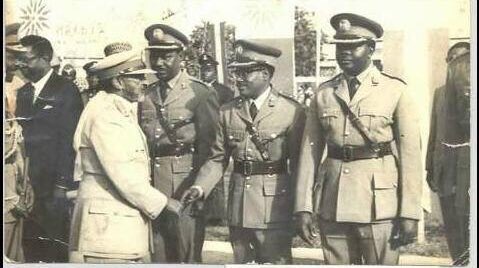
Roles and names cited in archival reconstructions.
Lt. Col. Bukar Suka Dimka: Dimka is consistently identified as the coup’s lead figure—both for the Ikoyi ambush team’s coordination and for the Radio Nigeria address that attempted to legitimise the takeover.
He was later convicted and executed by firing squad (commonly reported as 15 May 1976).
Lt. William Seri: In later reconstructions, Seri is frequently named among those on the hit team that fired on Murtala’s vehicle.
One detailed narrative describes the attack team as including Seri and others who approached and riddled the car with bullets.
Because multiple accounts use cautious phrasing (“allegedly included”), a responsible report should mirror that caution while noting his recurring identification in the literature.

Major General Iliya D. Bisalla (then Commissioner/Minister of Defence): Bisalla’s case remains one of the most politically sensitive because—while the Federal Military Government asserted complicity—subsequent historical writing has also noted disputes around the evidence and confessions used.
He was convicted by a Special Military Tribunal and executed (often reported as part of the March 1976 execution batch).
Any serious archival retelling should therefore include both points: the official conviction and the enduring controversy about how clearly complicity was established.
Joseph Dechi Gomwalk (former Military Governor, Benue-Plateau State): Gomwalk was tried and executed for alleged connections to the Dimka network, with later accounts emphasising the unusual tribunal history—where an initial process reportedly absolved some suspects before a later tribunal produced death sentences.
He is widely recorded as being executed on 15 May 1976.

Abdulkarim Zakari (civilian broadcaster, Radio Nigeria/NBC): Zakari’s name appears in reconstructions of how Dimka gained access to broadcast infrastructure.
A widely-cited account says he allegedly provided martial music used during the coup broadcast and showed Dimka into the broadcasting section, and that he was executed.
His inclusion underlines that the coup required civilian enablers inside state institutions—not only soldiers on the street.
The executions and what they signalled.
The Nigerian state’s response was deliberately demonstrative: swift tribunals followed by publicised executions, intended to reassert command authority and deter future conspiracies. Accounts commonly describe two execution moments—one in March 1976 involving a larger batch, and another in May 1976 for Dimka and others—reflecting how the state staged punishment in waves as investigations and tribunals progressed.

For Nigeria’s political development, the lasting significance is not only that the coup failed, but that it revealed how fragile a state can become when elite military networks are factionalised and when intelligence discipline is weak.
It also produced a hard lesson that echoed through later decades: the battle for the airwaves can create a momentary illusion of power, but without control of key formations and command centres, it collapses fast.

The National Patriots Movement recalls the 1976 tragedy as a warning against elite impunity and reckless power contests.
A nation fighting insecurity cannot afford internal sabotage by those entrusted with arms and authority. Nigeria must preserve history honestly—honouring victims, rejecting political violence, and strengthening lawful institutions so grievances are settled by reform and civic engagement, not bullets and broadcasts.
Dr. G. Fraser. MFR
The National Patriots.




