


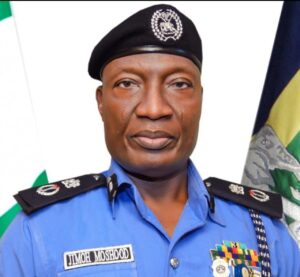
A fresh petition submitted to the Police Service Commission (PSC) seeking disciplinary action against Lagos State Commissioner of Police Olohundare Jimoh Moshood has sparked renewed debate over the growing trend of activist petitions targeting security officials during politically sensitive moments.

The petition, submitted by a coalition of civil society activists, alleges that the Commissioner personally ordered violent suppression of protesters and physically assaulted activist Hassan Taiwo Soweto during a January 28 protest at the Lagos State House of Assembly.
However, emerging details surrounding the incident raise critical questions about the accuracy of these allegations and the timing of the petition.

A Protest at a Sensitive Government Institution
The protest in question took place at the entrance of the Lagos State House of Assembly, a highly sensitive government facility requiring heightened security control.
According to accounts from security officials present at the scene, the demonstration quickly drew large crowds estimated in the thousands.
While protesters insisted they were exercising their democratic rights, police authorities had the responsibility of ensuring that the protest did not escalate into a security breach at a legislative complex.
In such circumstances, law enforcement agencies are required to strike a delicate balance between protecting the constitutional rights of protesters and safeguarding public institutions.
Legislative Commendation Contradicts Brutality Claims
One of the most significant contradictions to the brutality allegations is a formal letter issued by the Lagos State House of Assembly itself.

In the letter signed by the Clerk of the House, Mr. O. B. Onafeko, the Assembly commended Commissioner Jimoh Moshood and officers under his command for their handling of the protest.
The Assembly specifically praised the police command for:
• Prompt deployment of personnel
• Professional crowd management
• Engagement with protest leaders
• Preventing the protest from degenerating into violence
The letter noted that the police intervention “reinforced public confidence in the Nigeria Police Force as a responsible and responsive institution.”
This official commendation appears difficult to reconcile with the narrative presented in the petition alleging reckless violence and assault by the police leadership.
Questions Over Evidence
Equally important is the absence so far of an independent investigation confirming that the Commissioner personally assaulted any protester.
While medical claims have been cited by the petitioners, no judicial panel, police internal investigation report, or independent forensic review has publicly established that the injuries allegedly suffered were directly caused by the Commissioner.

Security experts note that allegations involving senior officers require clear evidentiary standards, including sworn statements, video documentation, or findings from credible investigative bodies.
Without such verification, petitions can easily become tools for reputational attacks.
Timing Raises Eyebrows
The timing of the petition has also drawn attention within security circles.

Commissioner Moshood is reportedly among senior police officers being considered for elevation to the rank of Assistant Inspector-General of Police, one of the most competitive promotion stages in the Nigeria Police Force hierarchy.
Observers note that promotion seasons within security institutions often trigger campaigns aimed at either promoting or discrediting candidates.
Former police administrators say it is not uncommon for petitions to surface shortly before promotion boards sit, especially against officers perceived as strong contenders.
The Broader Policing Challenge
The controversy also reflects a deeper tension between activist movements and law enforcement agencies across major cities in Nigeria.
Urban protests increasingly occur around eviction disputes, housing rights, and economic grievances.
In Lagos, a megacity of over 20 million people, these tensions are particularly pronounced.
Police commanders frequently face the difficult task of preventing demonstrations from escalating into clashes while ensuring the safety of public infrastructure and government institutions.
Security analysts warn that the growing politicization of police petitions risks undermining morale within the force if officers perceive disciplinary systems as vulnerable to external pressure.

The Role of the Police Service Commission
Ultimately, the responsibility now lies with the Police Service Commission, the constitutional body responsible for discipline and promotion within the Nigeria Police Force.
For the PSC, the challenge will be to carefully separate verified facts from advocacy claims.
A transparent review of the available evidence—including official reports from the Lagos State Police Command, the commendation issued by the Lagos State House of Assembly, and any independent witness testimony—will be critical to maintaining credibility in the police disciplinary process.
What remains clear is that the outcome of this petition will send an important signal.
It will determine whether police oversight mechanisms are guided primarily by evidence and institutional fairness—or whether they can be influenced by unverified petitions in highly charged political environments.
Nigeria’s democratic space must protect the right to protest, but it must equally protect public order and the integrity of institutions tasked with maintaining security.
The recent petition circulated against Lagos State Commissioner of Police, Olohundare Jimoh Moshood, appears to rely heavily on unverified allegations that contradict documented accounts of the January 28 protest at the Lagos State House of Assembly.
Notably, the House itself formally commended the police command for professionalism and restraint in preventing the protest from degenerating into violence.
In a period where senior police officers are undergoing promotion assessments, it is important that institutions such as the Police Service Commission guard against petitions that may be motivated by political pressure or reputational sabotage rather than credible evidence.
Dr. G. Fraser. MFR
President, the National Patriots .
Dr. G. Fraser. MFR
Headlinenews.news Special Investigative Report.




