


Nigeria is at a dangerous security crossroads. At a time when citizens are already overwhelmed by banditry, insurgency, and communal violence, revelations and admissions linked to the Office of the National Security Adviser (NSA) have introduced a far more alarming dynamic: the alleged recruitment and arming of a covert, non-statutory armed group outside legal mandate, oversight, and operational discipline.
This is not a routine policy disagreement. It is a national security emergency that demands immediate executive and legislative action.
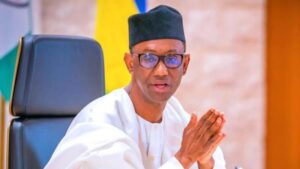
WHY RIBADU MUST STEP ASIDE: NSA ACCUSED OF OVERREACH AND ARMING A CONTROVERSIAL NON-STATE FORCE.
Incidents that triggered national alarm.
The controversy followed separate security incidents in Kwara and Kogi States. In Kwara, Nigerian Army personnel reportedly intercepted armed individuals carrying AK-47 rifles, who allegedly claimed the weapons were provided by government authorities.
The Kwara State Government denied any involvement and pointed instead to the Office of the NSA.
In Kogi State, naval officers reportedly encountered armed men wearing military-style uniforms. When challenged to identify themselves, the individuals allegedly opened fire, resulting in a gun battle in which two were killed. Identification recovered from the deceased reportedly linked them to Miyetti Allah, a socio-cultural group that has frequently featured in public discourse around Fulani militia violence during the Buhari years.
What escalated concern into a constitutional crisis was the public acknowledgement by NSA Mallam Nuhu Ribadu that the individuals were part of a secret vigilante initiative created to counter insecurity.
That admission—if accurately reported—places Nigeria in uncharted legal and institutional territory.
Why this is unprecedented in Nigeria.
In Nigeria’s security history, no National Security Adviser—military or civilian—has been publicly associated with the recruitment and arming of civilians using prohibited military weapons.

Where vigilante or community security structures exist, they are:
Locally constituted
State-regulated
Civilian in nature
Openly coordinated with police and military formations.
There is no known statutory authority empowering the NSA to:
Recruit civilians directly
Arm them with AK-47 rifles.

Operate covertly across states.
Deploy them without notifying governors or service chiefs.
If such authority exists, it must be produced publicly and immediately.
Escalating allegations: weapons, recruitment, and nationwide risk.
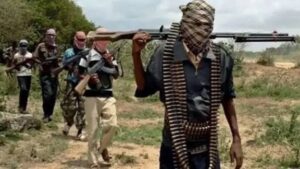
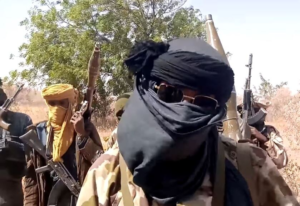
Adding to public anxiety are grave allegations circulating within security and civil society circles that the individuals recruited into this covert structure were allegedly issued brand-new AK-47 rifles, not recovered or obsolete weapons, and that these arms may now be unaccounted for beyond the initial incidents.
According to these claims—which require urgent, independent verification—recruitment was allegedly conducted centrally and drawn exclusively from a single ethnic and religious background. Analysts warn that if weapons were distributed without transparent chain-of-custody controls, tracking, or recall mechanisms, the implications extend far beyond Kwara and Kogi.
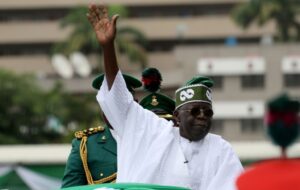
BREACH OF TRUST AT THE TOP: CALLS GROW FOR RIBADU’S EXIT OVER ALLEGED ARMING OF MIYETTI ALLAH-LINKED FORCE.
Security experts caution that any credible suggestion that assault rifles are dispersed across forested or ungoverned spaces without formal command, identification, or oversight constitutes a Category-One internal security threat, regardless of intent.
In counterterrorism doctrine, uncontrolled weapons flows almost inevitably re-enter criminal or insurgent ecosystems.
Critically, Nigerians have not been told:
How many weapons were issued.
Whether serial numbers were logged and tracked
Whether retrieval protocols exist.
Whether intelligence agencies are accounting for all firearms.
Whether any wider geographic spread has been verified.
The absence of official clarification has allowed fear and speculation to grow—a failure of crisis communication that compounds the underlying risk.
The vetting vacuum.
Equally troubling is the lack of publicly disclosed safeguards. There is no evidence that recruits were subjected to:
Background or criminal record checks.
Psychological evaluation.
Formal weapons training.
Rules of engagement and civilian-protection protocols.
Clear command-and-control structures.
Deconfliction arrangements with the Army, Navy, or Police.
In any professional security system, failure on even one of these points would trigger disciplinary review. Failure across all is institutional negligence.
Constitutional and legal implications.
Under Nigerian law, the Firearms Act and related regulations restrict possession and distribution of prohibited weapons such as AK-47s to recognised security forces. The NSA’s office is a coordinating and advisory institution, not an operational arm authorised to raise militias or distribute weapons.
More broadly, Section 14(2)(b) of the 1999 Constitution provides that “the security and welfare of the people shall be the primary purpose of government.” Actions that expose civilians and security personnel to avoidable harm violate that mandate.

How other democracies respond to such conduct.
This is not theoretical.
United States – Iran-Contra Affair:
Senior officials were investigated for facilitating covert arms operations outside congressional authorisation. The scandal triggered congressional hearings, indictments, resignations, and structural reforms to strengthen oversight of covert action.
United Kingdom – Collusion inquiries:
Allegations of state collusion with paramilitary groups during the Troubles led to the Stevens Inquiries, reputational damage to institutions, ministerial accountability, and decades of legal reckoning. Even the appearance of enabling irregular armed actors was treated as a democratic crisis.

In any G7 country, an NSA-equivalent admitting to arming civilians covertly would be immediately suspended, investigated by parliament, and potentially prosecuted for abuse of office or unlawful arms distribution.
Not treason—but still grave.
“Treason” is a narrow legal category requiring proof of intent. But in most democracies, conduct of this nature would trigger investigation for:
Abuse of office
Unlawful arms distribution
Gross misconduct in public office
Endangerment of national security
The global norm is clear: the official steps aside while an independent investigation proceeds.

The danger now.
The greatest risk is no longer political fallout—it is physical harm:
Friendly-fire incidents.
Diversion of weapons to criminals.
Escalation of communal violence.
Collapse of trust between civilians and security forces.
This is how states lose their monopoly on legitimate force.
Call for action.
The Coalition for Counterterrorism in Nigeria (CC-N) has issued an urgent appeal:
“The acknowledged recruitment and arming of a covert, non-statutory armed structure represents a grave breach of Nigeria’s national security governance. No democracy tolerates parallel armed capacities operating without oversight, vetting, and legislative cover. We call on President Bola Ahmed Tinubu to direct an immediate, independent investigation and require the National Security Adviser to step aside to preserve the integrity of that process.”

A defining test for leadership.
This is now a presidential test of institutional integrity. If the allegations are false, an independent probe will clear them. If they are true, Nigeria cannot afford delay.
National security is not managed through secrecy and improvisation. It is managed through law, discipline, and . The moment to act is now—before uncertainty hardens into tragedy.

“The National Patriots are alarmed by credible reports that a covert armed force, allegedly constituted under the Office of the National Security Adviser, has been operating since June 2025 across Nigeria’s forests with AK-47 rifles.
If such a force existed, its record is damning. Insecurity and banditry escalated sharply in the second half of 2025, including in parts of the South-West previously considered relatively stable. A secret armed deployment that coincides with worsening security raises grave and unavoidable questions.
The reported recruitment of operatives from a single ethnic group, allegedly drawn from the same conflict ecosystem Nigeria seeks to dismantle, is unethical, unprofessional, unlawful, and deeply suspicious. Counterterrorism doctrine does not permit fighting militias by replicating them.
Nigeria is not a testing ground for secret forces. We therefore call for the immediate suspension of the National Security Adviser and an independent investigation to protect lives, restore trust, and secure the Republic.”
Prof. Oluwarotimi Adeoye, Dr. G. Fraser. MFR.
Headlinenews.news Special Investigative Report.




