

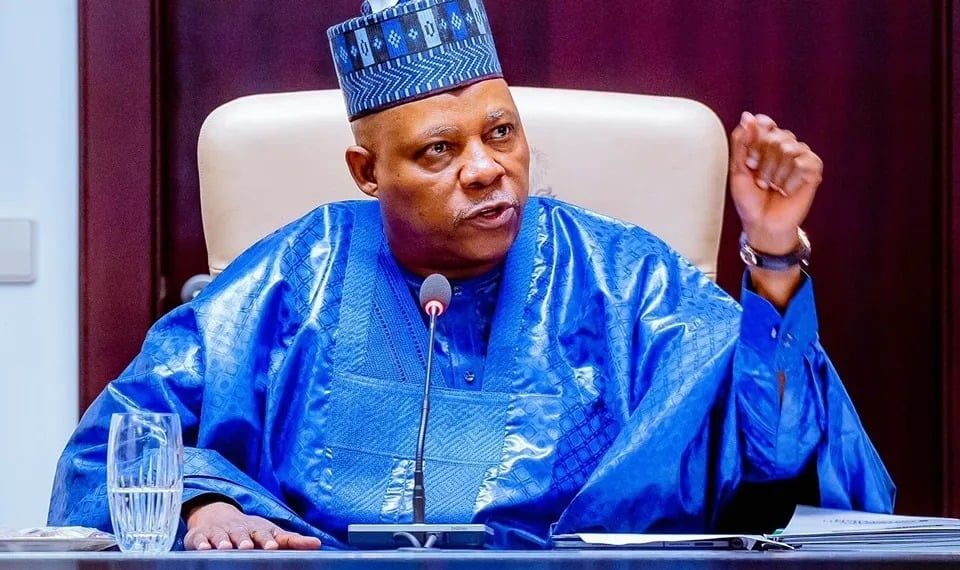
Vice President Kashim Shettima has reaffirmed President Bola Tinubu’s commitment to fixing Nigeria’s struggling power sector, stressing that the government will not compromise on energy security as it pushes forward with reforms.
Speaking at the commissioning of the new headquarters of the Nigeria Electricity Liability Management Company (NELMCO) in Abuja, Shettima said the administration is focused on building a transparent, accountable, and technology-driven electricity market that can support national growth. He noted that no country can achieve meaningful development without stable power supply.
He explained that the government’s approach includes using data for decision-making, deploying modern technology in asset management, and strengthening partnerships with both local and international stakeholders. According to him, institutions like NELMCO must operate with strong governance and accountability, adding that the new facility marks a fresh start for improved efficiency and innovation.

Shettima also called on private investors and global partners to take advantage of opportunities in the power sector, assuring them of a stable and business-friendly environment. He said the government is serious about reforms and capable of sustaining them.
Minister of Power, Adebayo Adelabu, said ongoing reforms—focused on policy changes, market liberalisation, and stronger institutions—are already repositioning the sector. He highlighted the Electricity Act 2023 as a key driver, noting that it has enabled states to participate more actively in electricity generation and distribution, with several state electricity markets already emerging.
Adelabu revealed that over $2 billion has been attracted into the sector, while revenue grew significantly in 2024. He added that government liabilities have dropped, and power generation capacity has seen slight improvements. Efforts are also underway to close the metering gap through the Presidential Metering Initiative, supported by major funding from both local and international sources.
On its part, NELMCO said it has made major progress in reducing legacy debts inherited from the defunct power system, saving the government hundreds of billions of naira. The agency also reported gains from asset sales and improved financial management.
Minister of Finance, Wale Edun, noted that stabilising the power sector would have a ripple effect across the economy, especially for small businesses. Lawmakers also pledged continued support to ensure the sector gets the legal backing needed to succeed.

NELMCO’s Managing Director, Mojoyinoluwa Dekalu-Thomas, said the agency is evolving beyond debt management into a key player in stabilising the electricity market. She added that it will play a vital role in supporting the transition to state-controlled electricity systems and improving investor confidence.
Meanwhile, energy expert Prof. Bart Nnaji called for urgent steps to fix structural issues in the sector. He emphasised the need to settle outstanding debts, restore key agreements, and allow cost-reflective tariffs. He also advocated building a stronger national grid and increasing investment in power generation, noting that Nigeria must significantly expand its electricity capacity to meet future economic demands.
Nnaji warned that without proper financial guarantees and investor confidence, it would remain difficult to attract funding for new power projects. He added that even if action is taken immediately, it could take years before new plants begin operation.
Overall, stakeholders agree that while progress is being made, sustained effort, investment, and policy consistency will be crucial to achieving reliable electricity in Nigeria.




