

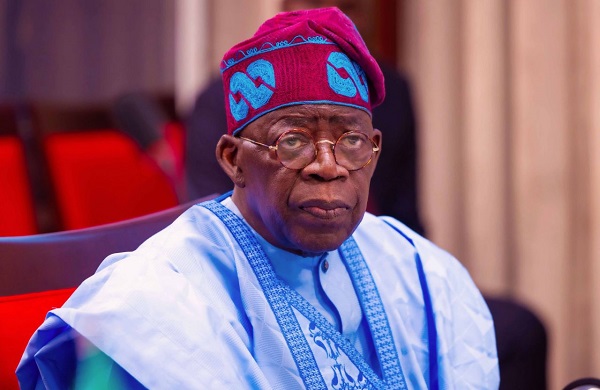
President Bola Ahmed Tinubu has pledged to pursue and overcome all forces threatening Nigeria, insisting that his government remains fully committed to restoring peace and safeguarding citizens across the country.
The President made this assurance on Sunday in Lokoja during a memorial event held in honour of former Kogi State Governor, Prince Abubakar Audu.

His message was delivered by the Minister of Information and National Orientation, Mohammed Idris, through a statement released by the minister’s media aide, Rabiu Ibrahim.
Tinubu reiterated that securing the nation, restoring peace, and expanding economic opportunities remain at the core of his administration’s priorities.
He acknowledged the recent security challenges facing the country but emphasized that they will not deter his government from fulfilling its responsibility to Nigerians.

“We are not blind to the setbacks we have faced or the security threats that have tested our resolve. But let me be clear: protecting the lives and welfare of every Nigerian remains my government’s highest duty. We have already taken firm steps in that direction,” he said.
The President stressed that the recently declared State of Emergency on national security is not symbolic but a decisive move aimed at strengthening national protection.
According to him, the initiative will lead to increased security personnel, modernized intelligence operations, and key reforms—including the push for State Police as a localized, community-focused solution to rising security threats.

“The State of Emergency declaration demonstrates the seriousness with which we are confronting insecurity. It is not just a pronouncement—it marks the beginning of an intensified campaign against all threats. We are expanding the strength and equipment of our armed forces, upgrading intelligence systems, and acting decisively to secure our nation. We will pursue the enemies of Nigeria wherever they hide and restore the peace every citizen deserves.
“To achieve lasting security, we must reform the entire structure of our security system. This is why we are strongly advocating for the establishment of State Police. A localized system will complement our national forces and create new employment opportunities at the grassroots. It is a bold but necessary constitutional move, and we are committed to making it a reality,” he added.

Tinubu also noted that the Federal Government is strengthening international diplomatic engagements to counter false narratives that misrepresent Nigeria’s religious tolerance and peaceful coexistence.
Reflecting on the life of the late Prince Abubakar Audu, the President described him as a major figure in Nigeria’s democratic progress. He said Prince Audu’s leadership helped shape modern governance in Kogi State and played a role in Nigeria’s transition to stable democratic rule.
He praised Audu as a leader whose contributions went beyond personal ambition and were instead focused on building strong institutions and supporting national development—a leadership model Tinubu said he also aspires to uphold.

“We are gathered today to honour a visionary leader. Prince Abubakar Audu was not just a public figure; he was a trailblazer. As the first democratically elected Governor of Kogi State in 1992 and again in 1999, he laid the foundation for the state’s progress and contributed significantly to our national democratic journey.
“He was a trusted ally, a brother in the struggle, and one of the pioneers who helped shape our democratic ideals. His legacy continues to inspire bold and transformative leadership—something this administration is committed to advancing through action, not just words,” Tinubu said.
The President further highlighted ongoing economic reforms, including a comprehensive plan to modernize the livestock sector and convert areas once marked by conflict into centres of economic growth and peaceful coexistence.
“This reform will introduce large-scale ranching, improved livestock management, and full integration of the livestock value chain into the national economy. Our aim is to turn this sector into a source of prosperity—creating jobs, strengthening food security, and promoting peace between farmers and herders,” he stated.
Tinubu added that through the Social Investment Programmes, his administration is expanding direct support to vulnerable groups, boosting small and medium enterprises, and equipping young Nigerians with skills to thrive globally.
He also noted that his government is undertaking the largest expansion of national infrastructure in recent years—from modernizing road and rail systems to upgrading power facilities.
“We are building the networks that will link our markets, drive industrial growth, and unite communities. The developmental foundation laid by Prince Audu in Kogi remains a model we are determined to strengthen and replicate across the nation,” he concluded.



