

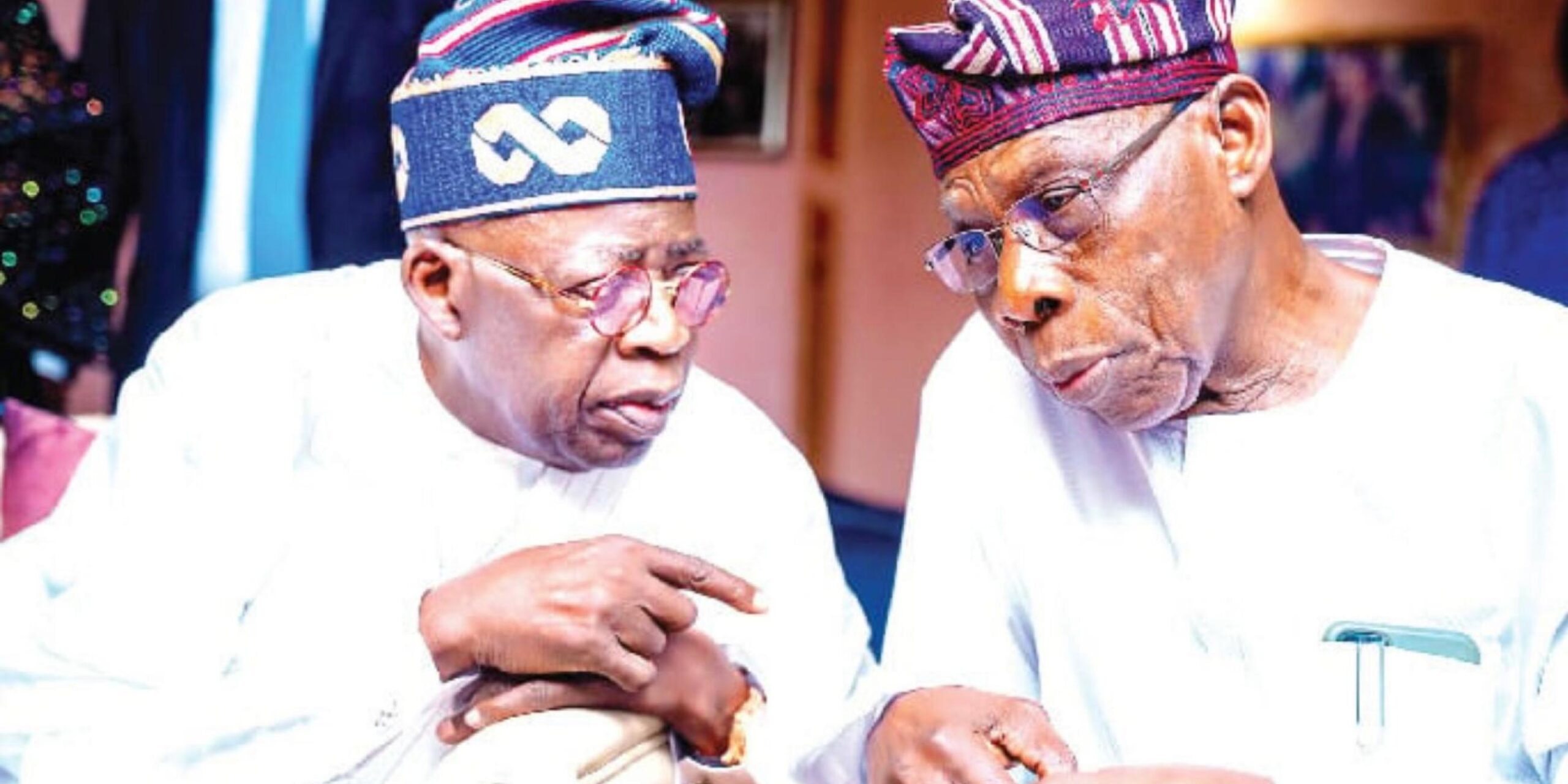
Sunday Dare, Special Adviser on Media and Public Communication to President Bola Tinubu, has responded to recent remarks by former President Olusegun Obasanjo, urging him to acknowledge the role his administration played in allowing terrorism to take root in Nigeria.

Dare appealed to Obasanjo to support current national security efforts instead of criticising the government.
In a statement posted on social media on Sunday, Dare cautioned that Obasanjo’s comments could distort public understanding of Nigeria’s security challenges and weaken citizens’ confidence in the government’s anti-terrorism operations.
Obasanjo, speaking during a Christmas Carol service in Jos, Plateau State, had accused the Tinubu administration of failing in its duty to protect Nigerians and argued that citizens had the right to call for international assistance when their government is unable to defend them.

“We Nigerians are being killed, and our government appears unable to protect us,” Obasanjo said.
He further criticised the government’s decision to negotiate with terrorists, claiming that when the state fails, Nigerians can legitimately appeal to the international community for help.
Responding, Dare said that if Obasanjo genuinely intends to contribute to national progress, he must first recognise that extremist groups laid their early foundations during his civilian presidency.

He encouraged the former president to use his global influence and connections to assist Nigeria’s counterterrorism efforts, as he has done for other nations.
Dare stressed that Obasanjo should refrain from attacking a government actively tackling multiple challenges — from economic reform and security operations to infrastructure development.
He also emphasised that those killing citizens, invading communities, kidnapping civilians, destroying facilities, and challenging state authority are terrorists, regardless of the labels they use or the flags they operate under.

According to Dare, Nigeria is battling a complex web of terrorist organisations, including internationally recognised groups, ISIS- and al-Qaeda-affiliated networks operating across the Sahel, violent extremists posing as bandits, cross-border militants exploiting weak borders, and ideological cells rooted in ungoverned territories.
He added, “Let’s be clear: they are all terrorists.”
Dare further noted that Boko Haram’s early ideology, recruitment, and camp formation took place during Obasanjo’s administration, eventually escalating into a full-blown insurgency aligned with global jihadist movements.
He said, “It is a historical fact that Boko Haram’s ideological seeds and early cells were planted during Obasanjo’s civilian presidency. While they recruited, indoctrinated, and built camps, the state failed to act decisively.
“What could have been contained early eventually became a violent insurgency, a cross-border terrorist network, and a regional threat aligned with global jihadist forces.
“For the leader under whom these first seeds were allowed to grow to now issue public critiques is not only ironic — it is dangerous.”
Dare explained that President Tinubu is confronting terrorism with upgraded military strategies, intelligence-led operations, territorial recovery, community cooperation, restoration of governance in affected areas, and counter-radicalisation programmes.

He added that Nigeria will continue to partner with international allies, including the United States, but will not relinquish control of its internal security or compromise its sovereignty.
Dare warned that public condemnation from former presidents damages national morale and emboldens terrorist groups, stressing that Obasanjo should offer constructive assistance rather than comments that undermine ongoing security efforts.



