

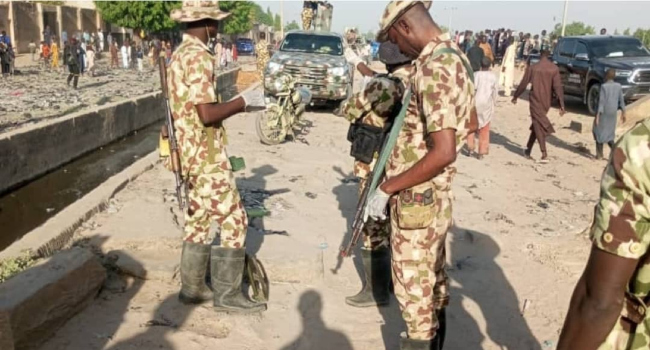
A senior Boko Haram commander, Abu Khalid, who served as the group’s second-in-command in the Sambisa Forest, has been killed alongside 10 other terrorists during a night-time military operation in Borno State.
The development was confirmed in a statement issued on Sunday by the Theatre Command Media Information Officer, Lieutenant-Colonel Sani Uba.

According to him, the operation came less than 24 hours after Nigerian troops neutralised another notorious Boko Haram/ISWAP leader, Julaibib, in the Gujba axis of the Timbuktu Triangle.
Uba explained that troops of Sector 1, working closely with members of the Civilian Joint Task Force (CJTF) under Operation Desert Sanity, encountered terrorists in the Komala general area of Konduga Local Government Area at about 11:00 p.m. during coordinated night offensives.
He described Abu Khalid as a high-ranking figure within the insurgent group, noting that he played a critical role in coordinating attacks and managing logistics within the Sambisa axis.

The military engagement, he said, led to the recovery of five AK-47 rifles, magazines, bicycles, assorted supplies, food items and a large cache of medical materials.
Uba added that no casualties were recorded among the troops, stressing that their morale remains strong as clearance operations continue across the Sambisa Forest, Mandara Mountains, Timbuktu Triangle and other known Boko Haram and ISWAP hideouts in the North-East.
Insurgency Battle
Nigeria has battled insurgency in the North-East for more than a decade.
Since the conflict began in 2009, more than 40,000 people have been killed and about two million displaced, according to United Nations estimates.
The violence has also spread beyond Nigeria’s borders into Niger, Cameroon and Chad, prompting the affected countries to form a regional military coalition against jihadist groups.

The latest operation occurred a day after an ISWAP roadside bomb attack along the Wajiroko–Azir axis in Damboa injured several soldiers.
Although the intensity of violence has reduced compared to a decade ago, when Boko Haram controlled large areas of territory, analysts have warned of a resurgence in jihadist attacks in recent times.
In recent months, the United States has criticised Nigeria’s handling of the conflict, with President Donald Trump describing the violence as “persecution” of Christians — a claim rejected by the Nigerian government and independent analysts.

Despite the disagreements, the US carried out surprise airstrikes on Christmas Day against militants believed to be linked to the Islamic State group. Authorities in Abuja and Washington said the joint operation killed several fighters, though the figures have not been independently verified.



