

United States President Donald Trump is framing his newly launched Gaza reconstruction initiative not merely as a post-conflict recovery plan, but as a deliberate alternative model of global governance that sidelines traditional multilateral institutions—most notably the United Nations.

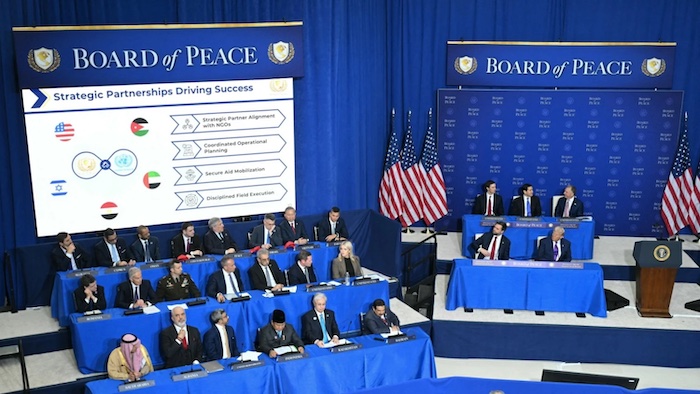
Speaking at the inaugural summit of the Board of Peace in Washington, DC, on Thursday, February 19, 2026, Trump presented the body as a streamlined, results-oriented coalition capable of delivering outcomes where legacy organizations have repeatedly failed.
“This is not about bureaucracy. This is about making peace stick,” he stated, explicitly suggesting the Board would “overlook” the United Nations to ensure effective implementation.

Hosted at the United States Institute for Peace, the gathering brought together regional powers, financial institutions, and prospective military contributors in what Trump described as a decisive break from consensus-driven diplomacy.
For decades, the UN has served as the primary international forum for addressing the Israeli-Palestinian conflict. Trump’s initiative signals a clear pivot toward a US-led, coalition-based approach that integrates state actors, private capital, and targeted military coordination outside the UN framework.

US Secretary of State Marco Rubio argued that conventional international mechanisms had proven incapable of resolving what he termed a “unique crisis.” Vice President JD Vance positioned the Board of Peace as evidence that bold, decisive leadership—rather than prolonged multilateral negotiations—can deliver lasting results.

France declined formal participation, reportedly citing concerns that the board risks undermining or duplicating UN functions. The UK, Italy, and Germany sent observers but withheld membership, pointing to constitutional, legal, and diplomatic complications.

Trump committed $10 billion in US funding, claiming an additional $7 billion from Gulf states and Central Asian partners, bringing the announced reconstruction package to $17 billion. World Bank President Ajay Banga confirmed the institution will act as a limited trustee for donor funds, while Apollo Global Management’s Marc Rowan highlighted Gaza’s coastal real estate as holding up to $50 billion in long-term economic potential.

The proposed International Stabilisation Force (ISF)—potentially 20,000 troops supported by 12,000 locally trained police—would include contributions from Indonesia, Morocco, Kosovo, Albania, and possibly Türkiye (despite reported reservations from Israeli Prime Minister Benjamin Netanyahu). Egypt and Jordan are expected to assist with police training.
Governance in Gaza during the transition will be managed by a Palestinian technocratic committee, though no Palestinian political leadership holds a seat on the Board of Peace itself. Qatar’s Prime Minister Sheikh Mohammed bin Abdulrahman bin Jassim Al Thani was the only senior figure at the summit to explicitly reference Palestinian aspirations for statehood.

Israeli Foreign Minister Gideon Sa’ar welcomed the board’s focus on disarmament and demilitarisation, describing it as the first serious attempt to address the conflict’s “root causes.”
Trump suggested the Board of Peace could serve as a replicable model for other intractable global conflicts, marking what he called a shift away from UN-led processes toward coalition-driven, investment-backed, and militarily supported stabilisation efforts led by the United States and willing partners.

While the initiative has reshaped diplomatic discourse around Gaza, analysts warn that declarations of peace and ambitious funding pledges do not automatically resolve underlying political, security, and territorial disputes. Without a binding disarmament agreement involving Hamas or firm guarantees against renewed escalation, the claim that the war is definitively over remains contested.
Success could establish a new doctrine of parallel international crisis management; failure risks deepening geopolitical divisions and reinforcing skepticism toward unilateral or coalition-led frameworks.




